
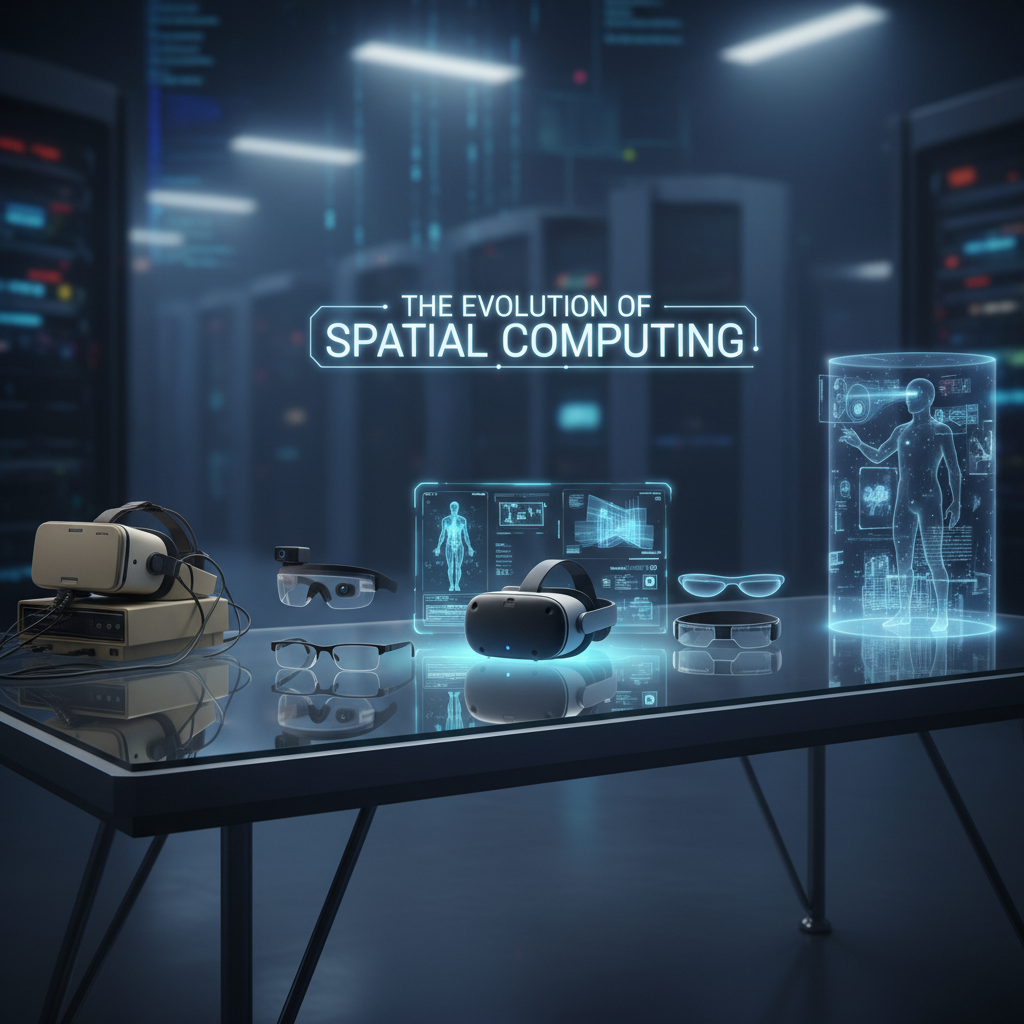
From Pixels to Presence: The Spatial Computing & MR Journey
Remember those sci-fi movies where characters interacted with holograms and digital information seamlessly integrated into their real world? What once felt like pure fantasy is rapidly becoming our reality thanks to the incredible evolution of spatial computing and mixed reality (MR) devices. Let’s take a friendly yet professional stroll through the exciting history and future of this transformative technology.
The Seeds of Spatial Computing: Early Visions
The concept of merging digital information with our physical surroundings isn’t new. It dates back to Ivan Sutherland’s “The Ultimate Display” in the 1960s, a visionary idea that laid the groundwork for head-mounted displays. While rudimentary, these early experiments sparked the imagination of researchers, pushing the boundaries of human-computer interaction beyond the traditional screen.
For decades, spatial computing remained largely within academic labs and specialized industrial applications, such as military simulations and high-end industrial design, where large, expensive setups were justifiable.
The Dawn of Modern Mixed Reality: Breaking Through
The early 2010s saw a renewed public interest in augmented reality (AR) and, by extension, mixed reality. Google Glass, though commercially unsuccessful in its initial consumer rollout, was a pivotal moment. It introduced the idea of hands-free, always-on digital overlays to a broader audience, highlighting both the immense potential and the significant social challenges of such technology.
A true game-changer arrived with the Microsoft HoloLens in 2016. This device offered a self-contained, untethered mixed reality experience, allowing users to place persistent holograms in their environment and interact with them using gestures and voice. It truly demonstrated the “mixed” aspect, blending digital content with the real world in a much more sophisticated way than previous AR attempts.
The Current Landscape: A Burst of Innovation
Today, the spatial computing landscape is bustling with innovation. We’ve moved beyond bulky prototypes to more refined, powerful, and increasingly accessible devices. Companies like Meta with their Quest series (initially focused on VR but rapidly expanding into MR capabilities) and Pico have made standalone headsets capable of impressive passthrough AR experiences.
Enterprise solutions continue to leverage MR for training, remote assistance, and complex design reviews, proving its immense value in professional settings. And with the recent arrival of devices like the Apple Vision Pro, the conversation around spatial computing has reached an entirely new level of mainstream attention, promising intuitive interaction and high-fidelity visual experiences.
The Future is Spatial: What’s Next?
Where are we headed? The trajectory points towards devices becoming lighter, more powerful, and more ubiquitous. Imagine smart glasses that seamlessly overlay information, offer real-time translations, or guide you through your day without needing to pull out a phone. Integration with artificial intelligence will make these experiences even more intuitive and personalized.
We’re on the cusp of a world where our digital lives don’t just live on screens, but rather are woven into the fabric of our physical spaces. From remote collaboration that feels like being in the same room, to immersive entertainment, to new ways of learning and interacting with our environment, spatial computing is set to redefine nearly every aspect of our lives.
The journey from early conceptualizations to today’s sophisticated mixed reality devices has been nothing short of remarkable. We’ve seen incredible progress in hardware, software, and user experience. As these technologies continue to evolve, they promise a future where the lines between the physical and digital blur, opening up unprecedented opportunities for creation, connection, and exploration. Get ready; the spatial era is here!


Leave a Reply