
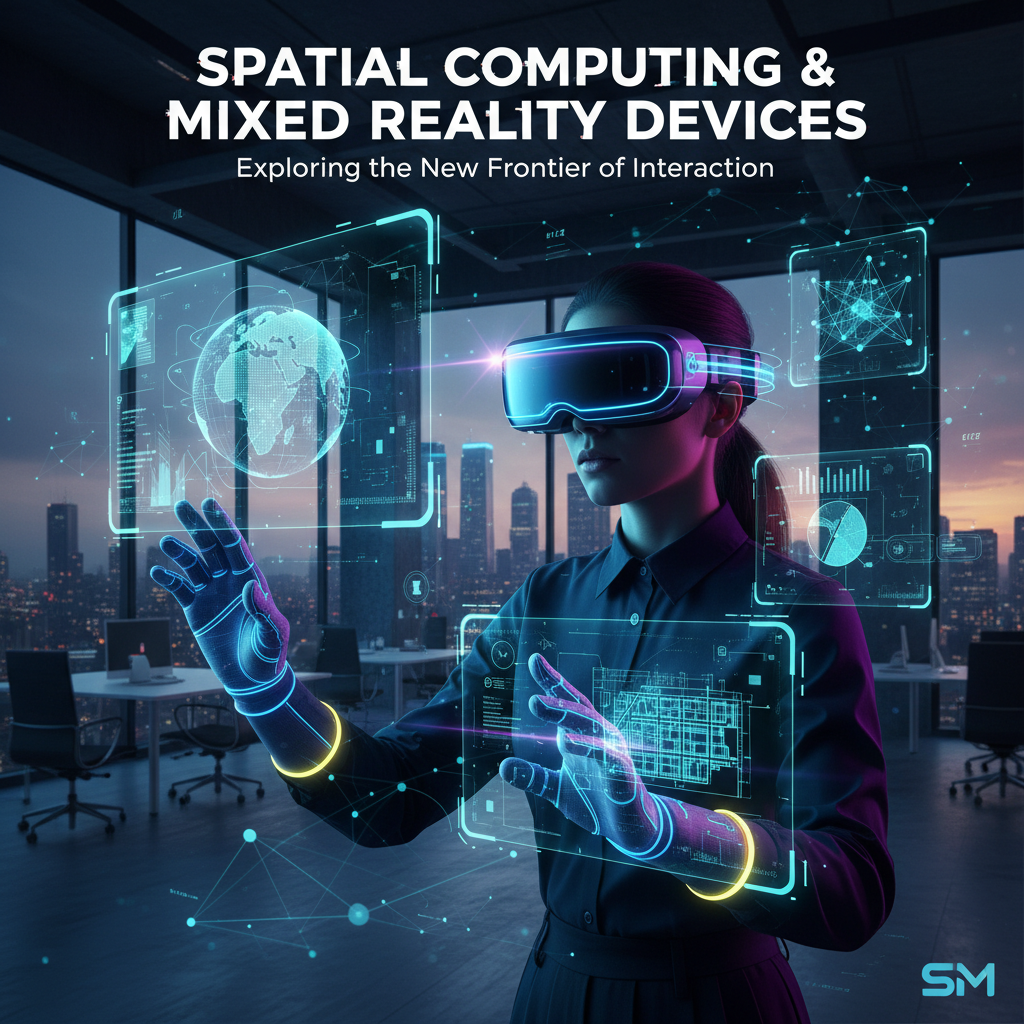
Stepping Into Tomorrow: Spatial Computing & Mixed Reality Devices
Ever wondered what it would be like if your digital world seamlessly blended with your physical surroundings? Welcome to the fascinating realm of Spatial Computing and Mixed Reality!
What Exactly is Spatial Computing?
Spatial computing is more than just a buzzword; it’s a revolutionary paradigm shift. Imagine your computer applications not confined to a flat screen, but existing and interacting within your actual physical space. It’s about technologies that understand and manipulate three-dimensional spaces, allowing digital content to appear, react, and persist in the real world.
Think about designing a new kitchen and seeing virtual cabinets appear precisely where they would go, or a surgeon practicing a complex procedure on a holographic patient. Spatial computing is the underlying framework that makes these interactions possible, recognizing objects, environments, and even user gestures to create a truly immersive experience.
The Magic of Mixed Reality Devices
At the heart of experiencing spatial computing are Mixed Reality (MR) devices. These incredible gadgets, often headsets, are the windows through which we perceive this blended reality. Unlike Virtual Reality (VR), which completely immerses you in a digital world, or Augmented Reality (AR), which overlays digital information onto the real world, MR seamlessly integrates both. You can interact with digital objects as if they were physically present, all while still seeing and engaging with your actual surroundings.
Devices like the Microsoft HoloLens and, more recently, the Apple Vision Pro, are prime examples. They use advanced sensors, cameras, and powerful processors to map your environment, track your movements, and render digital content with astonishing realism. This means you can walk around a virtual dinosaur in your living room, collaborate with remote colleagues around a shared holographic design, or even enjoy entertainment with screens that float in your actual space.
Beyond Entertainment: Real-World Applications
While the prospect of gaming or watching movies in a whole new way is exciting, the true potential of spatial computing and MR devices lies in their practical applications across various industries:
- Healthcare: Surgeons can visualize organs in 3D during operations, medical students can dissect virtual cadavers, and therapists can use MR for rehabilitation exercises.
- Education: Students can take virtual field trips to ancient Rome, explore the human anatomy up close, or conduct complex chemistry experiments without any real-world hazards.
- Manufacturing & Design: Engineers can prototype new products as holograms, architects can walk through their building designs before construction, and factory workers can receive guided instructions overlaid directly onto machinery.
- Retail: Customers can virtually “try on” clothes, preview furniture in their homes, or interact with product information in a new, engaging way.
The Road Ahead: Challenges and Opportunities
We’re still in the early days of this revolution, and like any groundbreaking technology, there are challenges to overcome. Cost, comfort, battery life, and the need for robust content ecosystems are all areas under active development. However, the opportunities are immense.
As these devices become more affordable, lighter, and more powerful, they promise to fundamentally change how we work, learn, create, and interact with information. Spatial computing isn’t just about new gadgets; it’s about a new way of interacting with our world, making digital content a natural extension of our physical existence.
Ready to Step In?
The future is no longer just on a screen; it’s all around us. Spatial computing and mixed reality devices are paving the way for a more intuitive, immersive, and interconnected world. Get ready to step into tomorrow – it’s going to be an incredible journey!


Leave a Reply