
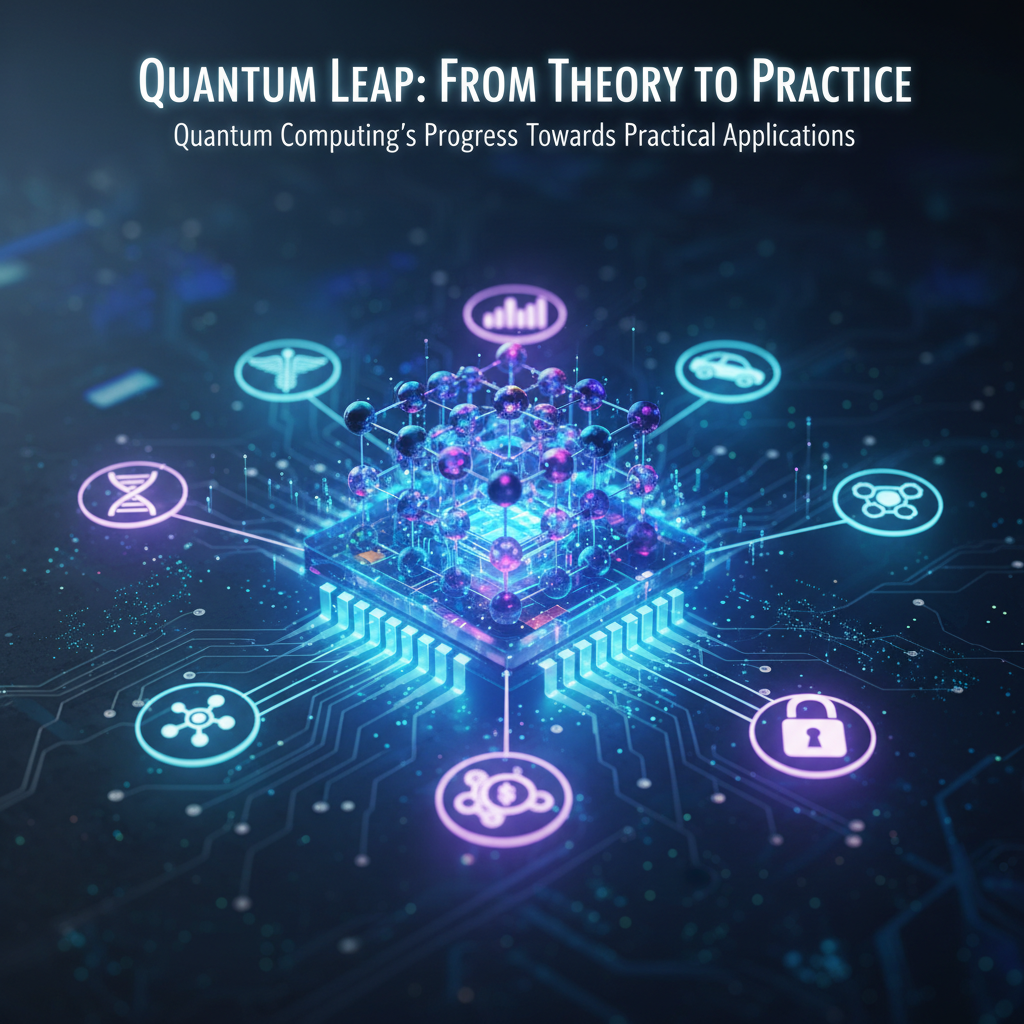
Quantum Computing: Bridging Theory & Reality
Once confined to the pages of science fiction and complex physics journals, quantum computing is steadily advancing from theoretical promise to the cusp of practical applications. Let’s explore how far we’ve come and what exciting possibilities lie ahead!
The Quantum Leap: What’s the Big Deal?
At its heart, quantum computing leverages the mind-bending principles of quantum mechanics, like superposition and entanglement, to perform calculations far beyond the reach of even the most powerful classical supercomputers for specific types of problems. Instead of bits being just 0 or 1, quantum bits (qubits) can be both at the same time, allowing for exponentially more information processing.
For years, this potential was mostly academic. However, recent breakthroughs in hardware stability, qubit count, and error correction are pushing the field rapidly forward, moving it from experimental curiosities to systems that can genuinely tackle complex tasks.
Key Milestones on the Path to Practicality
The journey from a fragile, few-qubit system to one capable of real-world impact is paved with significant achievements. We’re seeing:
- Hardware Evolution: Companies and research institutions are building increasingly stable and powerful quantum processors. While still susceptible to errors, the increase in qubit count and coherence times (how long a qubit can maintain its quantum state) is a crucial step.
- “Quantum Advantage” Demonstrations: While these demonstrations often involve highly specialized problems designed for quantum computers, they prove that quantum machines can outperform classical ones for certain computational tasks. This is a vital proof-of-concept.
- Software & Algorithm Development: User-friendly quantum programming frameworks (like Qiskit and Cirq) are making it easier for a broader range of scientists and developers to experiment with quantum algorithms, accelerating the discovery of new applications.
Where Quantum Computing Can Make a Real Impact
While general-purpose quantum computers are still a ways off, several fields are already seeing exploratory work and immense potential:
Drug Discovery & Materials Science
Imagine simulating complex molecular interactions with perfect accuracy to design new drugs or revolutionary materials. Classical computers struggle with the exponential complexity of quantum mechanics at the atomic level. Quantum computers, however, are inherently designed for this, promising breakthroughs in medicine, sustainable energy, and advanced manufacturing.
Financial Modeling & Optimization
The financial sector deals with vast datasets and complex optimization problems, from portfolio management to fraud detection. Quantum algorithms could potentially process these intricate relationships much faster, leading to more accurate risk assessments, better trading strategies, and more efficient resource allocation.
Cryptography & Cybersecurity
On one hand, quantum computers pose a threat to current encryption methods (Shor’s algorithm could break widely used public-key encryption). On the other, they offer solutions through “quantum-safe” cryptography, which is resistant even to future quantum attacks. This is a critical area of ongoing research and development.
Artificial Intelligence & Machine Learning
Quantum machine learning explores how quantum principles can enhance AI algorithms. This could lead to more efficient data analysis, faster pattern recognition, and the ability to train more sophisticated AI models, potentially unlocking new frontiers in AI development.
The Road Ahead: Challenges and Aspirations
Despite the exciting progress, significant hurdles remain. Building fault-tolerant quantum computers with millions of stable qubits is an enormous engineering challenge. Error correction, maintaining qubit coherence, and developing practical, error-resilient algorithms are still active areas of research.
Furthermore, understanding how to best harness quantum power for problems that truly matter in the real world is an ongoing discovery process. It’s not just about building the machines; it’s about learning how to “speak” to them effectively.
The Future is Quantum-Powered
Quantum computing is no longer just a theoretical concept; it’s a rapidly evolving field with tangible progress towards practical applications. While it will take time, and likely evolve incrementally rather than with a single “big bang,” the steady march of innovation suggests that quantum computers will indeed transform industries, solve previously intractable problems, and open up entirely new possibilities. Keep an eye on this space – the quantum future is getting closer!
“`


Leave a Reply