
Quantum Leaps: From Lab to Market
Quantum computing, once a futuristic concept relegated to science fiction, is rapidly evolving from theoretical possibility to tangible reality. The past few years have seen astonishing progress, pushing the boundaries of what’s computationally possible and sparking a global race to harness its immense power for commercial gain. Let’s dive into the exciting advancements and the dynamic efforts to bring quantum solutions to the marketplace.
Understanding the Quantum Edge
Unlike classical computers that store information as bits (0s or 1s), quantum computers use qubits, which can exist in multiple states simultaneously through superposition and entanglement. This allows them to process vast amounts of information in ways classical computers cannot, offering the potential to solve problems currently deemed intractable. From drug discovery to financial modeling, the implications are profound.
Recent Strides in Quantum Hardware and Software
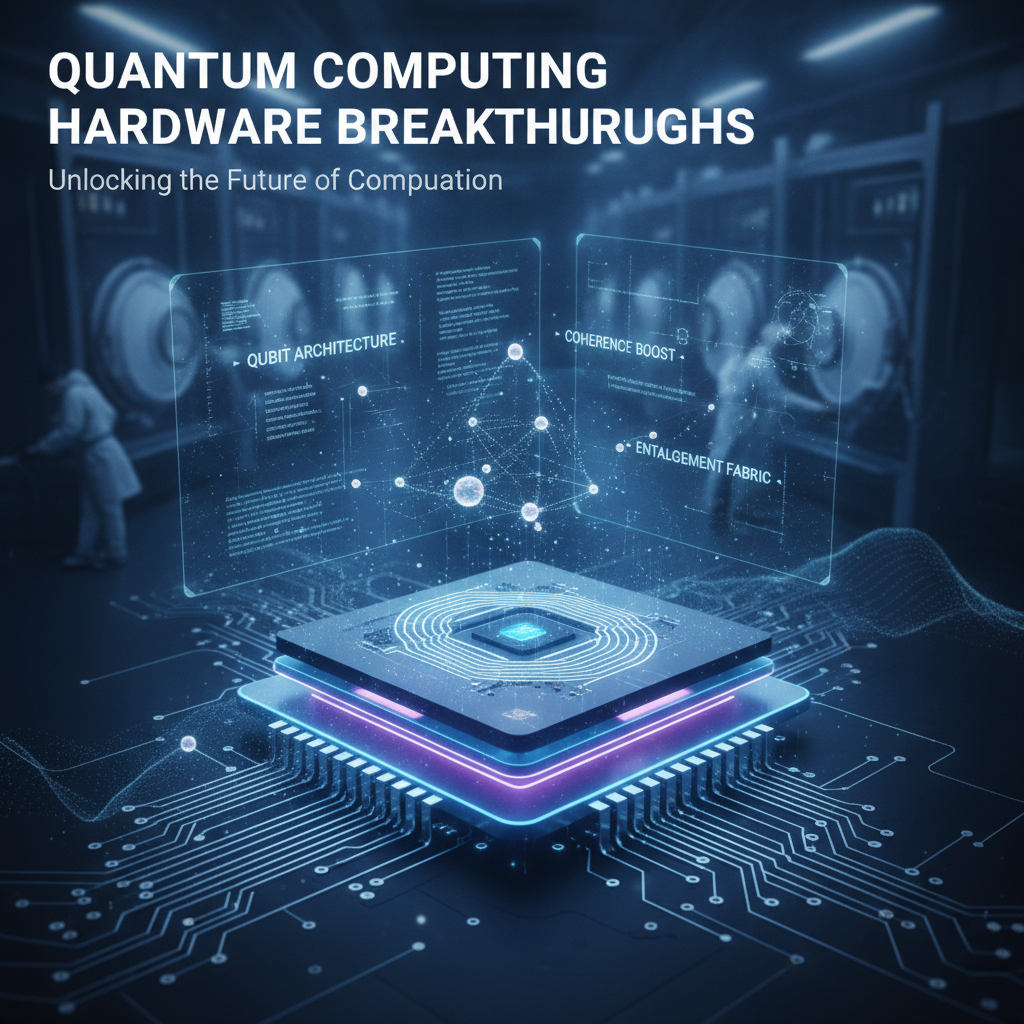
The field is buzzing with innovation. We’re seeing significant improvements in qubit stability and coherence times, crucial for reliable quantum operations. New types of qubits, such as superconducting qubits, trapped ions, photonic qubits, and topological qubits, are continually being developed and refined. Error correction techniques, though still in their early stages, are also advancing, paving the way for more robust quantum processors.
Beyond hardware, the software ecosystem is flourishing. Developers are creating new quantum algorithms (like improvements on Shor’s and Grover’s algorithms) and building user-friendly quantum programming frameworks and compilers. Cloud platforms from major tech giants are making quantum computing accessible to researchers and businesses worldwide, democratizing access to these powerful machines.
The Race for Commercialization
The commercialization landscape is vibrant and competitive. Tech giants like IBM, Google, Microsoft, and Amazon are heavily invested, offering quantum computing services through the cloud, fostering developer communities, and collaborating with enterprises. Startups are also playing a pivotal role, specializing in specific hardware architectures, quantum software, or applications tailored for particular industries.
Investment is pouring into the sector, signaling strong confidence in its future potential. Governments are funding national quantum initiatives, recognizing the strategic importance of quantum supremacy. Partnerships between quantum providers and industry leaders are becoming increasingly common, aimed at exploring practical use cases and developing tailored quantum solutions.
Key Industries and Potential Impact
While still in its nascent stages, quantum computing is already showing promise across several key sectors:
- Pharmaceuticals & Materials Science: Simulating molecular structures with unprecedented accuracy could revolutionize drug discovery, material design, and battery technology.
- Finance: Optimizing portfolios, detecting fraud, and complex risk analysis could see significant improvements.
- Logistics & Optimization: Solving complex routing problems and supply chain optimization more efficiently.
- Artificial Intelligence: Enhancing machine learning algorithms and tackling big data challenges.
The goal isn’t necessarily to replace classical computing but to augment it, tackling problems that are simply beyond current capabilities.
Navigating the Quantum Challenges Ahead
Despite the incredible progress, significant hurdles remain. Qubit fragility and high error rates are still a major concern, requiring sophisticated error correction that is computationally expensive. Scaling up quantum systems to thousands or millions of stable, interconnected qubits is a monumental engineering challenge. Furthermore, there’s a pressing need to develop a workforce skilled in quantum physics, computer science, and engineering to fully leverage this technology.
The Road Ahead: A Quantum Future?
While we might still be a decade or more away from a universal, fault-tolerant quantum computer, the current “Noisy Intermediate-Scale Quantum” (NISQ) devices are already proving valuable for research and specific problem-solving. The quantum computing industry is maturing rapidly, driven by both scientific curiosity and commercial imperative. As the technology continues to evolve, we can expect to see more practical applications emerge, transforming industries and reshaping our technological landscape. The quantum journey is just beginning, and it promises to be nothing short of revolutionary!


Leave a Reply