
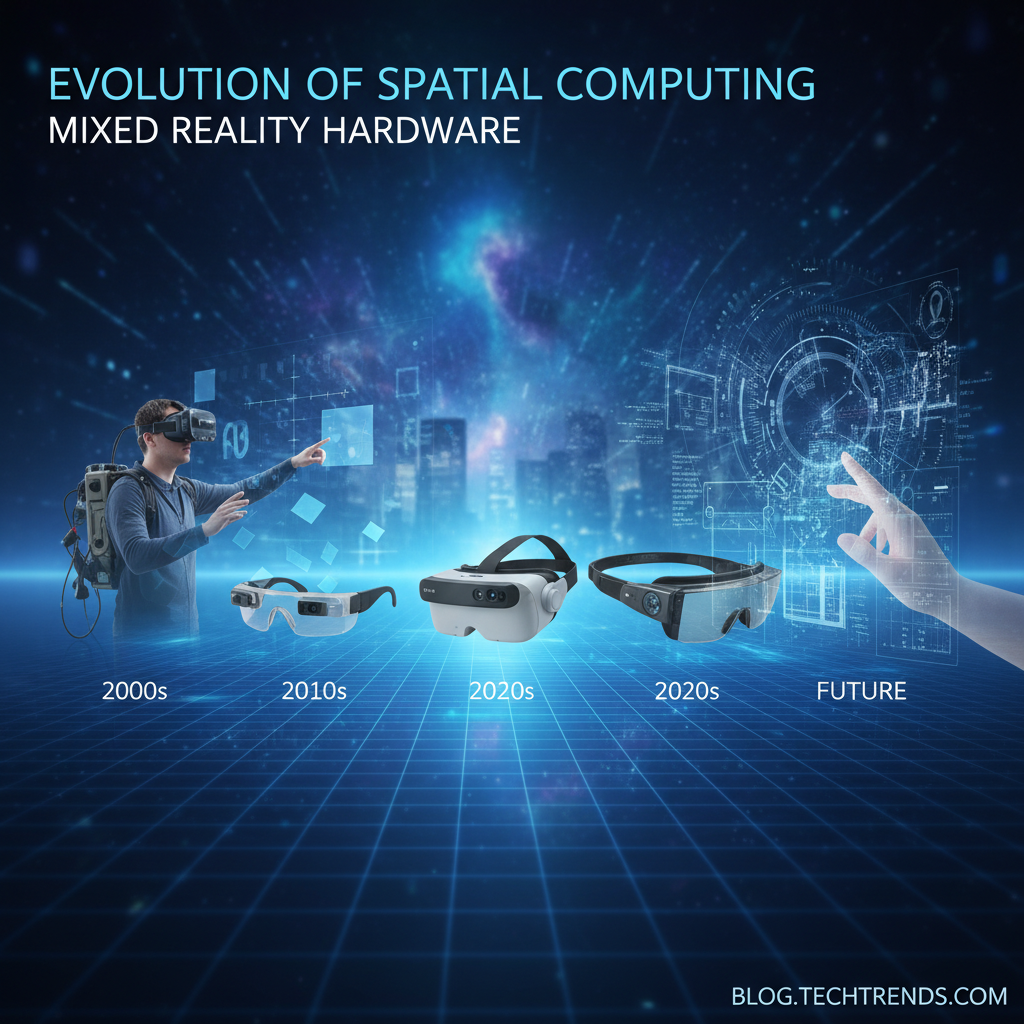
Evolution of Spatial Computing and Mixed Reality Hardware
Remember when interacting with computers meant staring at a flat screen? While traditional interfaces still have their place, we’re rapidly stepping into a new era where our digital worlds blend seamlessly with our physical environments. This isn’t just a futuristic dream; it’s the reality brought forth by incredible advancements in spatial computing and mixed reality (MR) hardware.
Join us on a journey through the fascinating evolution of the devices that are transforming how we work, play, and connect.
From Sci-Fi Dreams to Early Prototypes
The seeds of spatial computing were planted long before modern computers. Concepts like the Sensorama (1962), a multi-sensory simulator, showed early ambition. Fast forward to 1968, Ivan Sutherland’s “The Sword of Damocles” presented the world’s first head-mounted display, albeit one so heavy it had to be suspended from the ceiling. These were clunky, often room-sized machines, but they proved the fundamental possibility of immersive digital experiences. For decades, the technology remained largely in research labs, military simulations, and niche industrial applications, slowly refining the core ideas.
The Dawn of Consumer VR
The 2010s marked a significant turning point, often referred to as the “rebirth of VR.” The Oculus Rift, initially a Kickstarter sensation, captured the public’s imagination with its promise of accessible, immersive virtual worlds. Soon after, competitors like the HTC Vive introduced “room-scale” VR, allowing users to physically walk around virtual environments. PlayStation VR brought high-quality VR experiences to console gamers. While these first-generation consumer devices had their limitations—heavy cables, lower resolutions, and often high costs—they undeniably opened the floodgates, proving that virtual reality could be a compelling, personal experience for millions.
Augmented Reality: Bridging the Digital and Physical
While VR transported us *into* new worlds, Augmented Reality (AR) aimed to enhance our existing one. Google Glass, launched in 2013, was an early, ambitious attempt at consumer AR glasses. Though it faced social and privacy hurdles, it was a pivotal experiment that taught the industry valuable lessons. More broadly accessible AR truly took off with smartphones. Platforms like Apple’s ARKit and Google’s ARCore turned millions of mobile devices into powerful AR viewers, bringing playful filters, virtual furniture placement, and interactive games directly into our daily lives. These mobile solutions served as a crucial bridge, familiarizing a vast audience with the concept of digital overlays in the real world.
True Mixed Reality: A New Frontier
The distinction between AR and VR began to blur with the emergence of true Mixed Reality (MR). Devices like the Microsoft HoloLens (2016) and later the HoloLens 2 (2019) pioneered self-contained, untethered MR. These “holographic computers” allowed users to see and interact with digital objects precisely placed and anchored in their physical space, maintaining eye contact with the real world while manipulating virtual screens and 3D models. HoloLens found significant success in enterprise, healthcare, and education. Other contenders like Magic Leap also entered the fray, pushing the boundaries of lightfield technology to achieve more realistic digital integration. MR hardware strives for that perfect blend, making digital content feel genuinely present in our physical environment.
Today’s Innovations and Tomorrow’s Vision
Today, the MR hardware landscape is vibrant and rapidly evolving. Companies like Meta continue to refine their standalone Quest series, integrating passthrough mixed reality capabilities that allow users to toggle between full VR and an AR view of their surroundings. High-end professional devices from Varjo offer unparalleled visual fidelity, while new entrants like the Apple Vision Pro are redefining what a “spatial computer” can be with incredibly high-resolution passthrough, intuitive eye and hand tracking, and a premium user experience.
Looking ahead, the trajectory is clear: miniaturization into more comfortable, fashionable glasses, wider fields of view, even more natural and intuitive input methods (think brain-computer interfaces!), and tighter integration with AI to create truly adaptive and intelligent spatial experiences. The hardware is becoming more powerful, more accessible, and increasingly capable of disappearing into the background, allowing us to focus on the experiences themselves.
Conclusion
From Sutherland’s “Sword” to today’s sleek, powerful spatial computers, the journey of spatial computing and mixed reality hardware has been nothing short of astonishing. What began as clunky prototypes and niche tools is quickly becoming a cornerstone of how we interact with information and each other. We are witnessing the birth of a new computing paradigm, driven by relentless innovation in optics, sensors, processors, and display technologies. The future promises a world where digital information is no longer confined to screens but exists all around us, waiting to be explored. It’s an exciting time to be part of this evolution!
“`


Leave a Reply