
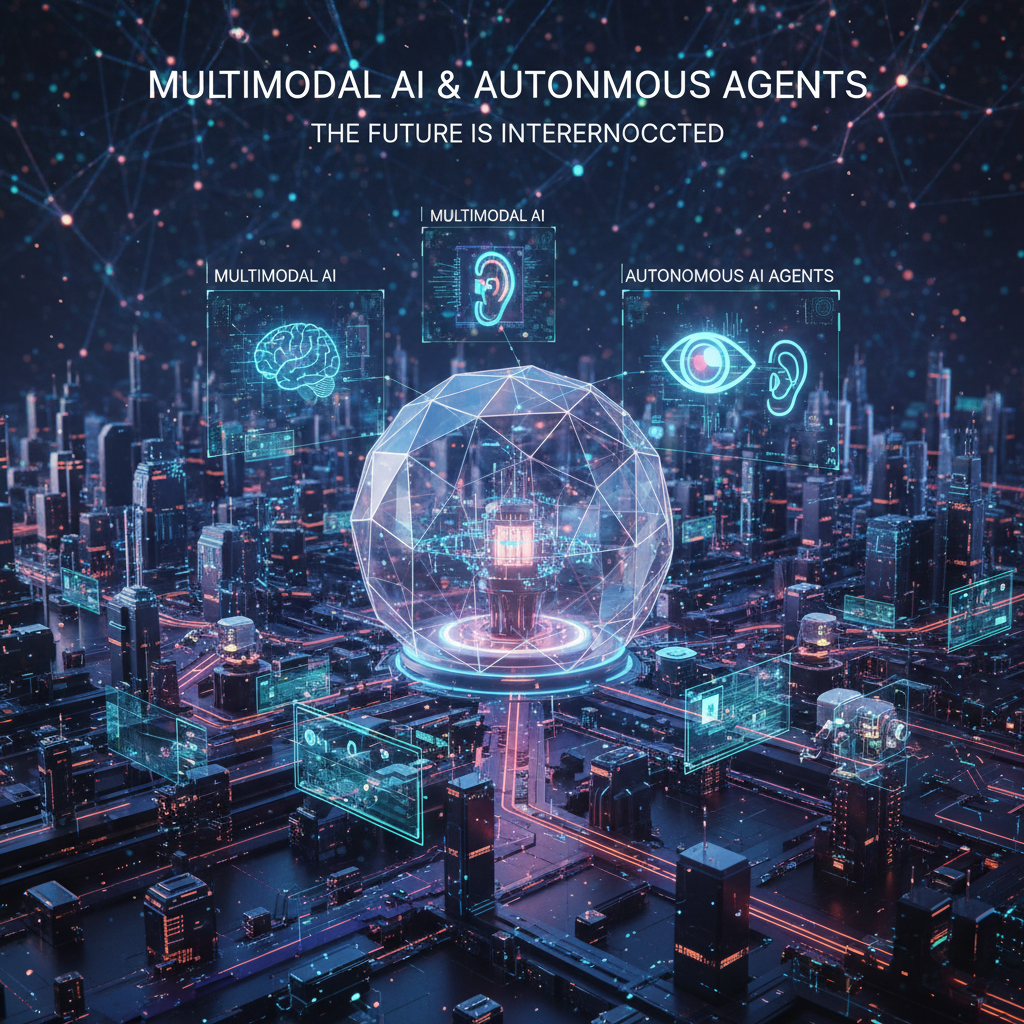
Seeing, Hearing, and Acting: The Power of Multimodal AI in Autonomous Agents
Artificial intelligence continues to redefine what’s possible, pushing boundaries from simple data processing to complex decision-making. Among the most exciting frontiers are Multimodal AI and Autonomous AI Agents. Individually powerful, their convergence promises a new era of intelligent systems that can perceive, understand, and interact with our world in profoundly human-like ways. Let’s dive into how these two groundbreaking fields are coming together to create truly intelligent agents.
What is Multimodal AI?
Imagine trying to understand a situation by only reading a description, without seeing any images or hearing any sounds. That’s often how traditional AI operates, specializing in one type of data – usually text or images. Multimodal AI breaks this barrier by enabling AI systems to process and interpret information from multiple modalities simultaneously. This includes text, images, audio, video, sensor data, and more.
By integrating different forms of input, Multimodal AI can build a much richer and more comprehensive understanding of the world. For example, it can analyze a video by simultaneously processing the visual content, the spoken dialogue, and any background sounds, leading to insights that no single modality could provide alone.
The Rise of Autonomous AI Agents
Autonomous AI Agents are intelligent systems designed to operate independently, often in complex environments, to achieve specific goals. Unlike passive AI programs, agents have the ability to perceive their surroundings, make decisions, plan actions, and execute those actions without constant human intervention.
Think of them as digital or robotic entities that can learn, adapt, and self-correct. From sophisticated virtual assistants that manage your schedule to robots navigating warehouses, or self-driving cars making split-second decisions on the road, autonomous agents are at the forefront of AI application, bringing intelligence directly into our physical and digital workflows.
The Synergy: How Multimodal AI Empowers Autonomous Agents
Here’s where the magic truly happens. When an autonomous agent is equipped with multimodal capabilities, its potential skyrockets. Instead of merely interpreting textual commands or visual cues in isolation, a multimodal autonomous agent can:
Perceive with Greater Context: An agent can “see” an object, “hear” what’s being said about it, and “read” related documents simultaneously. This holistic understanding dramatically improves its ability to grasp complex situations.
Make More Informed Decisions: With a richer tapestry of input data, the agent’s decision-making process becomes more robust, nuanced, and less prone to misinterpretation that might arise from relying on a single data source.
Interact More Naturally: Imagine an agent that can understand your spoken request (“Find me that red book”), identify the book in a video feed, and then navigate to it, all while understanding your gestures or expressions of satisfaction. Human-agent interaction becomes far more intuitive and effective.
Adapt and Be More Resilient: If one sensory input is poor (e.g., blurry image), the agent can rely more heavily on other modalities (e.g., audio description, text labels) to compensate, making it more robust in real-world, unpredictable environments.
Real-World Applications and Future Potential
The combination of Multimodal AI and Autonomous Agents is set to revolutionize numerous sectors:
Advanced Robotics: Robots that can not only see their environment but also understand verbal commands, interpret human emotions from facial expressions, and respond to touch, leading to safer and more collaborative human-robot interaction in manufacturing, healthcare, and home assistance.
Smart Cities: Autonomous agents monitoring urban environments could analyze camera feeds, soundscapes (e.g., sirens, broken glass), and sensor data to detect anomalies, manage traffic flow, and respond to emergencies more efficiently.
Healthcare Diagnostics: Agents capable of analyzing medical images (X-rays, MRIs), patient speech patterns, written medical histories, and real-time sensor data from wearables to provide more accurate diagnoses and personalized treatment plans.
Hyper-Personalized Assistants: Beyond current virtual assistants, these agents could understand complex multi-modal requests, anticipate needs based on your actions, expressions, and environment, and even learn your preferences across various contexts.
The Road Ahead
The integration of Multimodal AI into autonomous agents represents a significant leap forward in our quest to create truly intelligent systems. By allowing AI to perceive and understand the world through a richer, more diverse set of senses, we are paving the way for agents that are not just smart, but contextually aware, adaptable, and capable of operating with an unprecedented level of autonomy and sophistication. The future with these agents promises to be more intuitive, efficient, and interconnected than ever before.
“`

Leave a Reply