
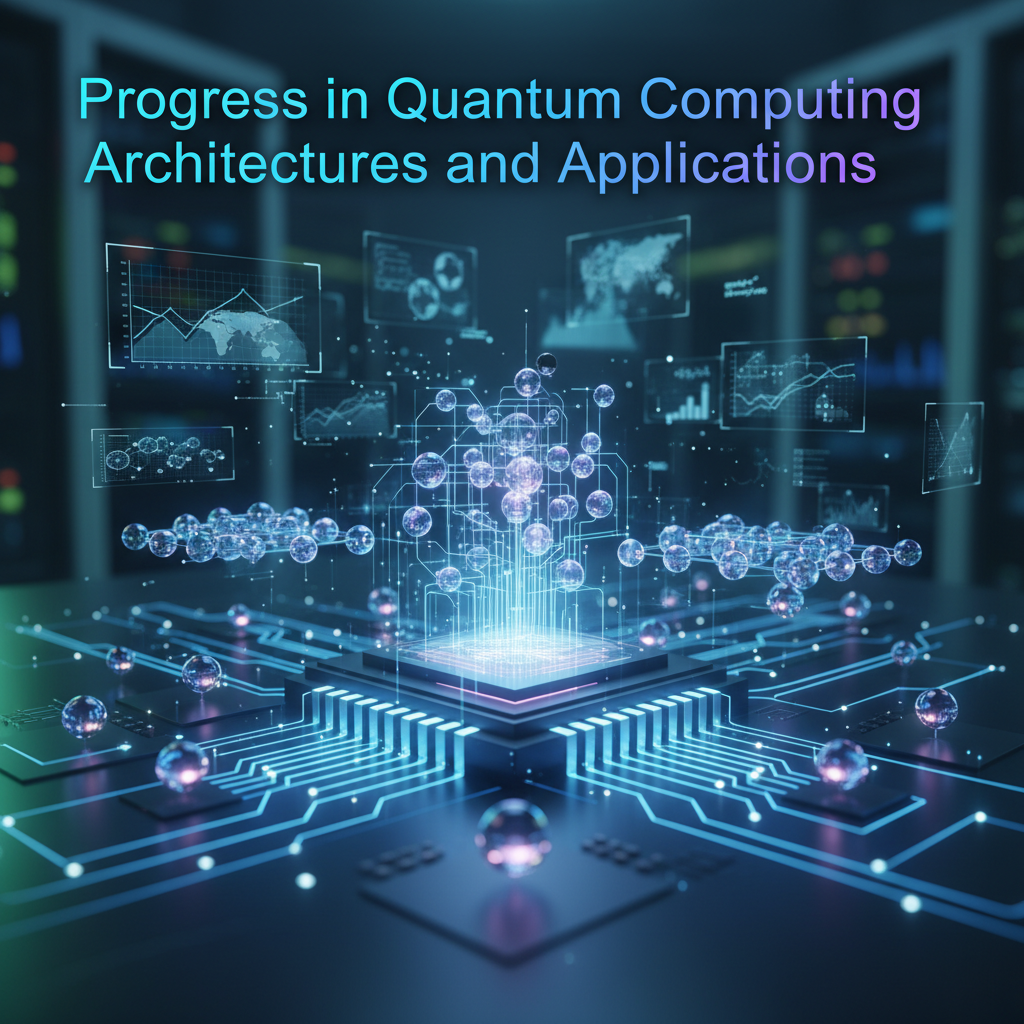
Quantum’s Next Wave: Architecture & Apps Advancing
The world of quantum computing is buzzing with unprecedented progress. What once felt like science fiction is rapidly becoming a tangible reality, driven by incredible advancements in how quantum computers are built (architectures) and what they can do (applications). Join us as we explore the exciting leaps forward in this groundbreaking field.
Architectural Breakthroughs: Building Better Quantum Machines
At the heart of quantum computing lies the qubit – the fundamental unit of quantum information. Recent years have seen remarkable strides in refining various qubit technologies. Superconducting qubits, like those pioneered by IBM and Google, continue to push the boundaries of coherence and connectivity. Trapped-ion systems, championed by companies like IonQ, offer high-fidelity operations and excellent scalability prospects.
Beyond these established players, innovative approaches like photonic qubits (PsiQuantum, Xanadu) promise high-speed operations, while efforts in topological qubits aim for inherent error resistance. Crucially, advancements aren’t just about individual qubits; they’re also about how they’re integrated. We’re seeing progress in modular architectures, enabling smaller, interconnected quantum processors to form larger, more powerful systems, paving the way for fault-tolerant quantum computing.
Expanding Application Horizons: What Quantum Computers Can Do
As quantum hardware matures, so does our understanding of its potential applications. While truly transformative applications still require larger, more stable machines, the “Noisy Intermediate-Scale Quantum” (NISQ) era is already showing promise in several areas:
- Drug Discovery & Materials Science: Simulating molecular interactions with unprecedented accuracy could revolutionize the development of new medicines and advanced materials.
- Financial Modeling: Quantum algorithms are being explored for optimizing portfolios, pricing complex derivatives, and detecting fraud with greater efficiency.
- Artificial Intelligence & Machine Learning: Quantum-enhanced machine learning could lead to more powerful algorithms for pattern recognition and data analysis.
- Optimization Problems: Industries from logistics to manufacturing stand to benefit from quantum solutions to complex scheduling and resource allocation challenges.
These early applications, though often proofs-of-concept, are vital for developing the algorithms and expertise needed for future, more complex problems.
Bridging the Gap: Software & Hardware Synergy
The rapid progress isn’t solely a hardware story. The ecosystem supporting quantum computing is also flourishing. Robust quantum software development kits (SDKs) like Qiskit, Cirq, and PennyLane are making it easier for developers to write and test quantum algorithms. Cloud access to quantum processors from major players means researchers and developers can experiment with real quantum hardware without needing their own lab.
This synergy between hardware architects, software developers, and application specialists is accelerating the field. As hardware becomes more capable, software tools evolve to harness that power, and new applications emerge from this collaborative environment.
The Future is Quantum-Powered
The journey of quantum computing is a marathon, not a sprint, but the pace of progress in architectures and applications is undeniably exciting. From perfecting the quantum bits themselves to discovering their potential across diverse industries, we are witnessing a foundational shift in how we approach computation.
Stay tuned as we continue to push the boundaries of what’s possible, moving ever closer to a future where quantum computers solve some of humanity’s most complex challenges.


Leave a Reply