
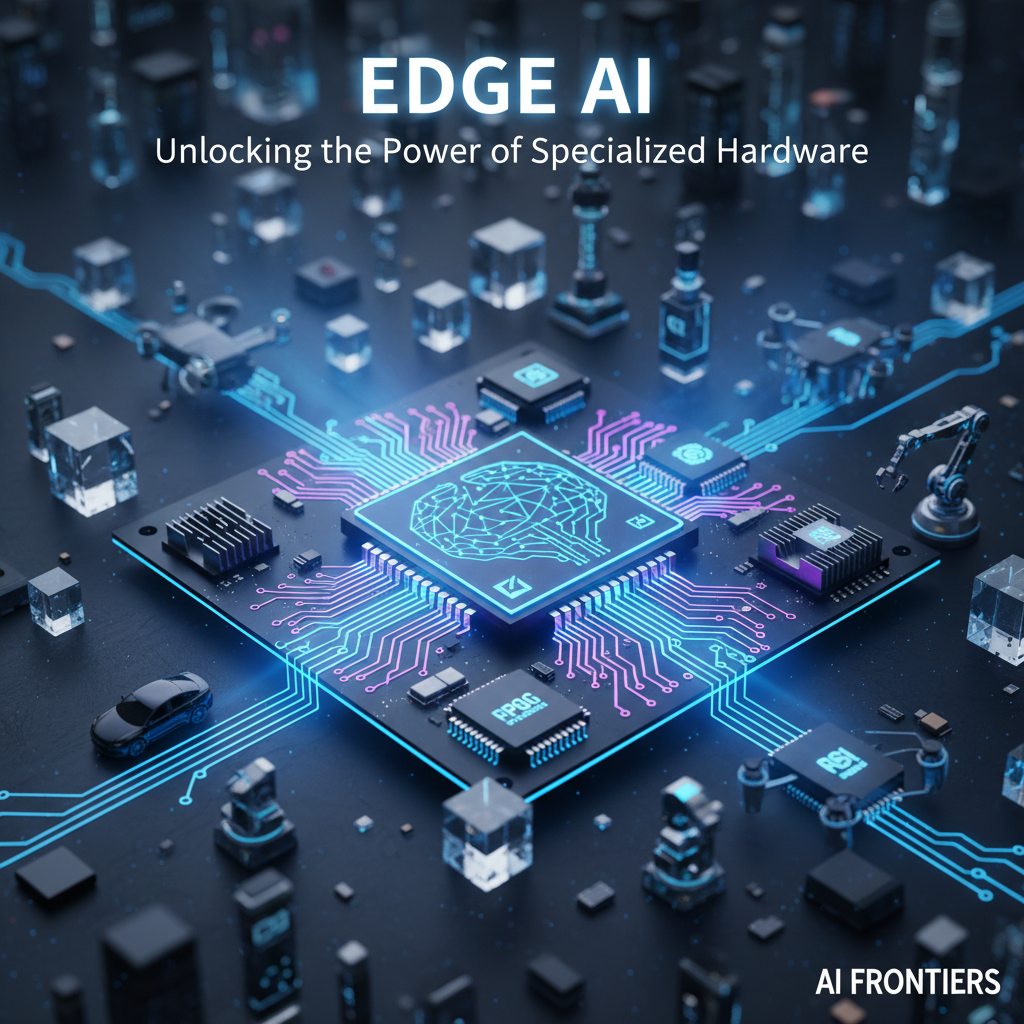
Unleashing AI’s Power at the Edge: Hardware Matters!
Hey there, tech enthusiasts! Have you ever wondered how AI is starting to make decisions in real-time, right where the action happens, without sending data all the way to a faraway cloud? Welcome to the fascinating world of Edge AI! It’s not just a buzzword; it’s a monumental shift in how we deploy artificial intelligence, and it’s powered by some truly remarkable specialized hardware.
The Edge of Innovation: What is Edge AI?
In simple terms, Edge AI refers to running AI algorithms directly on devices “at the edge” of the network – like your smartphone, a smart camera, an industrial robot, or even a drone – instead of relying on a centralized cloud server. Think of it as giving your local devices their own mini-brains, enabling them to process data and make decisions instantly, right where the data is generated.
Why Bring AI to the Edge?
The benefits of Edge AI are compelling and drive its rapid adoption:
- Lower Latency: Real-time decisions are crucial for applications like autonomous vehicles or critical industrial automation, where even milliseconds matter.
- Enhanced Privacy & Security: Sensitive data can be processed locally without being transmitted to the cloud, reducing privacy risks and potential breaches.
- Reduced Bandwidth & Cost: Less data needs to be sent over networks, saving bandwidth and associated cloud processing/storage costs.
- Improved Reliability: Edge devices can continue to operate and make intelligent decisions even if network connectivity is intermittent or lost.
Beyond Traditional Chips: The Need for Specialized Hardware
While general-purpose CPUs (Central Processing Units) and GPUs (Graphics Processing Units) have been the workhorses of AI in data centers, they aren’t always the most efficient choice for the edge. Edge devices often have strict constraints on power consumption, size, and cost. This is where specialized AI hardware steps in, designed from the ground up to excel at the unique demands of AI workloads with incredible efficiency.
Meet the Edge AI Accelerators
To deliver on the promise of Edge AI, a new breed of hardware has emerged, each with its own strengths:
NPUs: The Brains of Edge Devices
Neural Processing Units (NPUs) are microprocessors specifically optimized for accelerating machine learning (ML) workloads, particularly neural networks. They are designed to handle matrix multiplications and convolutions – the fundamental operations of AI – much more efficiently than traditional CPUs. You’ll find NPUs integrated into many modern smartphones and IoT devices, providing dedicated horsepower for tasks like facial recognition, voice commands, and real-time object detection.
FPGAs: The Flexible All-Rounders
Field-Programmable Gate Arrays (FPGAs) are integrated circuits that can be configured by a user after manufacturing. Unlike ASICs (which we’ll discuss next), FPGAs offer a high degree of flexibility. They can be reprogrammed for different AI models or future updates, making them ideal for scenarios where the AI algorithms might evolve, or where a custom hardware architecture is needed without the immense cost of designing a full ASIC. Their parallel processing capabilities make them strong contenders for a variety of edge AI applications.
ASICs: The Hyper-Specialists (and TPUs!)
Application-Specific Integrated Circuits (ASICs) are custom-designed chips built for a very specific task. When it comes to AI, ASICs are engineered to perform particular AI operations with maximum efficiency and speed, often consuming very little power. While they are expensive to design and manufacture, they offer the highest performance for their intended purpose. A famous example is Google’s Tensor Processing Unit (TPU), which is an ASIC specifically designed to accelerate TensorFlow computations. While TPUs are often associated with data centers, their principles are being miniaturized and adapted for specialized edge ASICs.
The Road Ahead: Challenges and Bright Futures
The journey of Edge AI and specialized hardware isn’t without its challenges. Designing and manufacturing these chips requires significant investment, and integrating them into diverse edge devices demands careful software optimization. However, the innovation continues at a rapid pace. We’re seeing more powerful, yet more energy-efficient, AI accelerators emerge, making sophisticated AI accessible to an ever-growing array of edge applications.
From smart homes and factories to healthcare and agriculture, Edge AI powered by specialized hardware is not just a glimpse into the future; it’s actively shaping our present. It’s an exciting synergy that promises to bring intelligence closer to us, making our devices smarter, our data safer, and our lives more efficient. So, next time your phone recognizes your face instantly, give a silent nod to the incredible specialized AI hardware working its magic at the edge!


Leave a Reply