
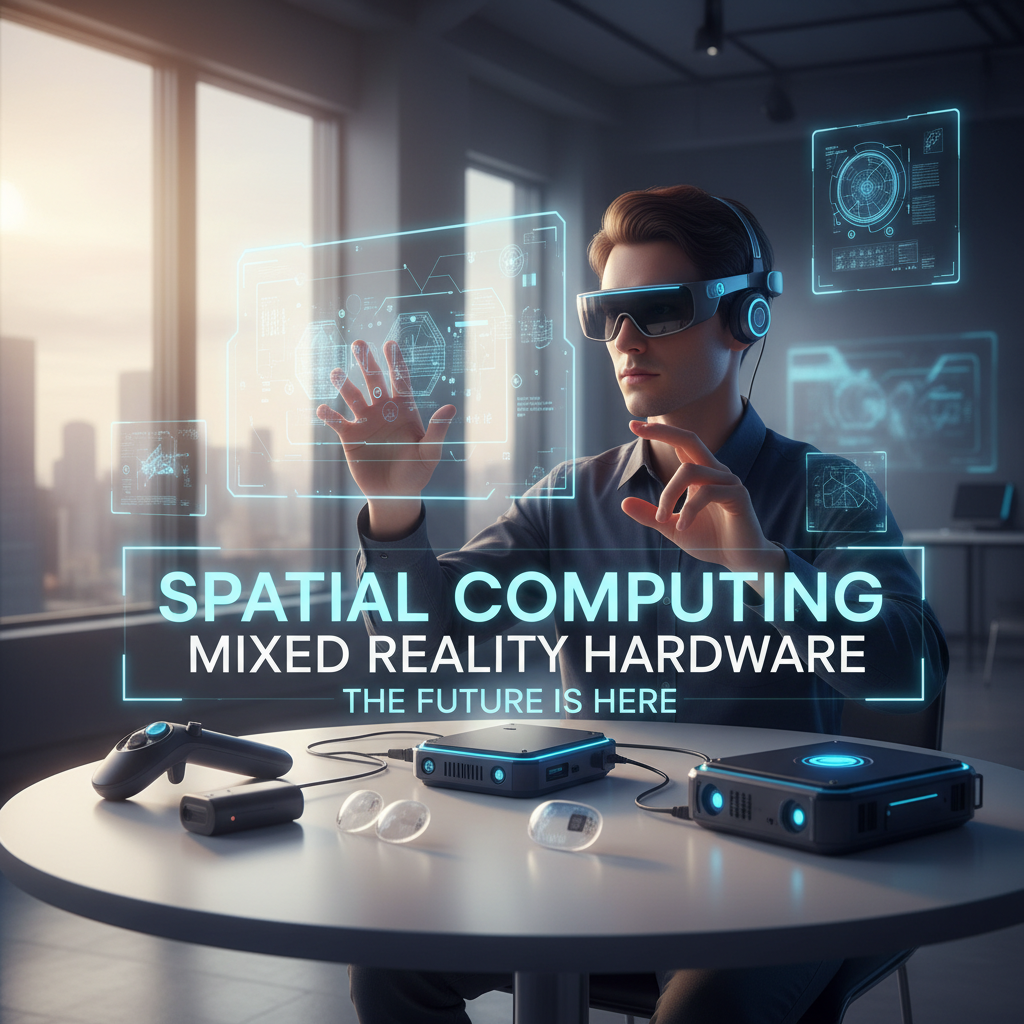
Stepping into the Future: MR Hardware Unveiled
Welcome to a future where digital and physical worlds aren’t just merging, they’re interacting seamlessly all around us! We’re talking about spatial computing, an evolution that takes us beyond screens into immersive, interactive environments. And at the heart of this exciting revolution lies cutting-edge Mixed Reality (MR) hardware.
What Exactly is Spatial Computing?
Think beyond Virtual Reality (VR) which fully immerses you, or Augmented Reality (AR) which overlays digital elements onto your view. Spatial computing allows digital content to exist and interact intelligently within your real-world space. It understands the dimensions of your room, the objects in it, and even your movements, enabling truly integrated experiences. This isn’t just seeing digital objects; it’s interacting with them as if they’re truly there, sharing your physical space.
The Powerhouse Behind the Scenes: Key Hardware Components
To achieve this magic, MR headsets are packed with incredible technology. It’s a symphony of optics, sensors, and processing power working in harmony:
- Advanced Optics & Displays: Unlike traditional screens, MR devices use sophisticated optical systems (like waveguides or pancake lenses) to project virtual images directly into your field of view, making them appear as if they’re part of your real environment. High-resolution micro-OLED or LCoS displays ensure crisp, vibrant visuals.
- Environmental Sensors & Cameras: This is where the “spatial” part truly comes alive. Multiple cameras and depth sensors (like LiDAR or structured light) continuously scan your surroundings, building a 3D map of your physical space. This mapping allows digital objects to “understand” and react to your real world, whether it’s anchoring a virtual screen to a wall or having a digital character walk around your furniture.
- Powerful Processors: All this real-time mapping, rendering, and interaction demands serious computational muscle. Custom-designed system-on-a-chip (SoC) architectures, often combining CPUs, GPUs, and Neural Processing Units (NPUs), are essential for running complex applications smoothly and efficiently, all within a compact, wearable form factor.
- Input & Interaction: From hand-tracking and eye-tracking to voice commands and external controllers, MR hardware offers diverse ways to interact with digital content naturally, blurring the lines between the physical and virtual.
Today’s Trailblazers: A Glimpse at Current Devices
While the field is rapidly evolving, several devices have pushed the boundaries of what’s possible in spatial computing and mixed reality:
- Microsoft HoloLens: A pioneer in enterprise MR, HoloLens has demonstrated the power of spatial computing for industrial design, remote assistance, and training. Its robust spatial mapping capabilities have set a high bar.
- Magic Leap: Known for its “Lightfield” technology, Magic Leap aims to project digital light directly into the eye, creating a strong sense of presence and depth, primarily targeting professional applications and developers.
- Apple Vision Pro: A recent high-profile entry, the Vision Pro emphasizes high-resolution displays, advanced eye-tracking, and seamless integration with the Apple ecosystem, positioning itself as a “spatial computer” for both productivity and entertainment.
- Varjo XR-3: A high-end solution primarily for professional simulation and design, offering unparalleled resolution and a wide field of view for critical applications.
What’s Next? Challenges & The Road Ahead
Despite the incredible advancements, MR hardware is still in its early stages. Key areas of ongoing innovation and challenges include:
- Form Factor & Comfort: Current devices can be bulky and heavy. Future iterations aim for lighter, more stylish designs resembling standard eyeglasses.
- Battery Life: Powering complex computation in a small device is demanding. Extended battery life is crucial for all-day use.
- Field of View (FoV) & Resolution: Expanding the visible area of digital content and increasing resolution will further enhance immersion and realism.
- Cost & Accessibility: High prices currently limit adoption. Reducing manufacturing costs will be vital for broader consumer reach.
- Ecosystem & Content: The hardware needs compelling software and applications to truly flourish, driving demand and utility.
The Future is Spatial, and It’s Exciting!
Spatial computing and mixed reality hardware are not just technological novelties; they represent a fundamental shift in how we will interact with information and each other. From revolutionizing industries like healthcare and manufacturing to transforming entertainment and social interaction, the devices emerging today are laying the groundwork for a truly interconnected, intelligent, and immersive future. Get ready – your world is about to become a whole lot more interactive!


Leave a Reply