
Beyond Text: Exploring Multimodal Generative AI
We’re living through an incredibly exciting era in artificial intelligence. What started with algorithms processing data has evolved into sophisticated systems capable of generating entirely new content. But the future isn’t just about generating text or images in isolation; it’s about seamlessly blending them. Welcome to the world of advanced generative AI and multimodal models!
What is Advanced Generative AI?
At its core, generative AI refers to AI systems that can create novel content, rather than just classifying or predicting existing data. Think large language models (LLMs) that write compelling stories, or image generators that conjure stunning visuals from simple prompts. “Advanced” here implies a leap in complexity, coherence, and the ability to produce high-quality, diverse outputs that often rival human-created work.
These advanced models learn intricate patterns and structures from vast datasets, allowing them to understand context, style, and nuance, which they then use to “imagine” and produce original content. It’s a fundamental shift from AI that analyzes to AI that invents.
The Power of Multimodal Models
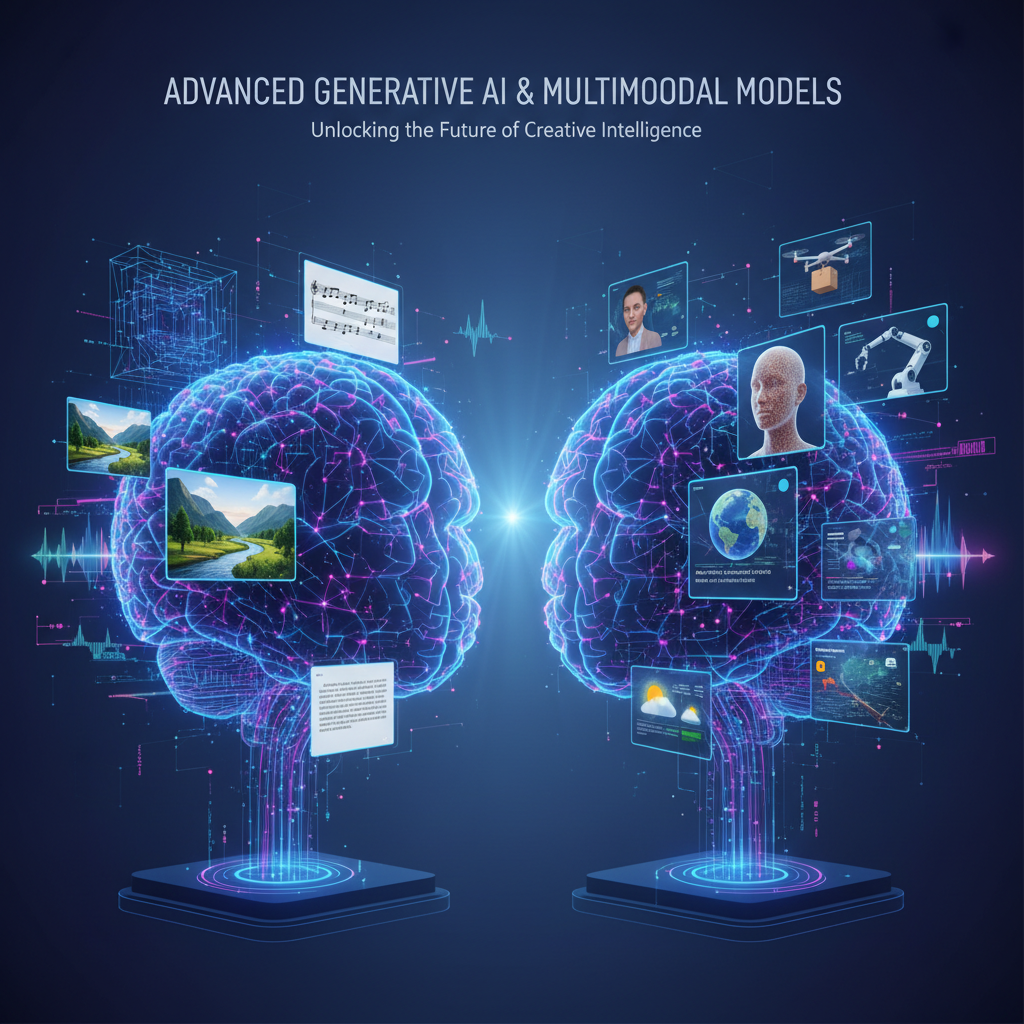
While impressive, many early generative AI models specialized in a single modality – text, images, or audio. Multimodal models, however, break these barriers by understanding and generating content across multiple modalities simultaneously. Imagine an AI that can not only describe a complex image but also create an image based on a detailed verbal description, or even generate a video from a script and a few still photos.
This capability is a massive step towards AI that mimics human perception and creativity more closely. Humans don’t experience the world through isolated senses; we see, hear, feel, and understand in an integrated way. Multimodal AI strives for that same holistic understanding, leading to richer, more contextually aware, and more powerful generative capabilities.
Examples abound: Text-to-Image models like DALL-E and Midjourney, Text-to-Video generators, models that can caption images with highly descriptive text, or even AI that combines audio and visual cues to create realistic conversational agents. The interaction between different data types unlocks previously impossible applications.
Real-World Applications & Impact
The implications of advanced generative AI and multimodal models are nothing short of revolutionary across various sectors:
Creative Industries: From generating unique artwork, music compositions, and video game assets to assisting scriptwriters and designers, these models are becoming powerful co-creators.
Healthcare & Science: Accelerating drug discovery by generating novel molecular structures, synthesizing complex medical images for training, or creating interactive educational materials for patients and students.
Education & Training: Personalizing learning experiences with adaptive content, generating diverse examples for explanations, and creating immersive simulations.
Accessibility: Automatically generating descriptive audio for images and videos, translating sign language into text, or converting complex documents into simplified visual summaries for different learning needs.
Content Creation: Revolutionizing marketing, journalism, and social media by enabling rapid generation of tailored, engaging content across text, images, and video formats.
Navigating Challenges and Ethics
As with any powerful technology, advanced generative AI and multimodal models come with their own set of challenges and ethical considerations. Issues like deepfakes and misinformation, bias embedded in training data, intellectual property concerns, and the potential impact on various job markets require careful attention.
Responsible development, transparency in AI models, robust ethical guidelines, and continuous public discourse are crucial to ensure these technologies benefit humanity positively and equitably. It’s a shared responsibility for researchers, developers, policymakers, and users alike to shape the future of AI wisely.
The Future is Bright (and Multimodal!)
We are just scratching the surface of what advanced generative AI and multimodal models can achieve. Expect to see even more seamless integration, higher fidelity outputs, and AI systems that can reason and create across modalities with increasing sophistication. Imagine AI that can understand a complex scientific paper, summarize it, generate illustrative diagrams, and then create a short explanatory video, all from a single prompt!
The journey from basic algorithms to these incredibly creative and versatile AI systems has been rapid and exhilarating. As we continue to push the boundaries, the possibilities for innovation, problem-solving, and human-AI collaboration are truly boundless. It’s an exciting time to be witnessing (and participating in!) the evolution of intelligence.


Leave a Reply