Generative AI: Seeing, Hearing, Creating!
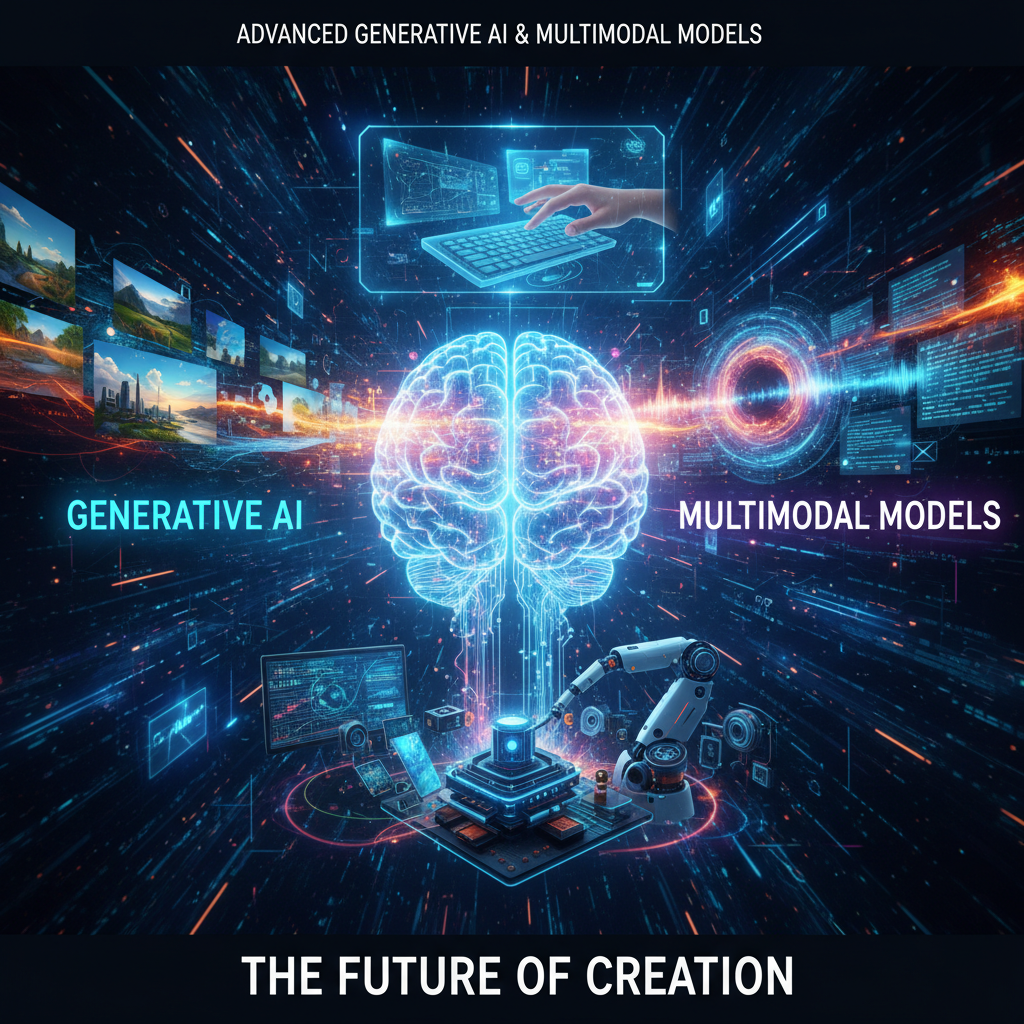
Welcome, tech enthusiasts and curious minds! Today, we’re diving deep into one of the most exciting and rapidly evolving areas in artificial intelligence: Advanced Generative AI and Multimodal Models. While you might already be familiar with AI creating text or images, the future is about seamlessly blending these capabilities and more. Let’s explore how AI is learning to perceive and create across different forms of information.
What Exactly Are Multimodal Models?
Traditionally, AI models were often built for a single type of data – text, images, or audio. Think of a text-only chatbot or an image recognition system. Multimodal models, however, are designed to process, understand, and generate information from multiple modalities simultaneously. This means they can take in text and images, or even audio and video, and create outputs that draw from all these diverse data types. It’s like teaching AI to use all its senses at once!
The Magic Behind Multimodal AI
So, how do these incredible models work their magic? At their core, multimodal AI leverages sophisticated neural network architectures, often building upon the success of transformer models. These architectures learn to create a unified representation (or “embedding”) for different types of data. This shared understanding allows the model to find connections and generate coherent outputs, whether it’s describing an image in text, generating a video from a text prompt, or creating an image based on both text and an existing image. Training these models requires vast datasets that meticulously link different modalities, allowing the AI to learn how they relate to each other in the real world.
Real-World Applications & Impact
The potential applications of advanced generative AI and multimodal models are truly mind-boggling and are already starting to reshape industries:
Creative Content Generation: From generating stunning images and illustrations from simple text prompts (think DALL-E, Midjourney) to creating realistic videos based on descriptions (like OpenAI’s Sora), these models are empowering artists, marketers, and storytellers in unprecedented ways.
Enhanced AI Assistants: Imagine an AI assistant that not only understands your voice commands but also interprets what’s on your screen, uses your camera feed, and can respond with both spoken words and visual cues. This leads to more intuitive and powerful interactions.
Accessibility Tools: Multimodal AI can dramatically improve accessibility, for instance, by accurately describing complex images for visually impaired users or converting sign language into spoken text in real-time.
Scientific Discovery: By processing diverse datasets, from molecular structures to research papers and experimental results, these models can accelerate research in fields like medicine and material science.
Challenges and the Road Ahead
While the advancements are breathtaking, the journey is not without its hurdles. Training multimodal models requires enormous computational resources and vast, high-quality, aligned datasets, which are expensive and complex to curate. Ethical considerations surrounding bias, deepfakes, and intellectual property also demand careful attention as these models become more powerful and accessible. However, research is rapidly progressing to address these challenges, pushing the boundaries of what’s possible and ensuring responsible development.
The convergence of advanced generative AI and multimodal capabilities is not just a technological leap; it’s a paradigm shift in how we interact with and create through artificial intelligence. We’re moving towards a future where AI can perceive, understand, and generate content across all forms of human expression. Get ready – the creative possibilities are endless!



Leave a Reply