
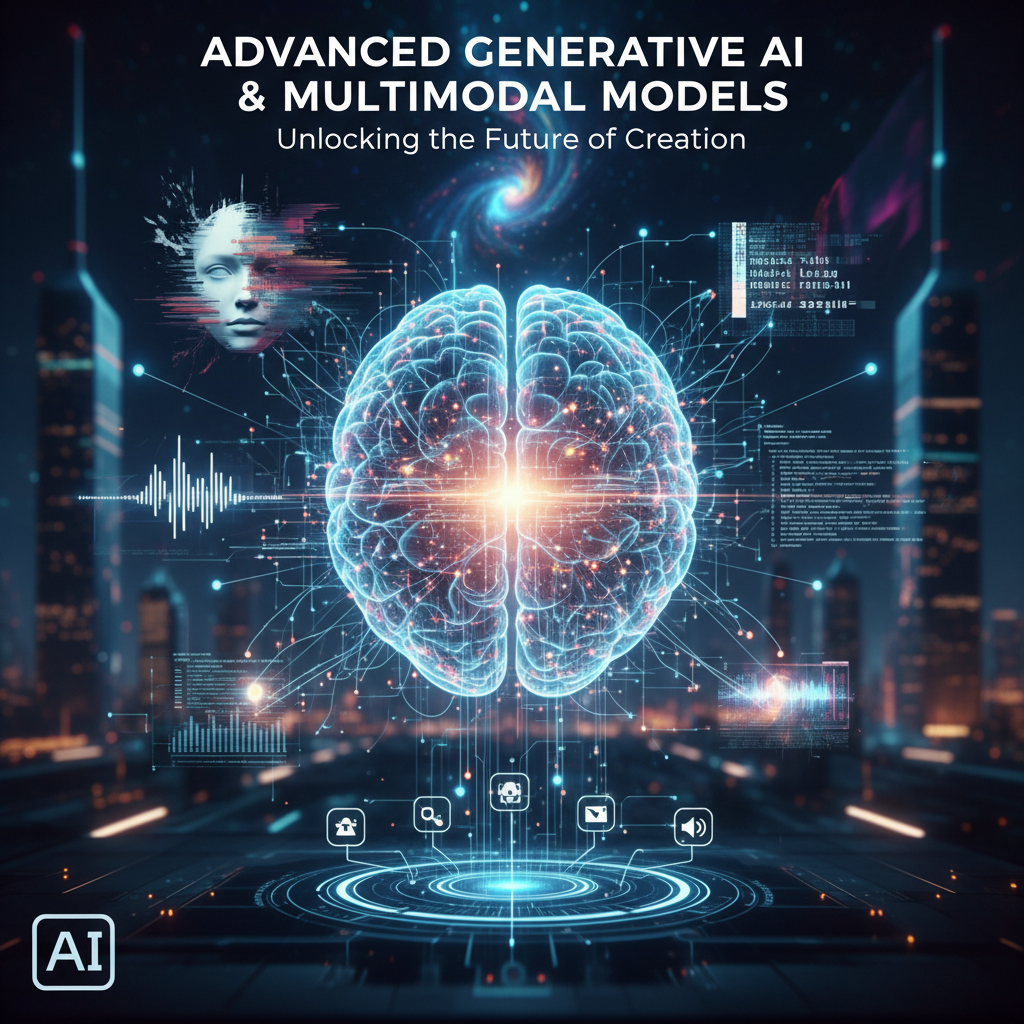
Hey there, tech enthusiasts and curious minds!
Get ready to dive into the cutting edge of artificial intelligence. We’re not just talking about chatbots anymore; we’re exploring a fascinating frontier where AI can understand, generate, and even create across multiple forms of media. Welcome to the world of Advanced Generative AI and Multimodal Models!
What Exactly is Advanced Generative AI?
Generative AI has evolved remarkably. Initially, models focused on generating text (think large language models like GPT). Advanced generative AI takes this a step further, producing highly realistic and complex outputs based on sophisticated patterns learned from vast datasets. It’s about AI not just understanding information, but *creating* new, original, and often indistinguishable content – be it text, images, audio, or even video.
These models leverage deep learning architectures, often built upon transformer networks, allowing them to capture intricate dependencies and contextual nuances that were previously impossible. They can learn the “style” or “essence” of data and then apply it to generate novel examples.
The Power of Multimodal Models
Here’s where things get really exciting! Multimodal models are a subset of advanced generative AI that can process and generate information from more than one modality. Instead of just handling text, they can simultaneously work with text, images, audio, and sometimes even video or 3D data.
Imagine an AI that can look at a picture, understand its content, describe it in perfect prose, and then even generate an audio narration for that description. Or an AI that can take a text prompt like “a robot playing a guitar on the moon” and produce a stunning, unique image that captures that vision. That’s multimodal in action!
This capability allows AI to mimic human perception and creativity more closely, as our own understanding of the world is inherently multimodal – we see, hear, feel, and read all at once.
Real-World Applications & Impact
The potential applications of advanced generative and multimodal AI are vast and transformative:
- Creative Industries: From aiding graphic designers in generating unique visual elements and assisting musicians with new compositions, to helping filmmakers create realistic scenes or characters.
- Content Creation: Automating the generation of social media posts, marketing materials, or even entire articles complete with relevant imagery.
- Education & Accessibility: Creating engaging interactive learning experiences, generating descriptive captions for images for visually impaired users, or translating sign language into text and vice versa.
- Scientific Research: Accelerating drug discovery by generating novel molecular structures or simulating complex biological processes.
- Human-Computer Interaction: Enabling more natural and intuitive interfaces where AI understands not just what you say, but also what you show or even what emotion you convey.
Looking Ahead: Challenges and Ethical Considerations
While the capabilities are astounding, this field also presents new challenges. Ensuring ethical use, preventing misuse (e.g., deepfakes), addressing biases inherent in training data, and developing robust safety mechanisms are paramount. We also need to continue exploring the computational demands and energy consumption of these increasingly complex models.
The future of AI is undeniably multimodal. As these models continue to evolve, they promise to unlock unprecedented levels of creativity, efficiency, and understanding, blurring the lines between what’s artificial and what’s indistinguishable from human-generated content.
What are your thoughts on this incredible leap in AI? Share your ideas in the comments below!
“`


Leave a Reply