Unlocking New Realities: Advanced Generative AI & Multimodal Models
The world of Artificial Intelligence is evolving at an exhilarating pace! What started with specialized models for text or images is rapidly converging into something far more powerful and comprehensive. We’re talking about Advanced Generative AI and Multimodal Models – the next frontier in creating intelligent systems that truly understand and interact with our complex world.
Beyond Basic Generation: What is “Advanced” Generative AI?
You’re likely familiar with Generative AI through popular tools like ChatGPT or Midjourney. These are fantastic, but “advanced” generative AI pushes the boundaries much further. It’s not just about generating plausible content; it’s about generating *controlled*, *coherent*, *context-aware*, and often *reasoned* content.
Advanced models demonstrate deeper understanding, allowing for more nuanced instruction, better long-form coherence, and the ability to adapt to complex scenarios. Think less about “make me an image of a cat” and more about “design a coherent series of images depicting a cat’s journey from kitten to elder, maintaining consistent style and emotion across each frame.” These models are becoming more efficient, robust, and capable of incorporating user feedback in real-time, moving beyond simple one-shot outputs.
The Magic of Multimodal Models: Seeing, Hearing, and Understanding
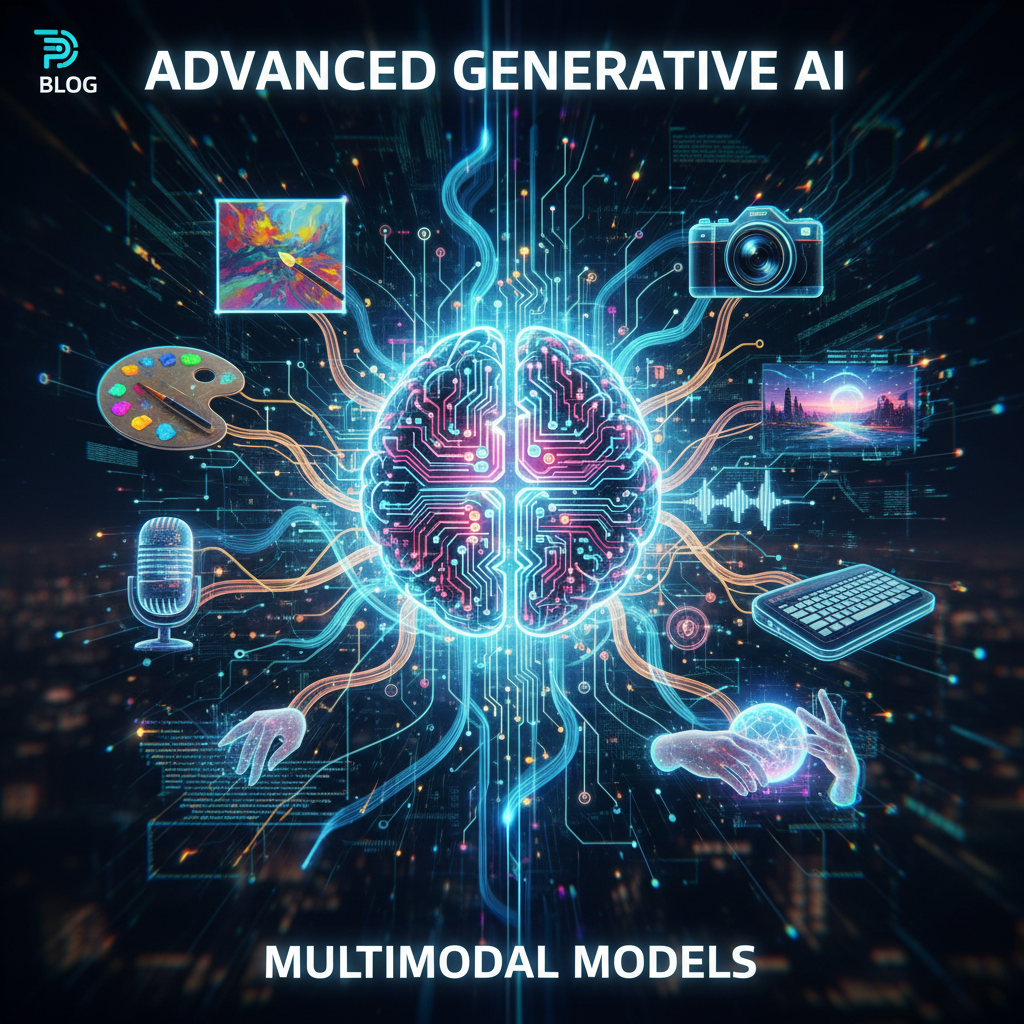
Our world isn’t just text, or just images – it’s a rich tapestry of sights, sounds, and interactions. Multimodal models are designed to reflect this reality. Instead of specializing in a single type of data (like text or audio), they can process, understand, and generate across multiple “modalities” simultaneously.
Imagine an AI that can:
- Analyze a video, describe the actions, identify emotions, and even transcribe the dialogue.
- Take a text prompt like “a serene forest scene with ambient bird sounds and soft morning light” and generate not just an image, but also a corresponding audio track and a 3D environment.
- Understand your spoken request to “find all red shirts in this image” and highlight them.
This is the power of multimodality – bridging the gap between how humans experience the world and how AI can interact with it.
The Synergy: Advanced Generative AI Meets Multimodality
When you combine advanced generative capabilities with multimodal understanding, something truly transformative happens. These systems can not only comprehend complex, real-world inputs (which are inherently multimodal) but also *generate* equally rich and diverse outputs.
This synergy allows for:
- Enhanced Creativity: From text-to-3D models to AI assistants that can generate entire multimedia presentations from a few bullet points.
- Deeper Understanding: An AI that can read a medical image, understand the accompanying patient notes, and then verbally explain a diagnosis.
- More Natural Interaction: Future AI assistants that can respond to our requests by showing relevant visuals, playing audio, or even simulating physical interactions.
Real-World Impact and the Road Ahead
The implications of Advanced Generative AI and Multimodal Models are vast. They promise to revolutionize creative industries, make education more immersive, enhance accessibility for people with disabilities, and even aid scientific discovery by processing and synthesizing complex data from various sources.
Of course, this frontier also brings challenges: ethical considerations around synthetic media, the need for robust and unbiased training data, and the sheer computational power required. However, the potential for these models to augment human capabilities, solve complex problems, and unlock new forms of creativity is immense and incredibly exciting.
We’re just beginning to scratch the surface of what’s possible. Keep an eye on this space – the future of AI is multimodal, intelligent, and more generative than ever before!
“`


Leave a Reply