
Quantum Leaps: The Hardware Powering Tomorrow’s Computers
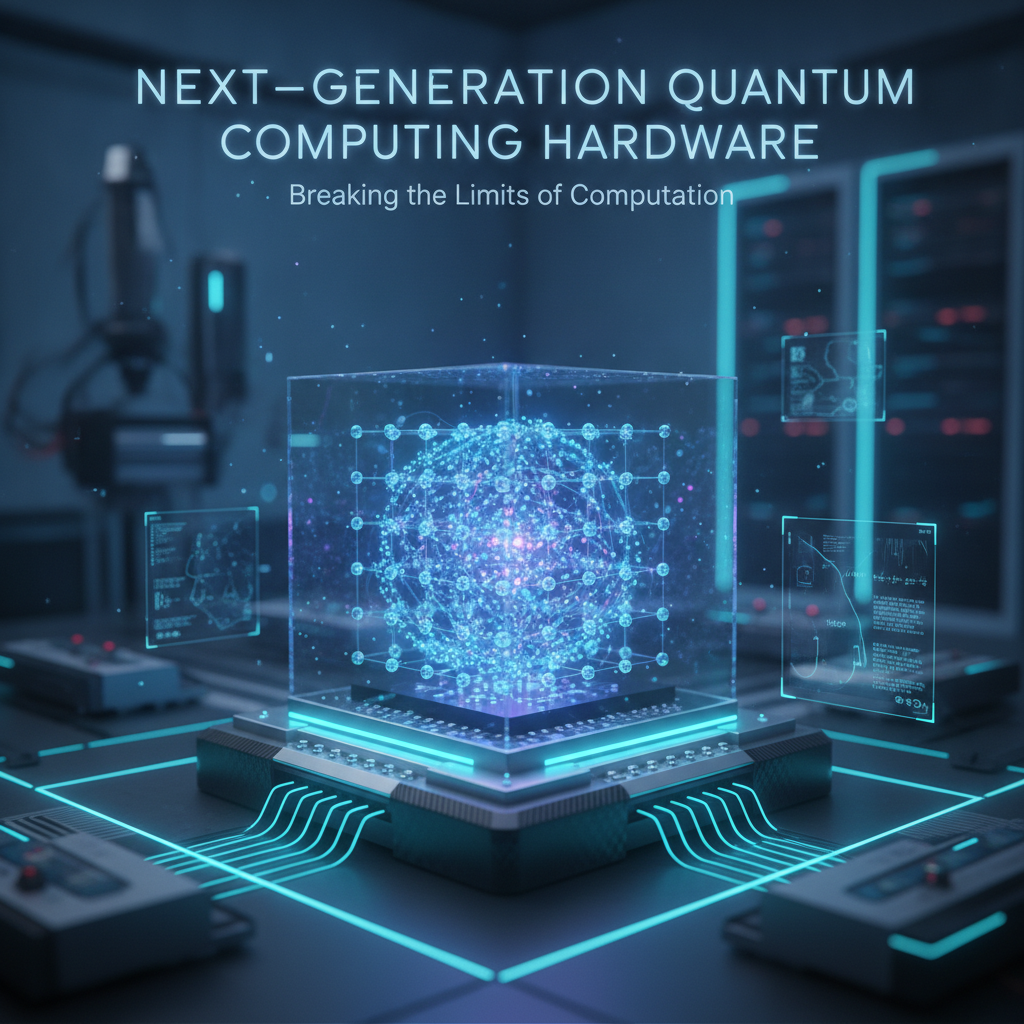
Quantum computing isn’t just a buzzword anymore; it’s a rapidly evolving field promising to solve problems currently intractable for even the most powerful supercomputers. From drug discovery and material science to complex financial modeling and advanced AI, the potential applications are immense. But to unlock this future, we need robust, reliable, and scalable hardware. Welcome to the exciting world of next-generation quantum computing hardware, where innovation knows no bounds!
Decoding the Quantum Advantage
Unlike classical computers that use bits (0s or 1s), quantum computers leverage qubits that can exist in superposition (both 0 and 1 simultaneously) and entanglement (where qubits are linked, regardless of distance). This allows them to process vast amounts of information in parallel. However, realizing this power in a physical device is incredibly challenging, pushing the boundaries of physics and engineering.
Current Hurdles: The Quest for Stability
Today’s quantum computers, often referred to as Noisy Intermediate-Scale Quantum (NISQ) devices, are impressive but face significant limitations. Qubits are incredibly delicate; they easily lose their “quantumness” (a phenomenon called decoherence) due to interaction with their environment. Keeping them stable, isolated, and precisely controlled at extreme temperatures (often near absolute zero) or in powerful electromagnetic traps is a monumental task. This quest for stability and scalability is driving the innovation in next-generation hardware.
Superconducting Qubits: The Established Path
One of the most mature quantum hardware platforms uses superconducting circuits. Companies like IBM and Google have made significant strides with this technology, creating chips with dozens of qubits. These circuits operate at ultra-low temperatures, cooled by sophisticated cryogenic systems. While they’ve achieved impressive gate fidelities, scaling them up to thousands or millions of qubits while maintaining performance remains a key challenge, requiring continuous advancements in chip design and error correction.
Trapped Ions: Precision in a Cage
Another leading contender is trapped-ion technology. Here, individual atoms are ionized and suspended in a vacuum using electromagnetic fields, forming a “quantum register.” Lasers are then used to manipulate their quantum states and facilitate entanglement. Companies like Quantinuum (a merger of Honeywell Quantum Solutions and Cambridge Quantum) are pioneers in this space. Trapped ions boast excellent qubit coherence times and high-fidelity operations, making them a strong candidate for future fault-tolerant quantum computers, though scaling the ion traps without introducing noise is a complex engineering feat.
Photonic & Neutral Atom Qubits: New Horizons
Beyond superconducting and trapped ions, other exciting architectures are emerging. Photonic quantum computing, championed by companies like PsiQuantum and Xanadu, uses photons (particles of light) as qubits. They offer the advantage of operating at room temperature and ease of integration with existing fiber optics infrastructure. The challenge lies in creating efficient single-photon sources and detectors. Neutral atoms, controlled by finely tuned laser arrays, are also gaining traction with startups like Atom Computing and ColdQuanta, promising highly scalable arrays of qubits with long coherence times, offering a different path to quantum supremacy.
The Road Ahead: Scalability & Error Correction
Regardless of the chosen hardware platform, two critical aspects define the next generation: scalability and error correction. Building truly useful quantum computers will require thousands, perhaps millions, of interconnected, high-fidelity qubits. Moreover, due to their inherent fragility, quantum systems are prone to errors. Developing sophisticated quantum error correction codes and the hardware to implement them effectively is paramount to building fault-tolerant machines that can run complex algorithms reliably.
A Quantum Future Awaits
The journey to powerful quantum computing is a marathon, not a sprint, and the hardware is the engine powering this race. From optimizing existing designs to exploring entirely new quantum phenomena, the innovations in next-generation quantum computing hardware are truly breathtaking. As scientists and engineers continue to push the boundaries of what’s possible, we’re getting closer to a future where quantum computers unlock solutions to humanity’s greatest challenges. Keep an eye on this space – the quantum revolution is just getting started!


Leave a Reply