
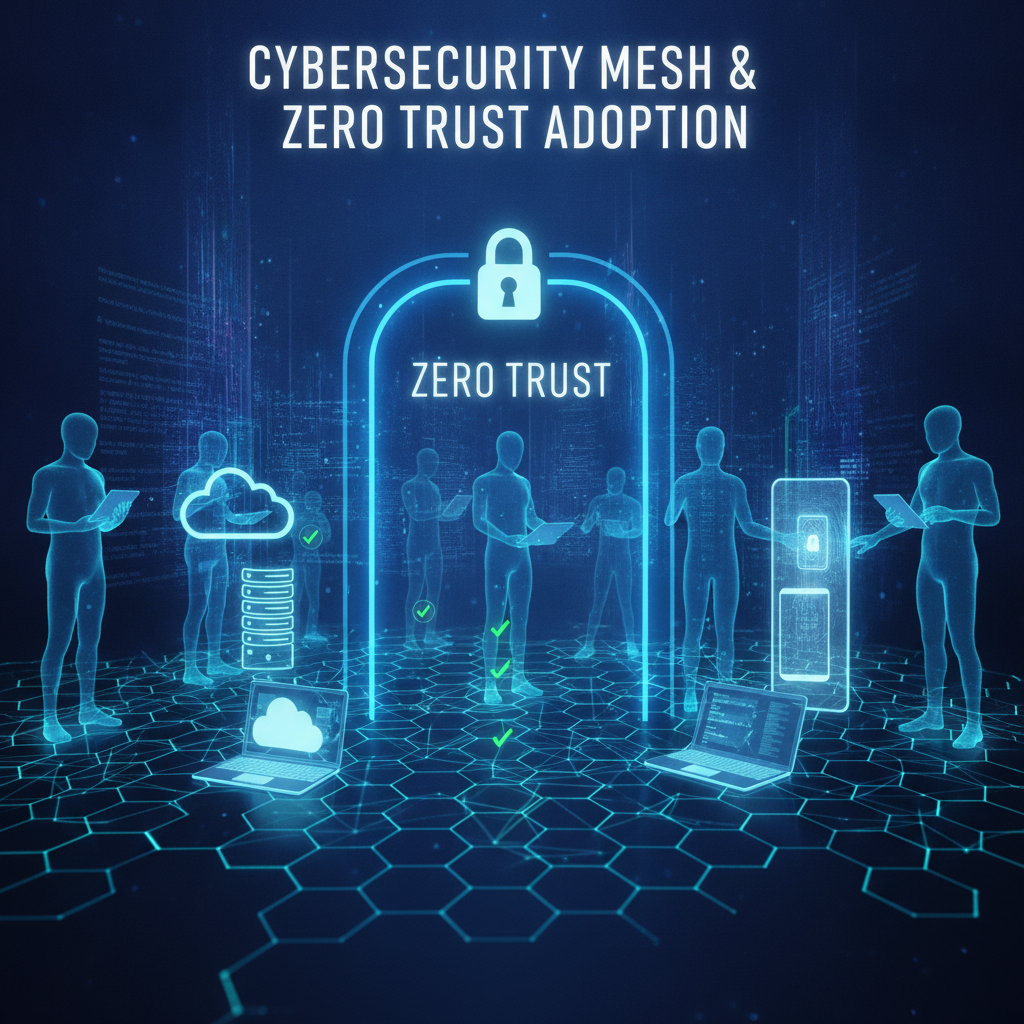
In today’s interconnected digital world, the traditional perimeter defense is no longer sufficient. With cloud adoption, remote workforces, and an ever-expanding attack surface, organizations need a more robust, adaptive, and proactive security strategy. Enter two powerful concepts that are revolutionizing cybersecurity: Cybersecurity Mesh Architecture and Zero Trust adoption.
The Evolving Threat Landscape
Remember when your corporate network was a castle with a moat? Those days are long gone! Data resides everywhere – in the cloud, on mobile devices, across various SaaS applications. Malicious actors are constantly innovating, and a single breach can have devastating consequences. This shift demands a fundamental rethinking of how we protect our valuable assets.
Understanding Zero Trust: Never Trust, Always Verify
At its core, Zero Trust is a security philosophy built on the principle of “never trust, always verify.” It means that no user, device, application, or service is inherently trusted, whether it’s inside or outside the traditional network perimeter. Every access request is rigorously authenticated and authorized, based on all available context, before access is granted – and even then, access is limited to the bare minimum required (least privilege).
- Key Principles:
- Assume breach.
- Verify explicitly.
- Enforce least privilege access.
- Microsegmentation.
- Continuous monitoring and authentication.
Introducing the Cybersecurity Mesh Architecture
While Zero Trust is the strategic mindset, the Cybersecurity Mesh Architecture (CSMA) is the distributed architectural framework that makes Zero Trust scalable and manageable across complex environments. Imagine a security fabric that weaves together disparate security controls, allowing them to interoperate and enforce consistent policies regardless of where the users, data, or applications reside.
Instead of a monolithic security stack, CSMA provides a collaborative approach, decentralizing policy enforcement and placing security decisions closer to the protected assets. It’s about creating a unified, adaptive security ecosystem.
The Power Duo: Why Mesh and Zero Trust Go Hand-in-Hand
Think of it this way: Zero Trust gives you the “what” – the strategy for how to secure everything. Cybersecurity Mesh gives you the “how” – the distributed infrastructure to effectively implement and scale that Zero Trust strategy across your entire digital estate. The mesh architecture enables the continuous, explicit verification required by Zero Trust, ensuring that policies are enforced consistently, whether data is in the cloud, on-premise, or at the edge.
Together, they provide:
- Enhanced Visibility: A comprehensive view of security posture across diverse environments.
- Consistent Policy Enforcement: Applying Zero Trust principles uniformly, irrespective of location.
- Reduced Attack Surface: Granular control limits potential entry points for attackers.
- Improved Resilience: Better ability to detect, respond to, and recover from threats.
- Agility: Adaptable security that supports rapid business changes and new technology adoption.
Navigating the Path to Adoption
Adopting Zero Trust and a Cybersecurity Mesh isn’t an overnight project; it’s a strategic journey. Here are a few considerations:
- Start Small: Identify a critical application or data set and apply Zero Trust principles there first.
- Focus on Identity: Identity is the new perimeter. Strong identity and access management (IAM) is foundational.
- Gain Visibility: Understand your assets, users, and data flows before defining policies.
- Automate Where Possible: Leverage automation for policy enforcement and threat response.
- Educate Your Team: A cultural shift is necessary for successful long-term adoption.
Ready to Secure Your Future?
The convergence of Cybersecurity Mesh Architecture and Zero Trust adoption represents a significant leap forward in organizational security. By embracing these powerful concepts, businesses can move beyond reactive defenses to build truly resilient, adaptive, and proactive security postures that protect against the threats of today and tomorrow. It’s not just about compliance; it’s about building trust in your digital operations.
“`



Leave a Reply