
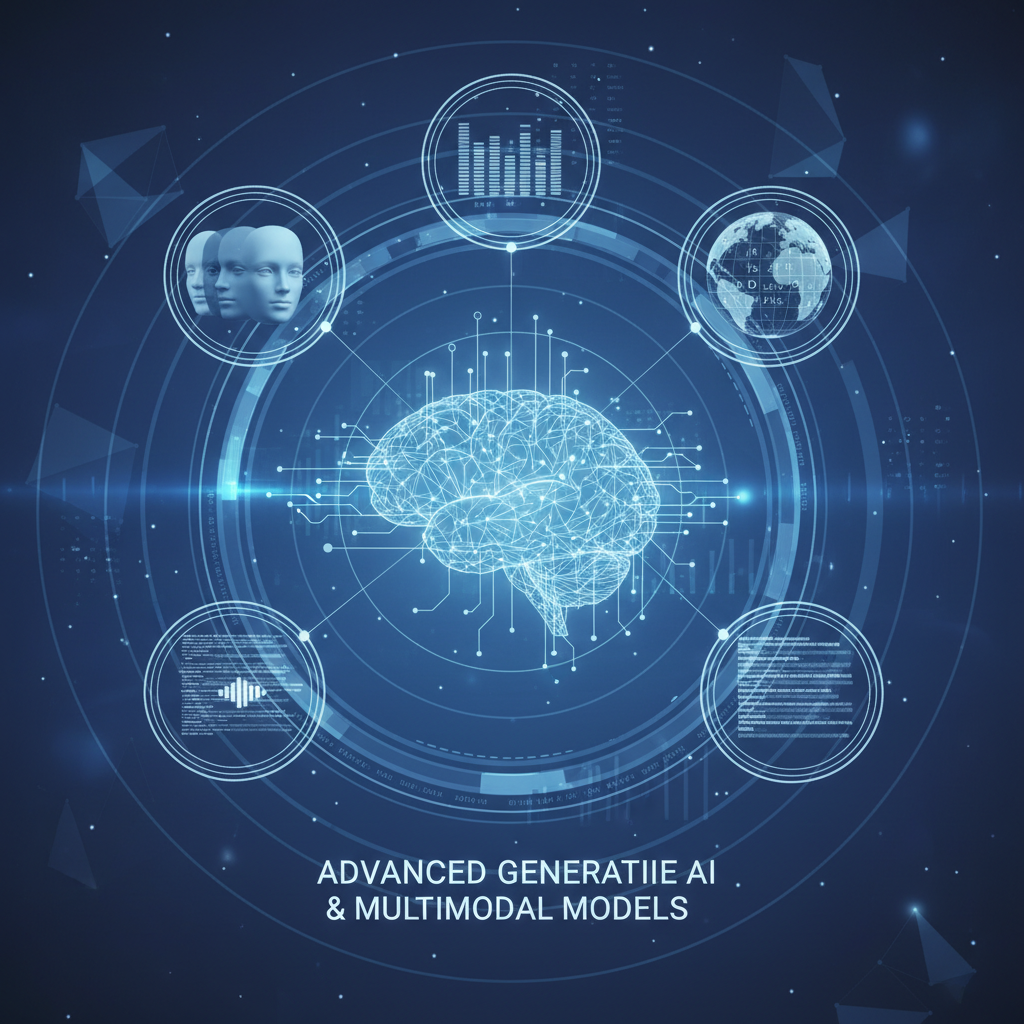
Generative AI has captivated the world, from crafting compelling text to generating stunning images. But what happens when these capabilities evolve beyond single data types? We’re diving into the exciting realm of Advanced Generative AI and Multimodal Models, where intelligence truly begins to mimic human understanding.
What Makes Generative AI “Advanced”?
While basic generative models can produce simple outputs, “advanced” typically refers to models that achieve higher levels of coherence, complexity, creativity, and contextual understanding. Think of the leap from simple text generation to large language models (LLMs) that can write entire essays, code, and engage in nuanced conversations. These models leverage vast datasets and sophisticated architectures to produce remarkably human-like or highly realistic outputs, pushing the boundaries of what AI can create.
The Power of Multimodal Models
Multimodal models are the next frontier. Unlike models that specialize in just text or just images, multimodal AI can process, understand, and generate information across multiple “modes” or data types simultaneously. Imagine an AI that can not only read a description but also generate a corresponding image, describe what it sees in a video, or even create a piece of music based on a textual prompt. By integrating different sensory inputs, these models gain a more holistic understanding of the world, much like humans do.
Real-World Applications and Impact
The implications of advanced generative AI and multimodal models are staggering. In creative fields, artists and designers are using text-to-image models (like DALL-E 3 or Midjourney) to rapidly prototype ideas. Text-to-video models (like Sora) promise to revolutionize filmmaking and content creation. In medicine, multimodal AI could analyze patient reports, medical images, and genomic data to provide more accurate diagnoses. For education, personalized learning experiences could be generated combining text, interactive visuals, and audio explanations. The ability to translate ideas seamlessly across different media unlocks unprecedented potential.
Challenges and the Road Ahead
While incredibly powerful, this technology isn’t without its hurdles. Training these advanced, multimodal models requires immense computational resources and colossal datasets. Ethical considerations are paramount, including issues of deepfakes, bias amplification, intellectual property, and responsible deployment. Researchers are actively working on making these models more efficient, controllable, and inherently safer. The future will likely see even more integrated understanding, personalized AI agents, and systems that can interact with the physical world in novel ways.
Advanced Generative AI and Multimodal Models are not just buzzwords; they represent a fundamental shift in how we interact with technology and how technology understands our world. As these models continue to evolve, they promise to unlock incredible new possibilities across every sector, inviting us to imagine a future where creativity and innovation know no bounds.
“`


Leave a Reply