
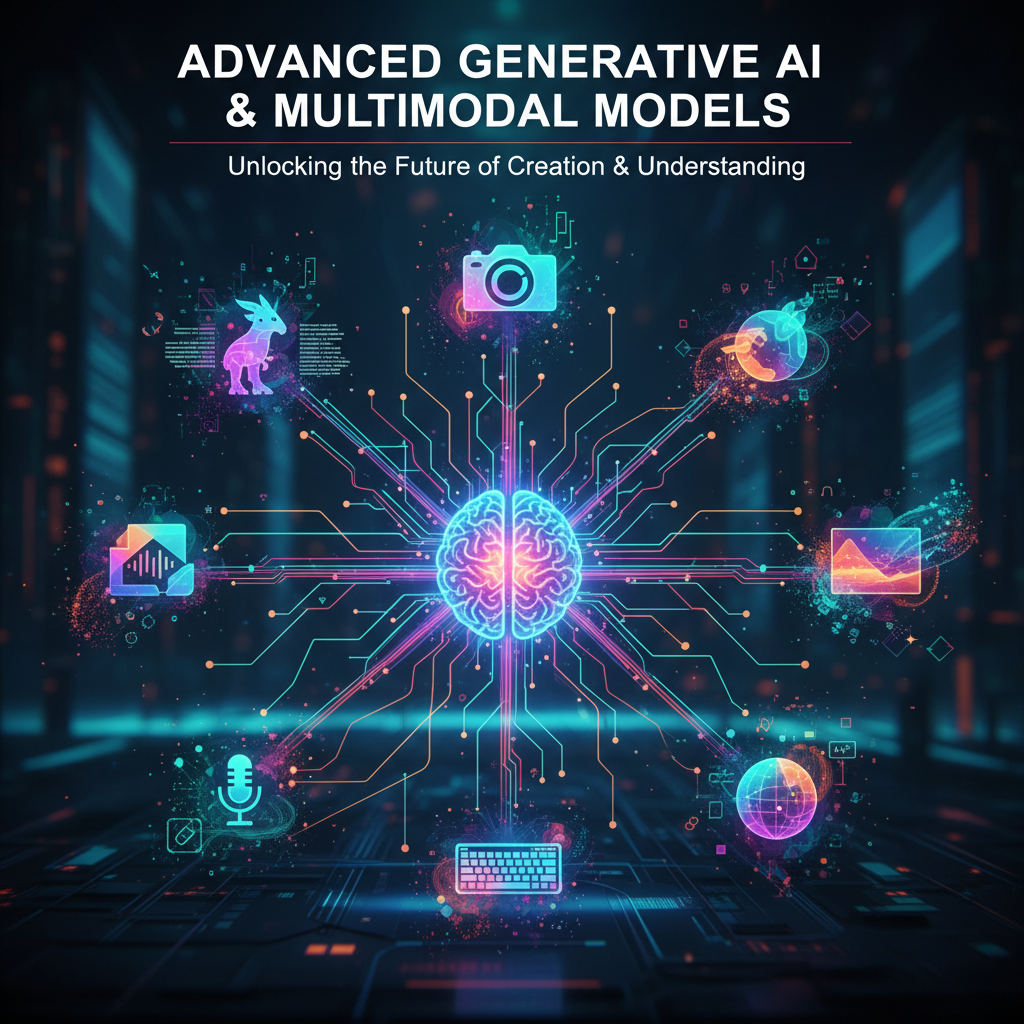
Beyond Text: The Multimodal AI Revolution
Welcome back to the blog! Today, we’re diving into one of the most exciting and rapidly evolving areas in artificial intelligence: Advanced Generative AI and Multimodal Models. Forget just generating text; we’re talking about AI that can understand, create, and interact across different types of data, opening up a universe of possibilities that were once purely sci-fi.
What is Advanced Generative AI?
You’ve likely heard of Generative AI through tools like ChatGPT or image generators. But “advanced” takes it a step further. We’re moving beyond simple pattern recognition to models that can grasp complex concepts, create highly coherent and contextually relevant outputs, and even learn to perform tasks with minimal examples. These models are not just remixing existing data; they’re synthesizing truly novel content, from intricate designs to sophisticated code, and even realistic simulations.
The “advanced” aspect also refers to their architecture – often larger, more efficiently trained, and capable of understanding deeper semantic relationships, allowing for greater creativity and accuracy in their generations. They can tackle more nuanced prompts and produce results that are remarkably human-like or even surpass human capabilities in specific creative domains.
The Power of Multimodal Models
This is where things get truly fascinating! Multimodal models are AI systems designed to process and understand information from multiple modalities simultaneously. Think about how humans perceive the world: we see, hear, read, and feel. A multimodal AI aims to mimic this by combining different data types like text, images, audio, video, and even 3D data.
For example, a multimodal model might analyze an image and its accompanying text description to generate a new, relevant image, or create an audio narrative for a video clip. This fusion of senses allows AI to build a much richer and more complete understanding of the world, leading to more intelligent, context-aware, and powerful applications. It’s about breaking down the silos between different data types and enabling AI to connect the dots in ways that were previously impossible.
Real-World Impact: Where Do We See This?
The applications of advanced generative AI and multimodal models are staggering and are already beginning to reshape various industries:
- Creative Arts: Generating stunning artwork, composing music, designing virtual worlds, and even co-creating stories with authors.
- Product Design & Engineering: Rapidly prototyping new product concepts, simulating materials, and optimizing designs based on visual and textual specifications.
- Scientific Discovery: Accelerating drug discovery by modeling molecular structures, analyzing complex biological images, and predicting material properties.
- Education & Accessibility: Creating personalized learning content (e.g., generating explanations for complex diagrams), or transforming visual content into audio descriptions for visually impaired users.
- Human-Computer Interaction: Enabling more natural and intuitive interfaces where you can interact with AI using speech, gestures, and text interchangeably.
Navigating the Future: Challenges & Ethical Considerations
While the potential is immense, it’s crucial to address the challenges. Advanced generative AI raises important questions about authenticity, intellectual property, and the potential for misuse (e.g., deepfakes or misinformation). Multimodal models, by their very nature, also require vast amounts of diverse data, which can exacerbate existing biases if not carefully curated and managed.
Ensuring responsible development, transparency in AI outputs, and robust ethical frameworks are paramount as these technologies become more integrated into our lives. It’s a collective responsibility to steer this powerful innovation towards beneficial outcomes for all.
The Road Ahead: Endless Possibilities
We are just at the beginning of understanding the full capabilities of advanced generative AI and multimodal models. As research continues to push boundaries, we can expect even more sophisticated, context-aware, and creative AI systems. Imagine an AI that can not only design a building but also simulate its structural integrity, energy efficiency, and even generate a realistic virtual walkthrough, all from a few natural language prompts.
The future of AI is undoubtedly multimodal and highly generative, promising a world where technology augments human creativity and problem-solving in unprecedented ways. It’s an exciting time to be alive and witness this revolution unfold!



Leave a Reply