The Next Frontier: Generative AI & Multimodal Models
Welcome back to the blog! Today, we’re diving deep into some of the most exciting advancements in artificial intelligence: Advanced Generative AI and Multimodal Models. These aren’t just buzzwords; they represent a fundamental shift in how AI understands, creates, and interacts with our world. Get ready to explore the cutting edge!
What Exactly Are We Talking About?
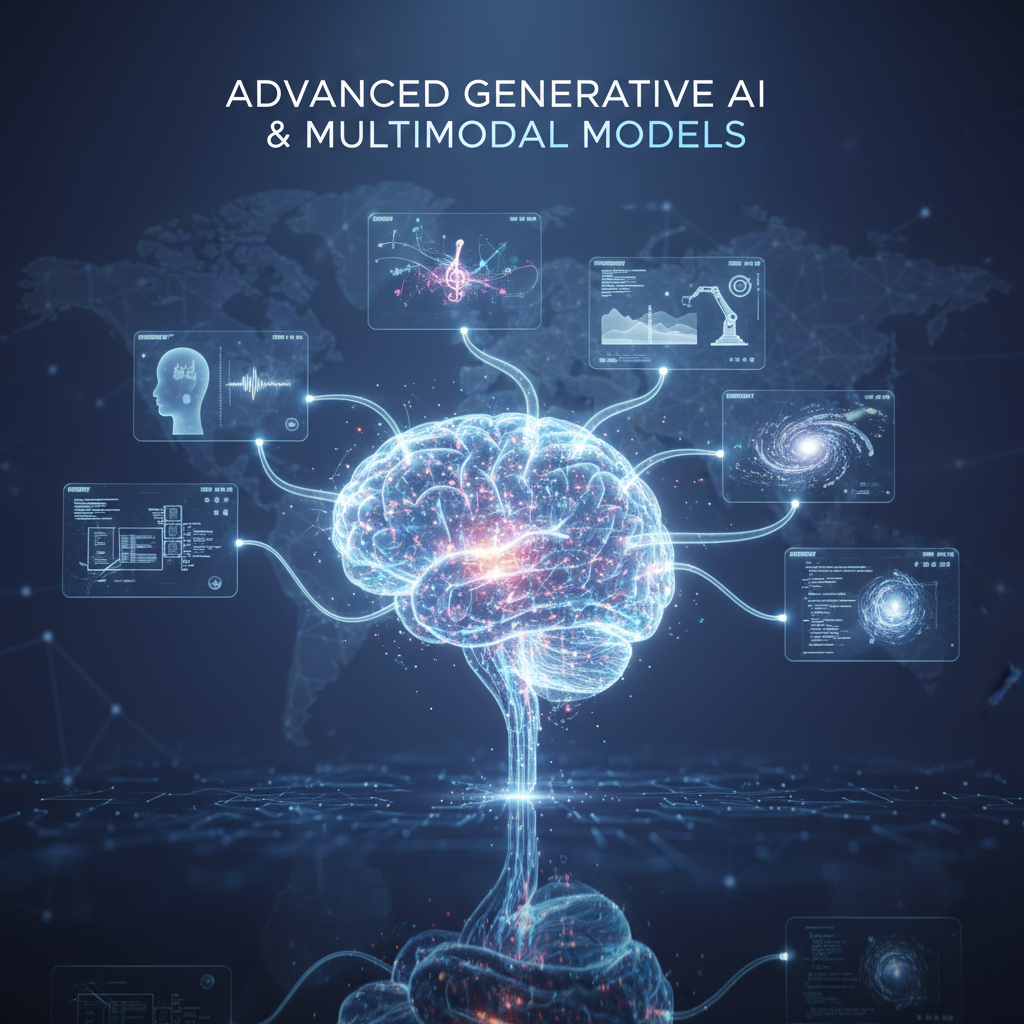
Generative AI, in its essence, is about creating something new. Think about tools that generate realistic images from text prompts (like DALL-E or Midjourney) or write compelling articles (like the one you’re reading!). When we add “advanced” to it, we’re looking at models with incredible scale, sophistication, and often, an ability to learn nuanced patterns from vast datasets.
Now, let’s bring in “multimodal.” While earlier AI models often specialized in one type of data – text, images, or audio – multimodal models break these barriers. They can process, understand, and generate content across multiple modalities simultaneously. Imagine an AI that can not only generate an image but also write a descriptive caption for it, narrate that caption, and even animate the image based on an audio input. That’s the power of multimodality!
Beyond Text: The Power of Multimodality
The ability to work with various data types is a game-changer. Here’s why:
- Richer Understanding: Humans perceive the world through sight, sound, touch, and more. Multimodal AI moves closer to this holistic understanding, processing complex relationships between different sensory inputs.
- Creative Synthesis: It enables unprecedented levels of creativity. An artist could describe a scene, and the AI generates a visual, composes accompanying music, and even writes a short story inspired by it – all from a single prompt.
- Enhanced Interaction: Think about virtual assistants that don’t just respond to your voice but also understand your gestures, interpret your emotions from facial expressions, and provide visual feedback.
Driving Technologies Behind the Magic
What makes these advanced models possible? Several key innovations:
- Transformer Architectures: These neural network designs, originally for language, have been adapted to handle sequences of various data types, proving incredibly effective for learning long-range dependencies across modalities.
- Diffusion Models: These models have revolutionized image and video generation, creating stunningly realistic and diverse outputs by iteratively refining noise into coherent data.
- Massive Datasets: The availability of vast, diverse datasets that include paired text-image, audio-video, or other multimodal combinations is crucial for training these complex systems effectively.
Real-World Applications & Future Outlook
The implications of advanced generative AI and multimodal models are profound and far-reaching:
- Content Creation: Revolutionizing media, entertainment, and advertising with automated generation of images, videos, music, and interactive experiences.
- Design & Engineering: Accelerating product design, architectural visualization, and even drug discovery by generating novel molecular structures.
- Education: Creating personalized learning materials that adapt to different learning styles, incorporating visual, auditory, and textual elements.
- Accessibility: Developing more intuitive and inclusive interfaces for individuals with disabilities, translating information across senses.
Of course, this exciting frontier also comes with its challenges, including ethical considerations, the potential for misuse, and the need for robust evaluation methods. However, the continuous innovation in this space promises a future where AI not only understands our world but actively helps us create a better, more imaginative one.
Join the Conversation!
What are your thoughts on advanced generative AI and multimodal models? Have you experimented with any of these tools? Share your insights in the comments below!
“`
Leave a Reply