
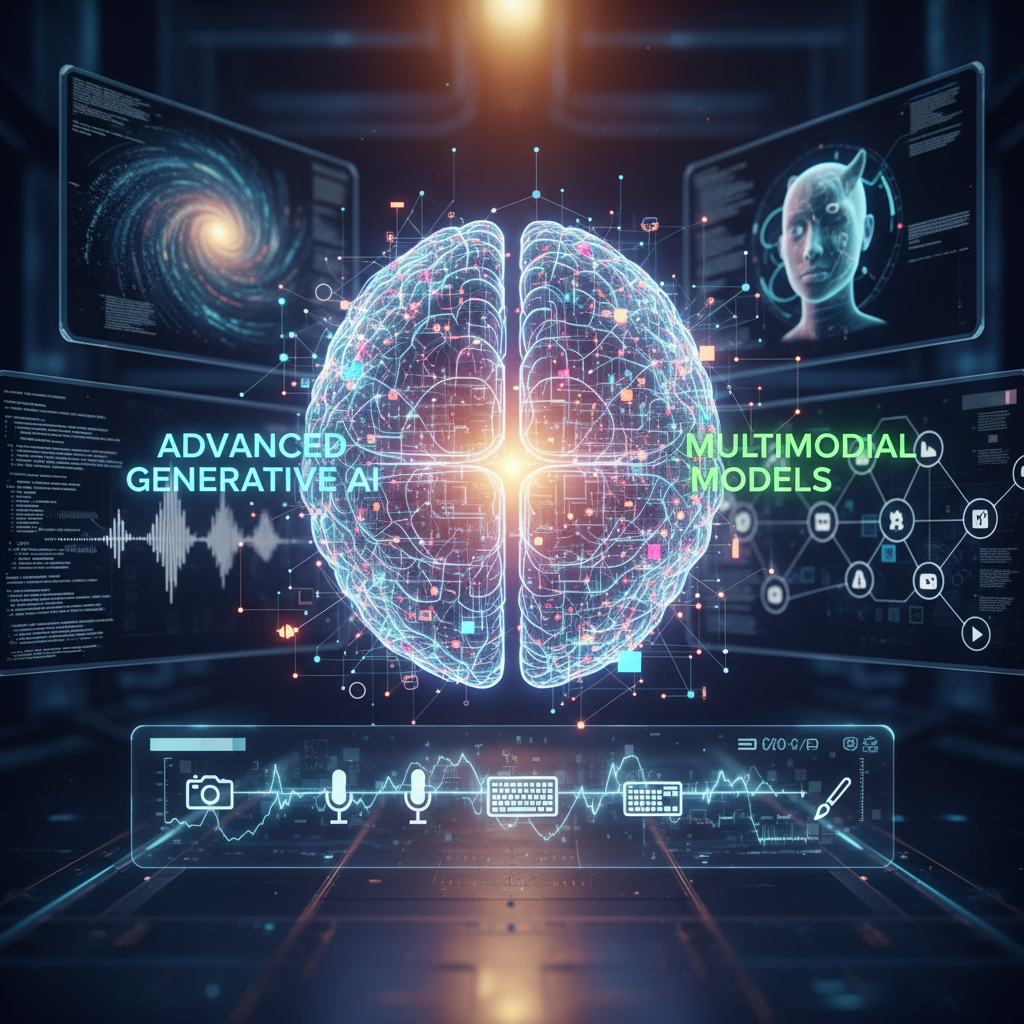
Unleashing Creativity: Advanced Generative & Multimodal AI
In the rapidly evolving world of artificial intelligence, generative models have already transformed how we create and interact with digital content. But what happens when these incredibly intelligent systems learn to speak not just one, but many “languages” – from text to images, audio, and beyond? Welcome to the exciting frontier of Advanced Generative AI and Multimodal Models!
Beyond Text: The Evolution of Generative AI
Remember the buzz around large language models (LLMs) like GPT-3, which could write essays, code, and even poetry? That was just the beginning. Advanced generative AI models today are pushing boundaries far beyond simple text completion. They’re developing a deeper contextual understanding, enabling more nuanced generations, and even demonstrating nascent forms of reasoning. These sophisticated models can generate incredibly realistic and coherent outputs across various data types, often based on complex prompts or diverse inputs.
The “advanced” aspect here refers to their ability to grasp subtle user intent, maintain long-range coherence in generated content, and sometimes even learn from a handful of examples (few-shot learning), making them incredibly versatile tools for innovation.
The Rise of Multimodal AI: A World of Senses
If generative AI is about creating, multimodal AI is about understanding and interacting with the world as we do—through multiple senses. A multimodal model is designed to process, interpret, and generate information from more than one modality. Think of it: text and images, text and audio, video and text, or even combining all three.
Instead of a model that only understands text or only recognizes images, a multimodal model can:
- Describe an image in detailed text.
- Generate a photorealistic image from a text description.
- Synthesize speech that matches an emotional tone conveyed in text.
- Create a video sequence based on a script and specific visual cues.
This ability to seamlessly switch between different types of data dramatically enhances an AI’s comprehension of the real world, which is inherently multimodal.
The Synergy: Where Advanced Generative Meets Multimodal
The real magic happens when advanced generative capabilities are combined with multimodal understanding. This isn’t just about a model generating an image *or* generating text; it’s about a single, integrated system that can generate coherent, high-quality content *across* modalities, often simultaneously or in sequence, maintaining a deep understanding of the underlying context.
Imagine a model that takes a simple text prompt like “a futuristic city at sunset with flying cars” and generates not only a stunning image but also a descriptive text narration for it, and perhaps even a short musical score that evokes the atmosphere. This holistic generation—where different outputs are consistent and complementary—is the hallmark of advanced generative multimodal models. They represent a significant leap towards AI that can truly “think” and “create” in a more human-like, interconnected way.
Transformative Applications and Impact
The implications of these powerful models are vast and diverse, spanning numerous industries:
- Creative Arts & Entertainment: Generating entire short films from scripts, personalized music compositions, or concept art for games and movies.
- Education: Creating dynamic, interactive learning materials that adapt to different learning styles by presenting information visually, audibly, and textually.
- Content Creation & Marketing: Automating the generation of entire marketing campaigns, complete with ad copy, images, and video snippets tailored to specific demographics.
- Accessibility: Automatically generating rich, detailed descriptions for images and videos for visually impaired users, or translating sign language into spoken word and vice-versa.
- Product Design: Rapidly prototyping designs by generating 3D models from sketches or natural language descriptions.
These models promise to democratize creativity and significantly boost productivity across many sectors.
Navigating Challenges and Glimpsing the Future
While incredibly promising, this field still faces challenges. Training such sophisticated models requires immense computational resources and vast, high-quality multimodal datasets. Ensuring ethical deployment, addressing biases present in training data, and developing robust methods for evaluating the coherence and quality of multimodal outputs are critical ongoing efforts.
Looking ahead, we can anticipate even more intuitive user interfaces, models with greater few-shot and zero-shot learning capabilities across modalities, and closer integration with robotics for physical world interaction. The future of AI is increasingly multimodal, bringing us closer to systems that can understand and interact with our complex world in truly profound ways.
Advanced generative AI and multimodal models are not just technological marvels; they are powerful tools shaping a future where creativity is unbounded and human-computer interaction becomes more natural and intuitive than ever before. It’s an exciting time to witness and participate in this incredible evolution!
“`


Leave a Reply