Beyond Text: Exploring Advanced Generative & Multimodal AI
The world of Artificial Intelligence is evolving at a breathtaking pace, and at the forefront of this revolution are Advanced Generative AI and Multimodal Models. Forget simple chatbots; we’re now talking about systems that can create, understand, and interact with the world in incredibly sophisticated ways. Let’s dive into what makes these technologies so groundbreaking and what they mean for our future.
What Are Advanced Generative AI Models?
Generative AI has moved far beyond just completing sentences. Advanced generative models are sophisticated algorithms capable of producing highly realistic and novel content across various domains. Think about AI that can write a compelling short story, compose an original piece of music, design architectural blueprints, or even generate functional code – all with remarkable coherence and creativity.
These models leverage deep learning techniques, often built upon transformer architectures, allowing them to learn complex patterns and relationships within vast datasets. This enables them to not just mimic existing data but to extrapolate, synthesize, and create entirely new outputs that are often indistinguishable from human-created content.
The Power of Multimodal Models
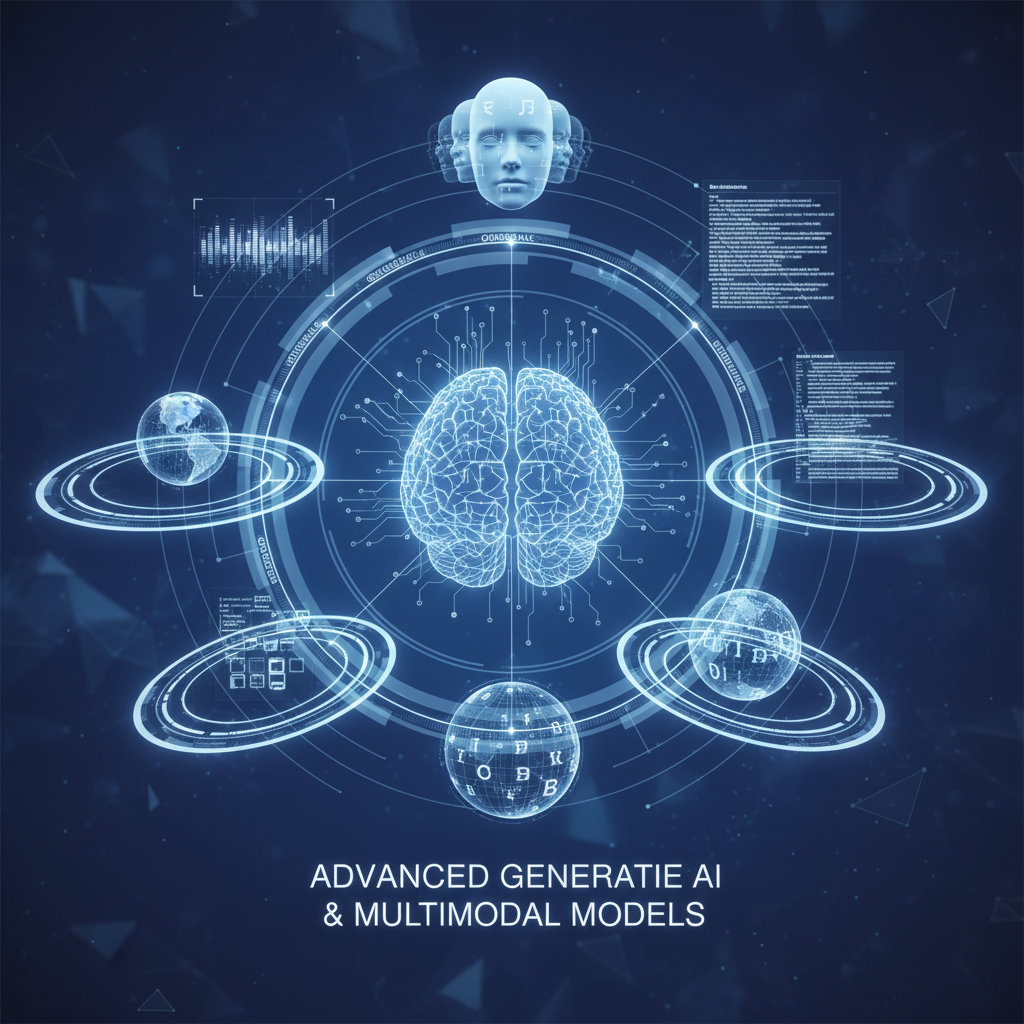
While advanced generative AI is impressive on its own, its true potential explodes when it becomes “multimodal.” Multimodal models are AI systems that can process, understand, and generate content across multiple types of data simultaneously. This means they can handle text, images, audio, video, and even sensor data, all within a single integrated framework.
Imagine an AI that can:
- Describe a complex image in detailed, natural language.
- Generate a video from a text prompt and an audio description.
- Create a song based on a visual scene and a lyrical theme.
- Answer questions about a document that contains both text and diagrams.
This ability to bridge different modalities allows AI to grasp a more holistic understanding of information, mirroring how humans perceive and interact with the world through multiple senses.
Real-World Applications and Impact
The implications of advanced generative and multimodal AI are vast and exciting, touching numerous industries and aspects of daily life:
- Creative Industries: Revolutionizing content creation for artists, writers, musicians, and filmmakers, offering new tools for inspiration and production.
- Education: Personalized learning experiences, interactive educational content, and AI tutors that can explain concepts using text, images, and audio.
- Healthcare: Assisting in drug discovery, generating synthetic medical data for research, and creating personalized treatment plans.
- Accessibility: Enhancing tools for individuals with disabilities, such as more sophisticated text-to-speech, speech-to-text, and visual description generators.
- Research & Development: Accelerating scientific discovery by generating hypotheses, designing experiments, and analyzing complex datasets.
Challenges and the Road Ahead
While the capabilities are astounding, these models also present challenges. Ethical considerations around data bias, the potential for misuse (e.g., deepfakes), intellectual property rights, and the sheer computational power required for training are all crucial areas of ongoing discussion and research. Ensuring responsible development and deployment is paramount.
Looking forward, we can expect even more seamless integration of modalities, further improvements in creativity and coherence, and a deeper understanding of human intent. The journey into advanced generative and multimodal AI is just beginning, promising a future filled with innovative possibilities.
Join the Conversation!
What excites you most about advanced generative AI and multimodal models? What applications do you envision? Share your thoughts in the comments below!
“`

Leave a Reply