
Beyond Text: The Multimodal AI Revolution
Welcome to the forefront of artificial intelligence! We’re moving past the era where AI models only understood text or images in isolation. The future is here, and it’s vibrant, dynamic, and incredibly intelligent: it’s all about Advanced Generative AI and Multimodal Models.
Unveiling Advanced Generative AI & Multimodal Models
Generative AI has captivated the world by creating new, original content – from compelling stories and code to stunning artwork and music. These models learn patterns from vast datasets and then use that knowledge to generate novel outputs that often mimic human creativity. Think of tools like DALL-E creating images from text descriptions, or advanced language models crafting entire articles.
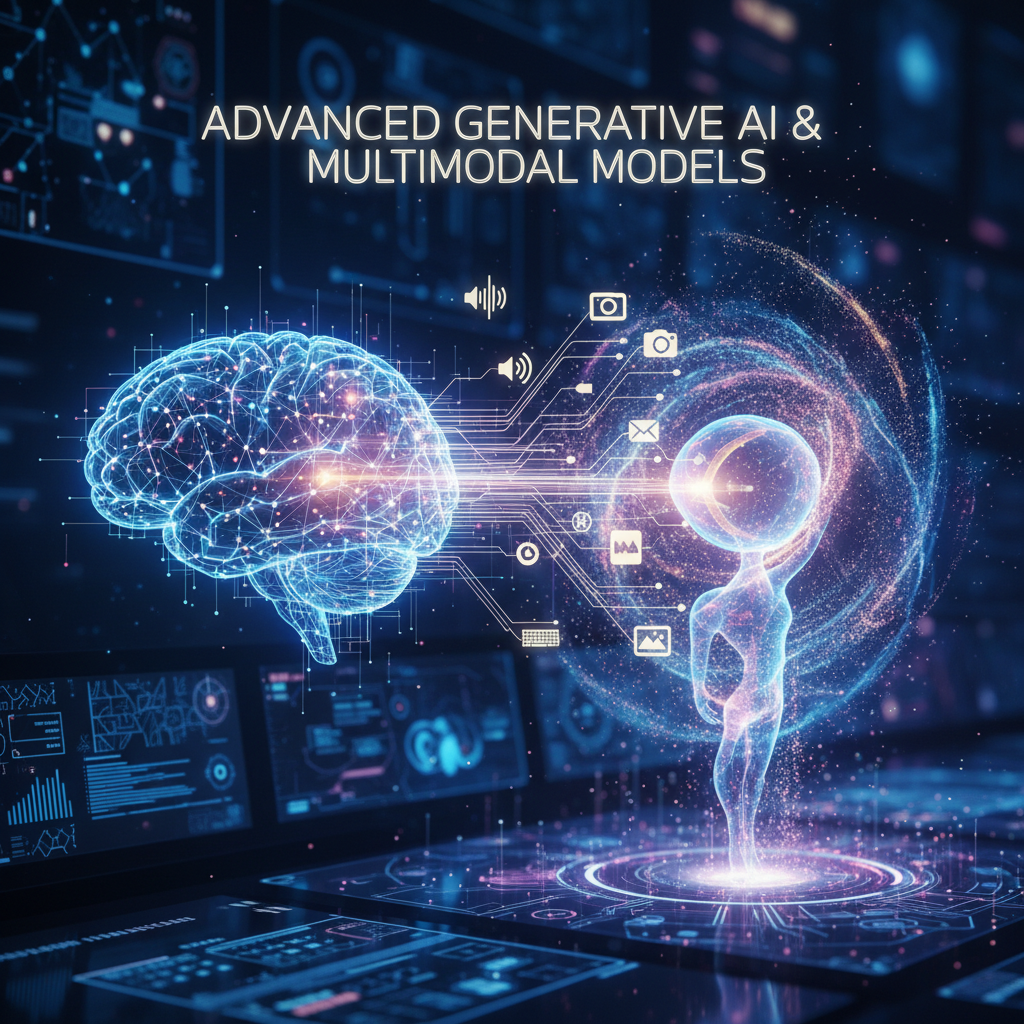
Now, imagine taking that generative power and extending it beyond a single data type. That’s where multimodal models come in. Instead of just processing text OR images OR audio, these cutting-edge models can understand, interpret, and generate content across multiple modalities simultaneously. They see the world more like we do, integrating different sensory inputs to form a richer, more comprehensive understanding.
Why Multimodality Matters: A Symphony of Data
The real world isn’t a collection of isolated data streams; it’s a rich tapestry of sights, sounds, text, and interactions. Traditional AI often struggled with this complexity, excelling in one domain but failing to connect the dots across others. Multimodal AI bridges these gaps, offering several profound advantages:
- Deeper Understanding: By combining information from text and images, for example, an AI can grasp nuances that neither modality could convey alone. A picture of a “dog” paired with text describing its “playful bark” creates a much richer context.
- Enhanced Creativity: These models can generate content that seamlessly blends different forms, like an AI creating an image based on a description and then generating an accompanying musical score or voiceover.
- More Natural Interaction: Future human-AI interactions will feel more intuitive, allowing us to communicate using speech, gestures, text, and visual cues, much like we interact with other humans.
- Robustness: If one modality has missing or noisy data, the model can leverage information from other modalities to compensate, leading to more resilient and accurate performance.
Pioneering Applications & Breakthroughs
The impact of advanced generative AI and multimodal models is already being felt across various sectors:
- Content Creation: From generating entire video scripts and storyboards to designing marketing campaigns complete with images, text, and voiceovers, content creation is becoming supercharged.
- Accessibility: Describing complex images for visually impaired users with richer, context-aware descriptions; translating sign language into speech and vice versa.
- Education: Creating interactive learning materials that adapt to a student’s preferred modality (visual, auditory, textual) or generating personalized explanations combining diagrams and descriptive text.
- Healthcare: Assisting doctors by analyzing medical images (X-rays, MRIs) alongside patient notes and historical data to provide more comprehensive diagnostic support.
- Robotics & Autonomous Systems: Enabling robots to better understand their environment through a fusion of visual, auditory, and haptic (touch) data, leading to safer and more intelligent interactions.
Models like OpenAI’s GPT-4, Google’s Gemini, and various research projects are pushing the boundaries, demonstrating incredible feats of understanding and generation across text, image, audio, and even video.
Navigating the Road Ahead: Challenges & Ethics
While the potential is immense, the journey isn’t without its hurdles. Multimodal models require vast computational resources and enormous, diverse datasets to train effectively. Ensuring these datasets are free from biases is a critical challenge, as biases can lead to unfair or inaccurate outputs.
Ethical considerations are paramount. We must address questions around the responsible use of AI-generated content, copyright issues, the potential for deepfakes, and the impact on employment. Developers and policymakers are working diligently to establish guidelines and frameworks that promote beneficial and ethical AI development.
The Future is Integrated: A Human-AI Collaboration
The era of advanced generative AI and multimodal models is not just about creating smarter machines; it’s about fostering new forms of creativity, problem-solving, and human-computer interaction. These models aren’t replacing human ingenuity; they’re amplifying it, offering powerful tools that can help us explore new frontiers and solve complex challenges in ways previously unimaginable.
As these models continue to evolve, we can look forward to a future where AI understands and interacts with our complex world in a truly holistic manner, making technology feel more intuitive, helpful, and integrated into our daily lives. The revolution has just begun, and it promises to be a fascinating ride!
“`



Leave a Reply