Beyond Text: The Magic of Multimodal AI
Welcome back, tech enthusiasts! Today, we’re diving deep into one of the most exciting frontiers of artificial intelligence: advanced generative AI and multimodal models. If you thought AI was just about generating text, prepare to have your mind blown!
Generative AI: A Quick Refresher
Before we jump into the ‘multimodal’ magic, let’s quickly recap generative AI. At its core, generative AI refers to systems capable of creating new, original content – be it text, images, audio, or even code – that mimics the style and patterns of the data it was trained on. Think large language models (LLMs) like GPT-3 or GPT-4, which can write essays, answer questions, and even compose poetry.
Enter Multimodal Models: The Game Changer
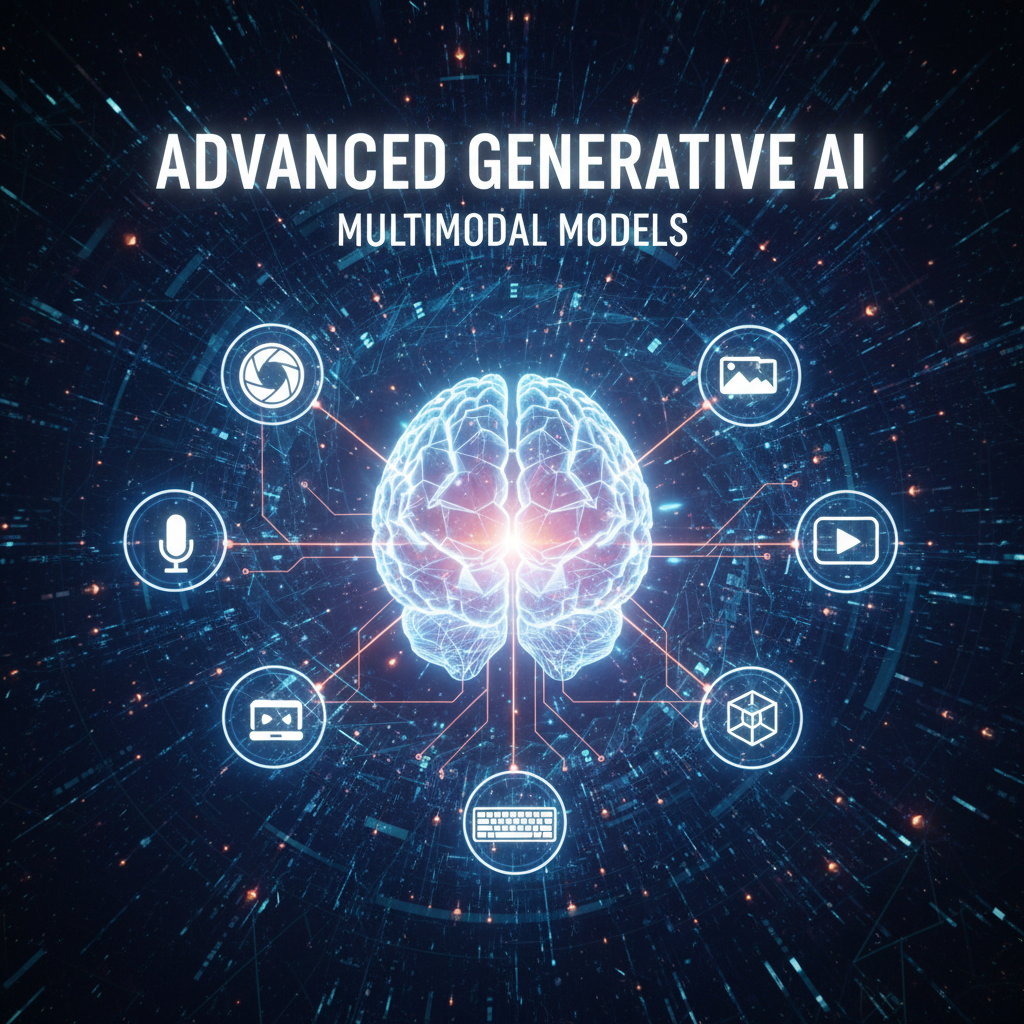
Here’s where things get really interesting! ‘Multimodal’ simply means that these AI models can process and generate content across multiple types of data simultaneously. Instead of just understanding text, a multimodal AI can comprehend and generate based on text, images, audio, video, and even 3D data, all at once. Imagine an AI that doesn’t just read about a cat but can also see one, hear its meow, and then describe it perfectly in text or even generate a new image of a cat!
This capability to seamlessly integrate and interpret different forms of information allows for a much richer and more human-like understanding of the world. It’s a huge leap towards AI systems that can interact with us in more natural and intuitive ways.
How They Work: A Glimpse Behind the Curtain
While the inner workings are complex, the basic idea is that these models are trained on massive datasets containing paired or related multimodal information. For instance, images with descriptive captions, or videos with spoken narratives. They learn to find common representations and relationships across these different modalities, allowing them to translate from one form to another, or generate entirely new combinations.
Architectures like advanced Transformers, often seen in LLMs, are being adapted and extended to handle this complex interplay of different data types, creating a unified understanding across varied inputs.
Real-World Applications & Impact
The applications for advanced generative AI and multimodal models are truly mind-bending:
- Text-to-Image/Video Generation: Describe a scene, and the AI generates stunning visuals or dynamic video clips. (Think DALL-E, Midjourney, Stable Diffusion).
- AI Assistants: More intelligent virtual assistants that can understand not just your voice commands but also the context from your screen or camera.
- Content Creation: Revolutionizing advertising, entertainment, and design by creating highly personalized and diverse content almost instantly.
- Healthcare: Generating synthetic medical images for training, or assisting in diagnoses by correlating visual data with patient records.
- Education: Creating interactive learning materials that adapt to a student’s preferred modality (visual, auditory, textual).
The Road Ahead: Challenges & Opportunities
As with any powerful technology, there are challenges. Ensuring ethical use, mitigating biases present in training data, and developing robust safety mechanisms are paramount. The computational resources required are also immense.
However, the opportunities for innovation are boundless. Multimodal AI promises to unlock new levels of creativity, efficiency, and human-computer interaction, pushing the boundaries of what we thought possible with artificial intelligence.
Conclusion
Advanced generative AI and multimodal models are not just incremental improvements; they represent a paradigm shift in how AI understands and interacts with our complex world. They are building bridges between different forms of information, leading us towards an AI future that is richer, more intuitive, and infinitely more creative. So, stay curious, experiment responsibly, and get ready for the multimodal revolution!

Leave a Reply