
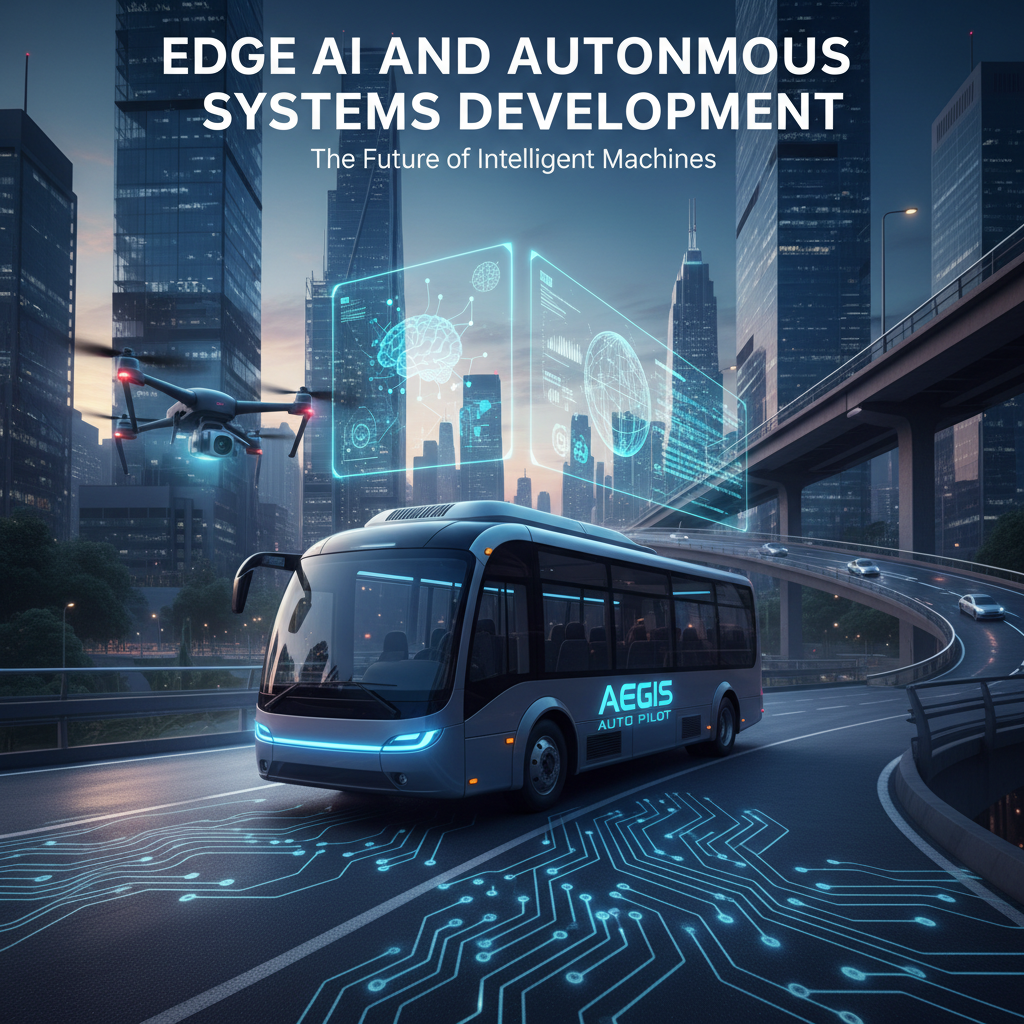
Edge AI & Autonomous Systems: Building the Future
The world around us is becoming increasingly intelligent and interconnected. From self-driving cars navigating our streets to smart factories optimizing production, autonomous systems powered by Artificial Intelligence are redefining what’s possible. But often, the real magic isn’t happening in distant cloud servers; it’s happening right at the source, on the “edge.” Welcome to the exciting realm of Edge AI and Autonomous Systems development!
What is Edge AI and Why Does it Matter?
Traditionally, AI processing required sending vast amounts of data to powerful cloud data centers for analysis. While effective, this approach can introduce latency, consume significant bandwidth, and raise privacy concerns. Edge AI flips this model on its head.
Edge AI refers to the deployment of AI algorithms directly on local devices, sensors, or gateways—the “edge” of the network. This means data is processed where it’s created, leading to lightning-fast decision-making, reduced reliance on constant connectivity, enhanced data privacy, and lower operational costs. Imagine a security camera that can identify an intruder in real-time without sending every frame to the cloud, or a drone making immediate navigation adjustments based on onboard sensor data.
The Autonomous Systems Revolution
Autonomous systems are entities that can perform tasks with a high degree of independence, often making decisions and adapting to environments without constant human intervention. These systems range from the complex (like robotic surgical assistants) to the everyday (like smart thermostats learning your preferences).
Edge AI is the bedrock for truly autonomous systems. By enabling real-time, on-device intelligence, it empowers these systems to react instantaneously to their surroundings, handle unpredictable situations, and operate reliably even in remote or disconnected environments. This synergy is unlocking incredible potential across various industries, from logistics and healthcare to agriculture and personal robotics.
Key Development Challenges & Opportunities
Developing for Edge AI and autonomous systems comes with its unique set of challenges and exciting opportunities:
- Resource Constraints: Edge devices often have limited processing power, memory, and battery life. Developers must optimize AI models to be lightweight yet accurate.
- Security & Privacy: Protecting data and AI models deployed on distributed edge devices is paramount.
- Connectivity & Robustness: Ensuring systems can operate effectively in varying network conditions, including intermittent connectivity.
- Interdisciplinary Skills: Success requires a blend of machine learning expertise, embedded systems knowledge, and a deep understanding of the specific application domain.
Despite these hurdles, the opportunities are immense. We’re seeing innovation in specialized hardware (like AI accelerators), new software frameworks for model optimization, and novel approaches to distributed AI. The demand for skilled professionals in this space is booming, offering a chance to build the next generation of intelligent machines.
Getting Started with Edge AI & Autonomous Systems
Curious to dive in? Here are a few ways to begin your journey:
- Explore Frameworks: Get familiar with tools like TensorFlow Lite, PyTorch Mobile, OpenVINO, or NVIDIA’s Jetson platform, which are designed for edge deployment.
- Hardware Platforms: Experiment with single-board computers like Raspberry Pi, NVIDIA Jetson Developer Kits, or Google Coral devices.
- Learn Core Concepts: Understand model quantization, pruning, and neural network architecture search (NAS) for optimizing models.
- Build Small Projects: Start with simple projects like object detection on a local camera feed or an automated smart home task.
The Future is On the Edge
The convergence of Edge AI and autonomous systems is not just a technological trend; it’s a fundamental shift in how we build and interact with intelligent technology. It promises a future where devices are smarter, more responsive, and more integrated into our lives, enhancing safety, efficiency, and convenience. The developers working in this field today are truly shaping tomorrow’s world, one intelligent edge device at a time. Are you ready to be part of the revolution?
“`



Leave a Reply