
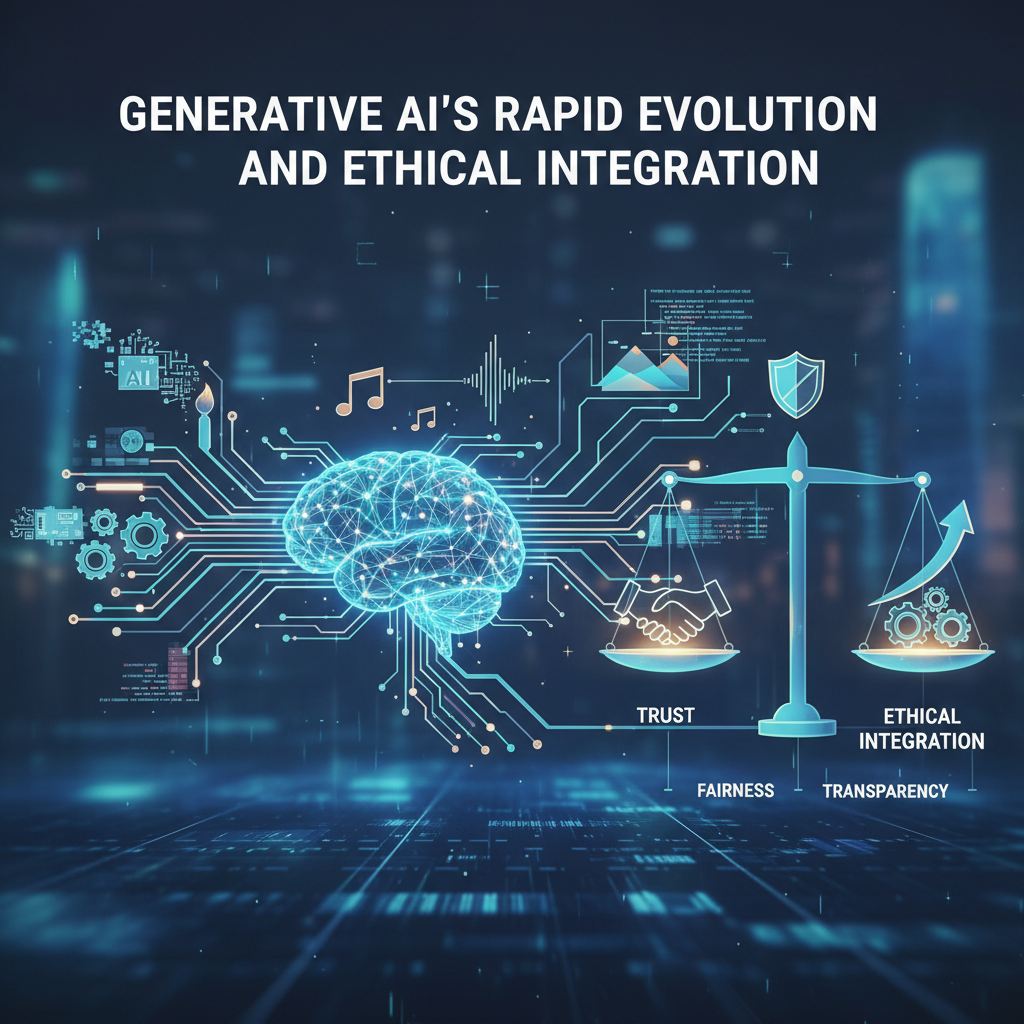
Navigating Generative AI’s Fast Lane Ethically
It feels like just yesterday we were marveling at AI generating simple text, and today, it’s composing symphonies, designing buildings, and writing complex code. Generative AI is undoubtedly one of the most transformative technologies of our time, evolving at a breathtaking pace. But with great power and speed comes great responsibility. How do we keep up, and more importantly, how do we ensure this revolution is guided by ethics?
The Incredible Speed of Innovation
From large language models (LLMs) that can hold surprisingly human-like conversations to tools that create photorealistic images, compelling videos, and even novel proteins, Generative AI’s capabilities are expanding at an exponential rate. Researchers and developers are pushing boundaries daily, leading to incredible advancements in creativity, efficiency, and problem-solving across countless industries. This rapid evolution promises a future where AI can amplify human potential in ways we’re only just beginning to imagine.
Why Ethical Integration Isn’t Optional
As Generative AI becomes more sophisticated and integrated into our daily lives, the “how” we use it becomes as important as the “what” it can do. Without a strong ethical framework, we risk exacerbating existing societal biases, spreading misinformation, infringing on intellectual property, and even eroding trust in digital content. Ethical integration isn’t a hurdle; it’s the foundation upon which sustainable, beneficial AI growth must be built.
Key Pillars for Responsible Development
To navigate this exciting yet complex landscape, we need to focus on several critical ethical considerations:
Transparency & Explainability: Users should understand when they are interacting with AI, and developers should strive to make AI’s decision-making processes as transparent as possible, especially in sensitive applications.
Bias Mitigation: AI models learn from vast datasets, which often reflect existing societal biases. Rigorous efforts are needed to identify, measure, and mitigate these biases to ensure fair and equitable outcomes for all.
Data Privacy & Security: The data used to train and operate Generative AI models must be handled with the utmost care, adhering to strict privacy regulations and robust security protocols.
Accountability & Governance: Clear lines of accountability must be established for AI’s outputs. Who is responsible when an AI system makes an error or causes harm? This requires thoughtful policies and governance structures.
Human Oversight & Collaboration: While AI can automate many tasks, human insight, judgment, and ethical reasoning remain indispensable. The goal should be augmentation, not replacement, fostering collaboration between humans and AI.
Towards a Collaborative, Ethical Future
The journey of Generative AI’s rapid evolution and ethical integration is a collective one. It requires ongoing dialogue and collaboration among technologists, ethicists, policymakers, businesses, and the public. By fostering education, developing robust standards, and prioritizing human values in every stage of development, we can harness the incredible power of Generative AI to create a future that is not just innovative, but also fair, safe, and beneficial for everyone.
Let’s embrace this new era with optimism and a commitment to building AI responsibly, ensuring its rapid evolution serves humanity’s best interests.



Leave a Reply