
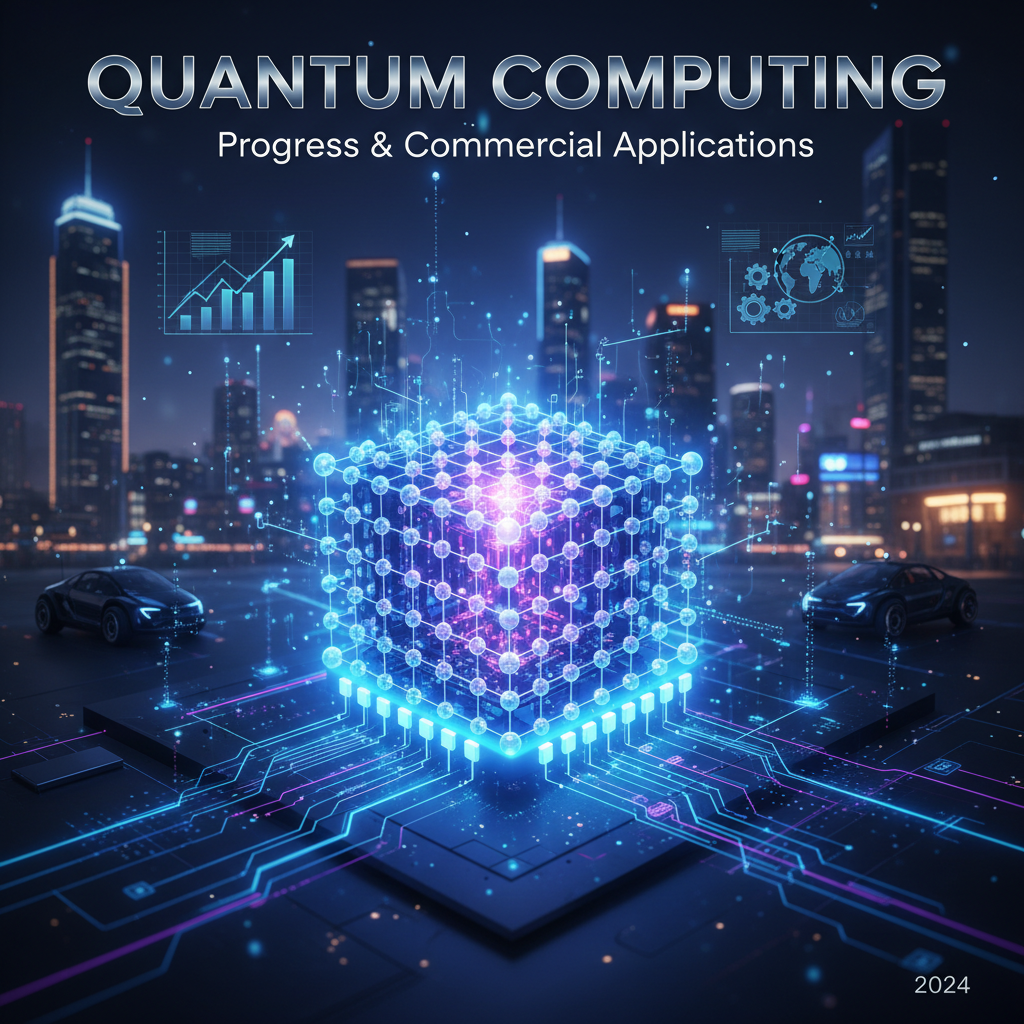
Quantum Leaps: From Lab to Commercial Reality
Hey there, fellow tech enthusiasts! Have you ever wondered what the buzz around quantum computing is all about? It sounds like something straight out of a sci-fi movie, but believe it or not, this revolutionary technology is making incredible progress and starting to find its footing in the commercial world. Let’s dive in and demystify the exciting advancements and where we might see quantum power at work soon!
The Current State of Quantum Progress
Just a few years ago, quantum computers were mostly theoretical concepts or highly experimental lab setups. Today, we’re seeing tangible improvements in hardware, software, and error correction techniques. Companies like IBM, Google, Quantinuum, and Rigetti are pushing the boundaries, increasing the number of stable qubits and improving their coherence times – essentially, making them more powerful and reliable for longer periods. We’re moving beyond simple demonstrations to tackling more complex problems, albeit still on a relatively small scale.
A key metric, “Quantum Volume,” has seen impressive growth, indicating more powerful and accurate quantum processors. While a full-blown fault-tolerant quantum computer is still some years away, the “Noisy Intermediate-Scale Quantum” (NISQ) era is allowing us to experiment with machines that, while imperfect, can still offer insights into real-world challenges.
Emerging Commercial Applications
So, where will all this mind-bending power actually be used? The potential applications are vast and could disrupt several industries. Here are some of the most promising areas:
1. Drug Discovery and Materials Science
Imagine designing new drugs or materials at the atomic level, predicting their properties with unprecedented accuracy. Quantum computers can simulate molecular interactions far more effectively than classical supercomputers, potentially accelerating the discovery of life-saving medicines, more efficient catalysts, or even novel materials for sustainable energy.
2. Financial Modeling and Optimization
The financial sector is ripe for quantum disruption. Complex tasks like portfolio optimization, fraud detection, and risk analysis involve processing massive datasets and intricate calculations. Quantum algorithms could analyze market fluctuations, identify hidden patterns, and optimize investment strategies with speed and precision currently impossible, leading to better financial decisions and more stable markets.
3. Logistics and Supply Chain Optimization
From routing delivery trucks to managing global supply chains, optimization problems are everywhere. Quantum algorithms are uniquely suited to solve these “traveling salesman problem” variants faster. This could lead to massive efficiencies, reducing fuel consumption, cutting delivery times, and streamlining operations for businesses worldwide.
4. Artificial Intelligence and Machine Learning
Quantum computing has the potential to supercharge AI. Quantum Machine Learning (QML) could enhance pattern recognition, improve training times for complex neural networks, and enable AI to tackle problems currently beyond its reach. Think more accurate medical diagnostics, smarter autonomous systems, and highly personalized experiences.
5. Cybersecurity
While quantum computers pose a theoretical threat to current encryption methods (like RSA), they also offer solutions. Quantum cryptography promises truly unhackable communication, and quantum-resistant algorithms are being developed to safeguard our digital world against future quantum attacks.
The Road Ahead: Hybrid Approaches and Accessibility
It’s important to note that quantum computers won’t replace classical computers overnight. Instead, we’re likely to see a “hybrid” approach where classical systems handle most tasks, offloading specific, computationally intensive problems to quantum processors. Tools like IBM’s Qiskit and Google’s Cirq are making quantum programming more accessible, allowing developers and researchers to experiment and build applications even without owning a quantum computer.
The journey from quantum physics lab to mainstream commercial tool is long and filled with challenges, from error correction to scaling. However, the consistent progress and the burgeoning interest from major industries signal that quantum computing is no longer just a futuristic dream – it’s an emerging reality with immense potential to reshape our world.
What excites you most about the future of quantum computing? Let us know in the comments!
“`


Leave a Reply