
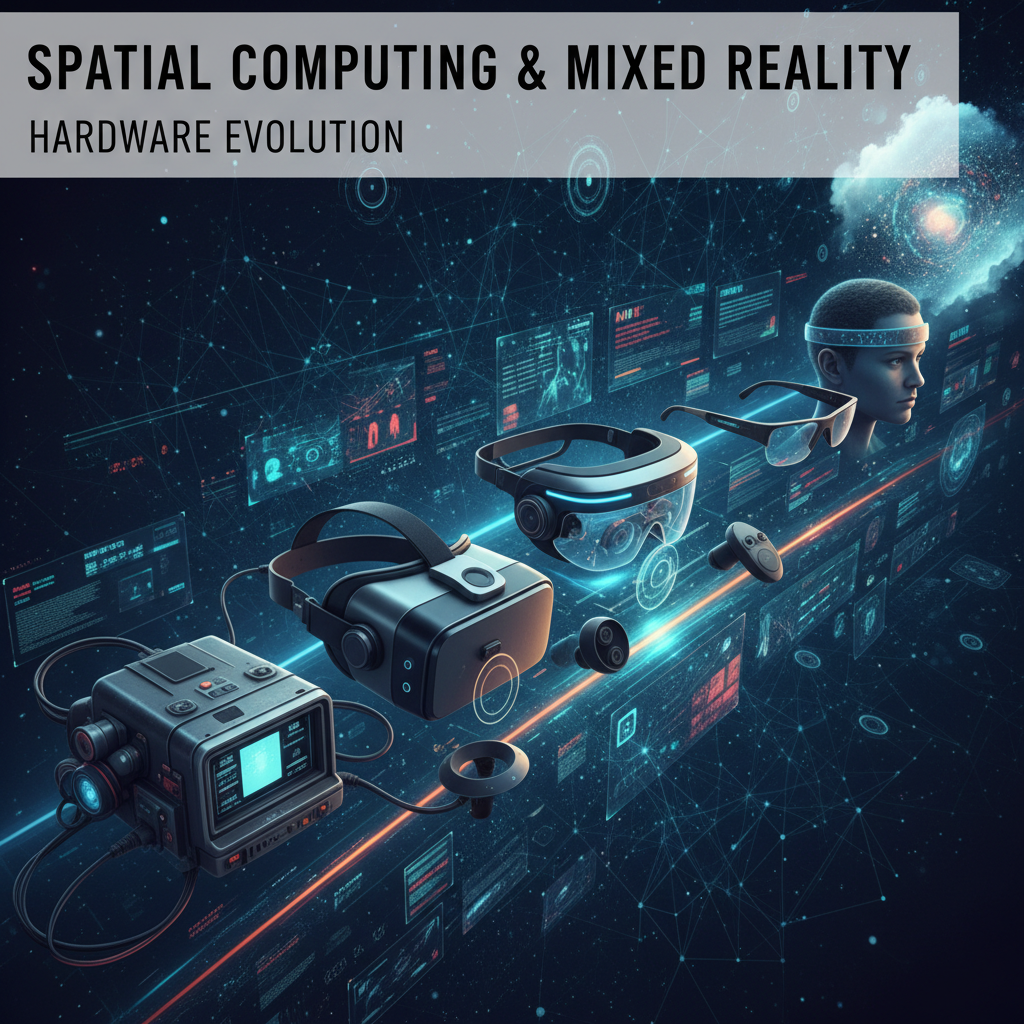
Spatial Computing Hardware: A Journey to Tomorrow
Hello there, tech enthusiasts! Have you ever imagined interacting with digital information seamlessly integrated into your physical world? That’s the promise of Spatial Computing and Mixed Reality (MR). It’s a field rapidly evolving, and nowhere is this more evident than in the incredible progress of the hardware that makes it all possible. Let’s take a fascinating look at how these devices have transformed from clunky prototypes to sophisticated tools shaping our future.
The Early Seeds: Visionary Beginnings
The concept of blending digital with reality isn’t new. Pioneers like Ivan Sutherland’s “The Ultimate Display” in the 1960s laid the foundational ideas, albeit with hardware that required users to be tethered to massive computing rigs. For decades, the technology remained largely in research labs, military applications, and industrial settings due to its sheer cost, size, and computational demands. Think bulky head-mounted displays (HMDs) with limited fields of view and even more limited processing power – a far cry from what we see today!
The Dawn of Consumer Awareness: VR Takes the Stage
The early 2010s saw a significant shift with the re-emergence of Virtual Reality (VR), particularly spearheaded by companies like Oculus. While not strictly Mixed Reality, consumer VR headsets like the Oculus Rift and HTC Vive ignited public imagination and paved the way for more sophisticated spatial computing hardware. These devices, initially requiring powerful PCs, introduced us to immersive digital worlds and refined the display, tracking, and interaction technologies that would soon inform true MR.
During this period, we also saw the initial forays into true Augmented Reality (AR) with mobile phone apps, showing overlays on our smartphone screens. However, the dream was always to ditch the screen and have the digital content directly in our field of vision.
Stepping into Mixed Reality: The First Dedicated Devices
The mid-2010s truly kickstarted the dedicated Mixed Reality hardware era. Microsoft’s HoloLens was a groundbreaking device, offering a glimpse into holographic computing. While expensive and primarily aimed at enterprise users, it demonstrated the potential for digital objects to exist and interact convincingly within our physical space. Magic Leap also entered the scene, promising revolutionary light-field technology to deliver incredibly realistic digital overlays. These devices, though having their limitations, proved that the MR vision was not just possible, but practically achievable outside of laboratories.
Today’s Innovations: Sleeker, Smarter, More Seamless
Fast forward to today, and the pace of innovation is breathtaking. We’re seeing a rapid evolution towards more capable, lighter, and more user-friendly MR hardware. Devices like Meta’s Quest series, while still primarily VR, increasingly incorporate advanced passthrough video, blurring the lines between VR and MR. This allows users to see their physical surroundings while interacting with digital content.
The recent introduction of devices like the Apple Vision Pro marks another significant leap. These devices boast incredibly high-resolution displays, sophisticated eye and hand tracking, and powerful spatial processors, enabling truly compelling and immersive mixed reality experiences. We’re witnessing the transition from clunky headsets to more refined, often standalone, spatial computers that fit more comfortably into our lives and workflows.
The Road Ahead: Lighter, Faster, Everywhere
What does the future hold for Spatial Computing and Mixed Reality hardware? We can expect continued advancements in miniaturization, leading to lighter, more comfortable form factors – perhaps even eventually resembling regular glasses. Battery life will improve, processing power will increase exponentially, and sensor fusion will become even more sophisticated, enabling perfectly tracked and realistic digital interactions. As the hardware becomes more accessible and intuitive, we’ll see MR integrate seamlessly into education, healthcare, entertainment, and everyday tasks. The journey from science fiction to practical reality is well underway, and we’re just beginning to unlock the incredible potential of spatial computing. It’s truly an exciting time to be part of this revolution!
“`


Leave a Reply