
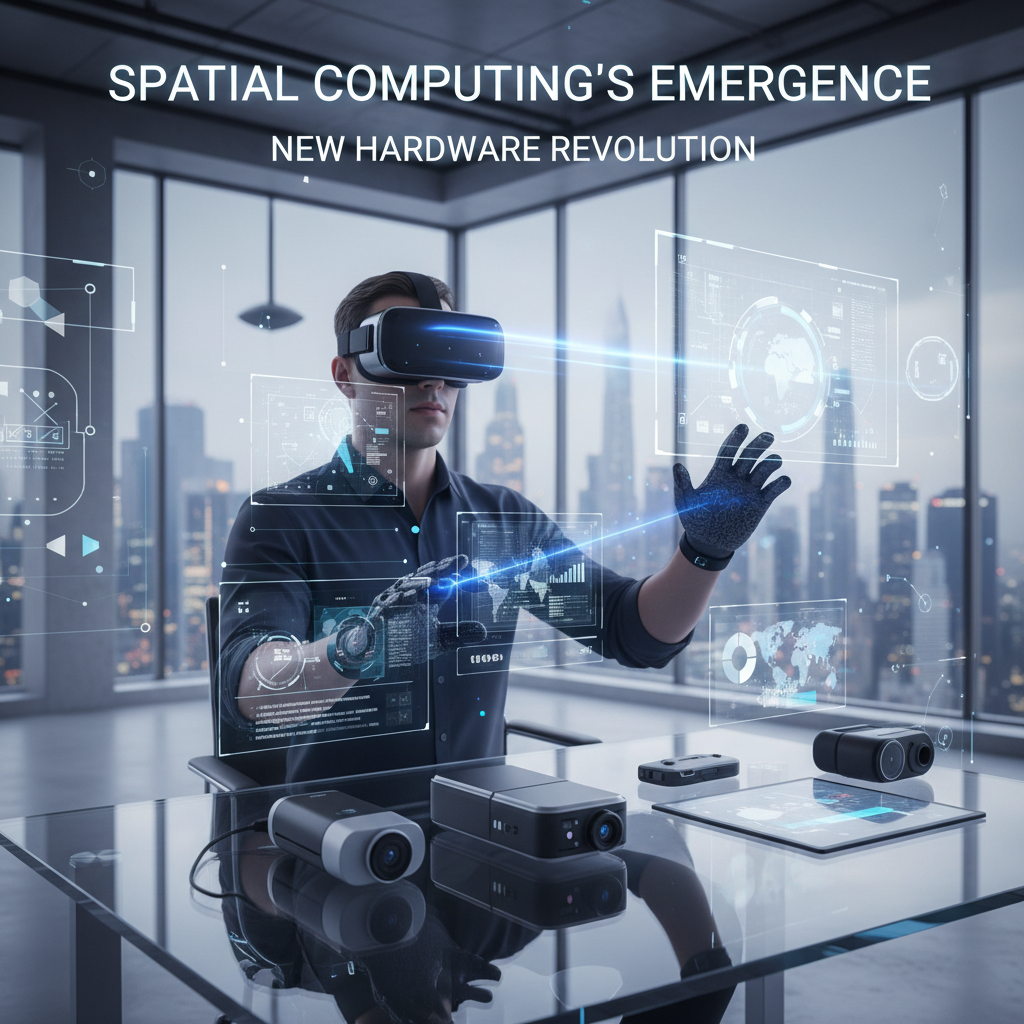
The Dawn of Spatial Computing: Hardware Unleashed
We stand at the cusp of a technological revolution, one that promises to redefine our interaction with digital information and the physical world around us. This isn’t just about virtual reality; it’s about Spatial Computing, and it’s rapidly emerging, largely thanks to groundbreaking new hardware.
What is Spatial Computing, Anyway?
Imagine your digital world no longer confined to flat screens. Spatial computing is the harmonious blend of our physical environment with digital content, allowing us to interact with data, applications, and other people in a three-dimensional space. It’s about leveraging technology to understand and map the real world, then overlaying digital information in a way that feels intuitive, natural, and truly integrated. Think of it as computing that understands space, context, and human intention.
The Hardware Revolution Fueling the Future
For years, the concept of spatial computing felt like science fiction. Now, new hardware is making it a reality. Devices like Apple’s Vision Pro, Meta Quest 3, and various mixed reality headsets from companies like Microsoft are not just incremental upgrades; they represent a significant leap forward. These advanced pieces of tech boast:
- High-Resolution Displays: Offering stunning visual fidelity that makes digital objects appear crisp and real.
- Powerful Processors: Enabling complex real-time rendering and sophisticated sensor fusion.
- Precise Tracking Systems: Accurately mapping your environment and your movements, allowing for seamless interaction.
- Intuitive Input Methods: From hand tracking and eye tracking to natural language processing, making interactions feel effortless.
These devices are shrinking in size, becoming more comfortable, and offering unparalleled immersion, moving us beyond simple “VR games” into a truly spatial interface for work, creativity, and connection.
Beyond Gaming: Real-World Applications
While immersive gaming is undoubtedly an exciting application, the true potential of spatial computing extends far beyond entertainment. We’re seeing its emergence in diverse sectors:
- Productivity & Collaboration: Imagine virtual meeting rooms where colleagues from around the globe can interact with 3D models and data as if they were physically present. Architects can walk through building designs, engineers can collaborate on prototypes, and educators can conduct immersive lessons.
- Healthcare: Surgeons can practice complex procedures in a risk-free virtual environment, while medical students can dissect digital cadavers. Therapists can use spatial experiences for rehabilitation or exposure therapy.
- Retail & Design: Customers can virtually “try on” clothes or visualize furniture in their homes before purchasing. Designers can iterate on products in a shared spatial environment, speeding up development cycles.
- Education & Training: From exploring ancient civilizations to learning complex machinery, spatial computing offers unparalleled immersive learning experiences that traditional methods simply can’t match.
Challenges and the Road Ahead
While the future looks incredibly bright, the path to widespread adoption isn’t without its hurdles. Challenges include the high cost of current devices, battery life limitations, the need for robust content creation tools, and addressing privacy concerns. However, as hardware continues to evolve, becoming more affordable and powerful, and as developers explore this new frontier, we can expect these obstacles to diminish.
Spatial computing is more than just a new gadget; it’s a paradigm shift in how we interact with technology and each other. The new wave of hardware is just the beginning, paving the way for a future where our digital and physical realities seamlessly merge, opening up possibilities we’ve only just begun to imagine. Are you ready to step into this new dimension?



Leave a Reply