
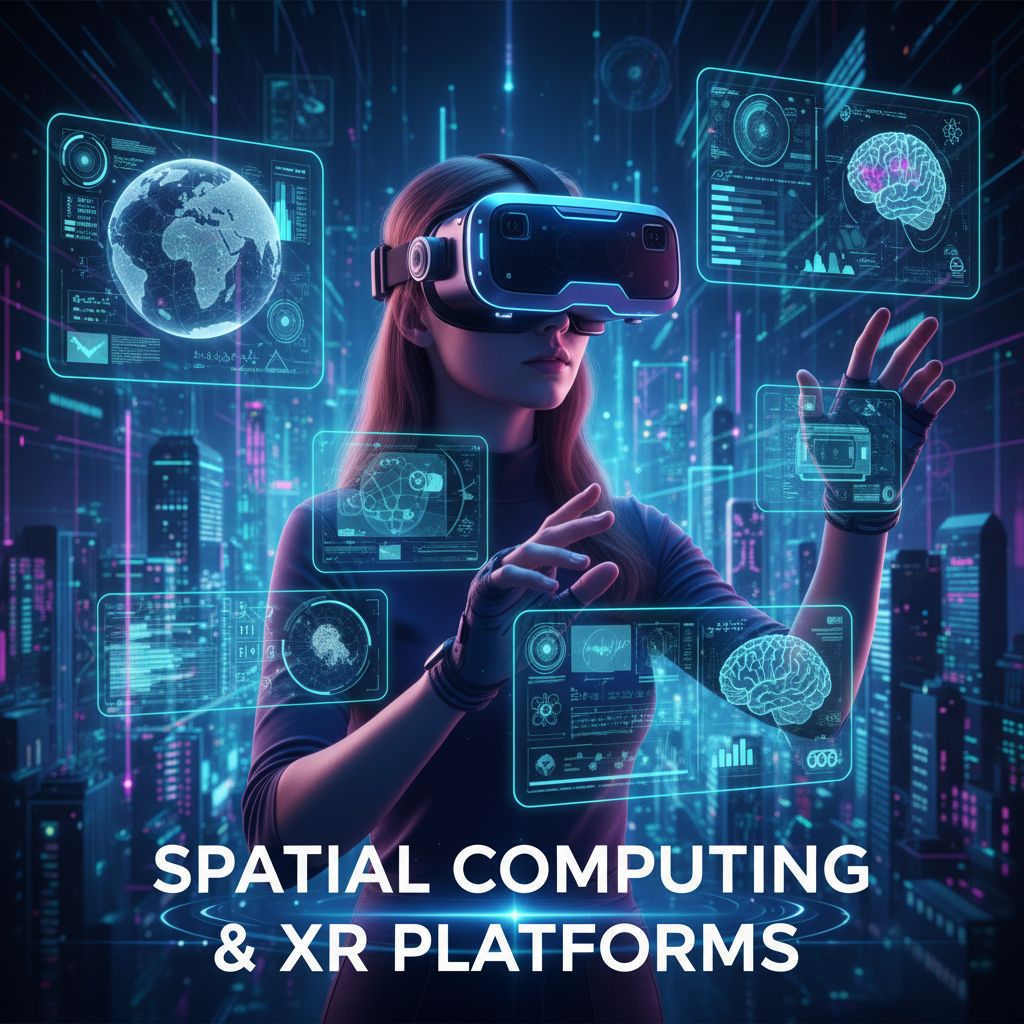
Hello there! Are you ready to explore the next frontier of digital interaction? We’re stepping beyond flat screens and into a world where digital information seamlessly blends with our physical environment. Welcome to the exciting realm of Spatial Computing and Extended Reality (XR) platforms!
What is Spatial Computing?
Imagine your digital world not confined to a device, but intelligently understanding and interacting with the space around you. That’s the essence of Spatial Computing. It’s a paradigm shift where computers perceive, process, and manipulate real-world spaces, allowing digital content to exist and interact within them. Think of it as giving our devices a spatial awareness, enabling applications to understand where you are, what objects are around you, and how you’re moving.
This isn’t just about placing digital objects; it’s about context. From navigation apps that guide you with virtual arrows superimposed on your actual street view, to industrial applications creating “digital twins” of machinery for maintenance, Spatial Computing empowers more intuitive and integrated experiences.
Understanding Extended Reality (XR) Platforms
Now, how do we experience this spatially aware digital world? That’s where Extended Reality (XR) comes in. XR is an umbrella term encompassing Virtual Reality (VR), Augmented Reality (AR), and Mixed Reality (MR) – all technologies that merge the real and virtual worlds to create immersive experiences.
- Virtual Reality (VR): Completely immerses you in a simulated digital environment, often through a headset that blocks out the real world. Think deep-sea dives or alien planet explorations from your living room.
- Augmented Reality (AR): Overlays digital information onto your view of the real world. Pokémon Go was an early, popular example, but AR is rapidly transforming fields like retail and healthcare.
- Mixed Reality (MR): Takes AR a step further by allowing digital objects to not only appear in the real world but also interact with it and with you. Imagine placing a virtual piece of furniture in your room and being able to walk around it, even seeing it disappear behind a physical object.
The Convergence: Why It Matters
The true magic happens when Spatial Computing meets XR platforms. XR provides the eyes and hands for Spatial Computing. It’s through VR headsets, AR glasses, and MR devices that we can actually *see* and *interact* with the spatially aware digital content. Spatial Computing provides the intelligence and context, making those XR experiences truly powerful and practical.
This synergy is poised to revolutionize industries. In healthcare, surgeons can practice complex procedures on holographic models. Educators can create interactive learning environments where students dissect virtual organs or explore historical sites. Manufacturing benefits from virtual prototyping and remote assistance. And of course, entertainment and social interactions are being redefined, offering unprecedented levels of immersion and connection.
Challenges and The Road Ahead
While the potential is vast, the journey is just beginning. Challenges remain, including the need for more powerful yet comfortable hardware, intuitive content creation tools, robust ethical guidelines, and widespread public adoption. However, the pace of innovation is accelerating rapidly.
The future promises even more seamless integration: lighter AR glasses, more natural human-computer interaction, and ubiquitous spatial awareness that will make our digital and physical lives indistinguishable in the most beneficial ways. We’re moving towards a world where computing is no longer confined to a screen, but woven into the very fabric of our reality.
Spatial Computing and XR platforms are not just technologies; they represent a fundamental shift in how we will interact with information and each other. Get ready to experience a world where your imagination can truly take shape around you!
“`


Leave a Reply