
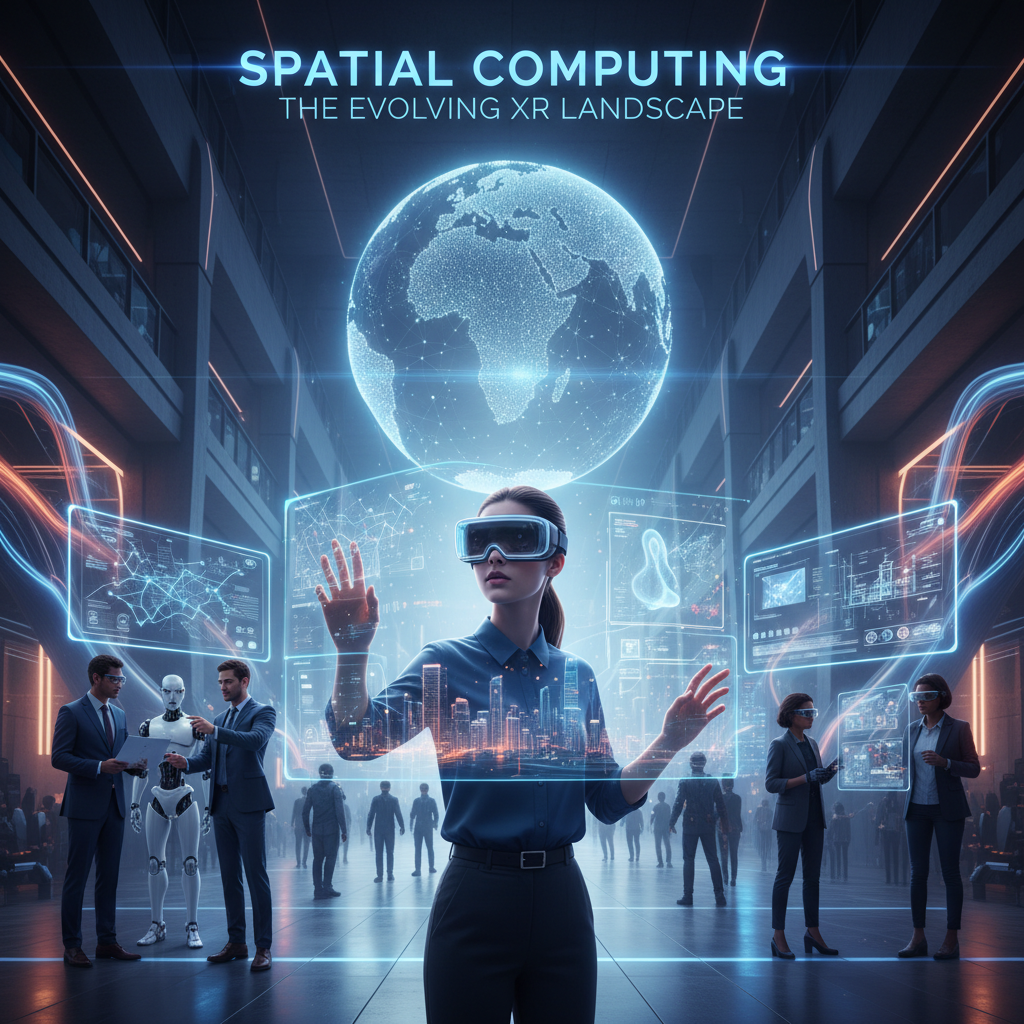
Ever feel like your digital world is constrained by a flat screen? Imagine a world where your digital content isn’t just *on* your desk, but *in* your room, interacting with your physical environment. Welcome to the exciting frontier of Spatial Computing and the rapidly evolving XR (Extended Reality) landscape!
What is Spatial Computing?
At its core, Spatial Computing is about enabling computers to understand and interact with our physical world, not just a screen. It’s the ability for digital systems to perceive, manipulate, and respond to objects and environments in 3D space, much like humans do. Think of it as giving computers a spatial awareness, allowing them to blend seamlessly with our reality rather than being confined to a separate device. This isn’t just about viewing content; it’s about experiencing it within your own physical surroundings.
The Evolving XR Landscape: A Spectrum of Experiences
Spatial Computing is the foundational concept that powers much of what we call XR. XR is an umbrella term encompassing Virtual Reality (VR), Augmented Reality (AR), and Mixed Reality (MR), each offering a unique way to bridge the digital and physical:
- Virtual Reality (VR): Fully immersive digital environments that transport you to another world, completely replacing your physical surroundings.
- Augmented Reality (AR): Overlays digital information onto your real-world view, enhancing it without obscuring it (think Pokémon GO or Snapchat filters).
- Mixed Reality (MR): The sweet spot where digital and physical objects co-exist and interact in real-time. This is where Spatial Computing truly shines, allowing digital content to anchor itself and respond to the real world.
Why Now? The Perfect Storm
While these concepts have been around for a while, several advancements are making Spatial Computing and XR more accessible and powerful than ever before:
- Hardware Evolution: Lighter, more powerful headsets (like the Apple Vision Pro, Meta Quest series, and Magic Leap) with advanced sensors, improved displays, and better tracking.
- Powerful Software & AI: Sophisticated spatial mapping, scene understanding, and AI algorithms allow devices to understand and interact with environments with unprecedented accuracy.
- Enhanced Connectivity: 5G and future networks provide the low latency and high bandwidth needed for seamless, real-time spatial experiences.
Transforming Industries and Everyday Life
The implications of Spatial Computing are vast and will redefine how we work, learn, play, and connect:
- Work & Collaboration: Imagine virtual meeting rooms where 3D models can be manipulated collaboratively, or engineers designing prototypes as holograms in their office.
- Education & Training: Immersive learning experiences, from dissecting virtual organs in medical school to repairing complex machinery with AR overlays.
- Entertainment & Gaming: Beyond traditional screens, games can adapt to your living room, or you can watch movies with characters appearing to sit next to you.
- Design & Retail: Architects can walk through building designs before they’re built, and customers can preview furniture in their homes before buying.
The Road Ahead: Challenges and Excitement
While the future is incredibly bright, challenges remain. We need to overcome hurdles like device comfort, content creation pipelines, interoperability between platforms, and making these technologies more affordable and widely adopted. However, the rapid pace of innovation suggests we’re on the cusp of a paradigm shift.
Spatial Computing isn’t just a new technology; it’s a new way of interacting with information and each other. It promises to liberate our digital lives from the confines of flat screens and integrate them seamlessly into the rich tapestry of our physical world. Get ready to step into a future where the line between digital and physical blurs in exciting and meaningful ways!
“`



Leave a Reply