
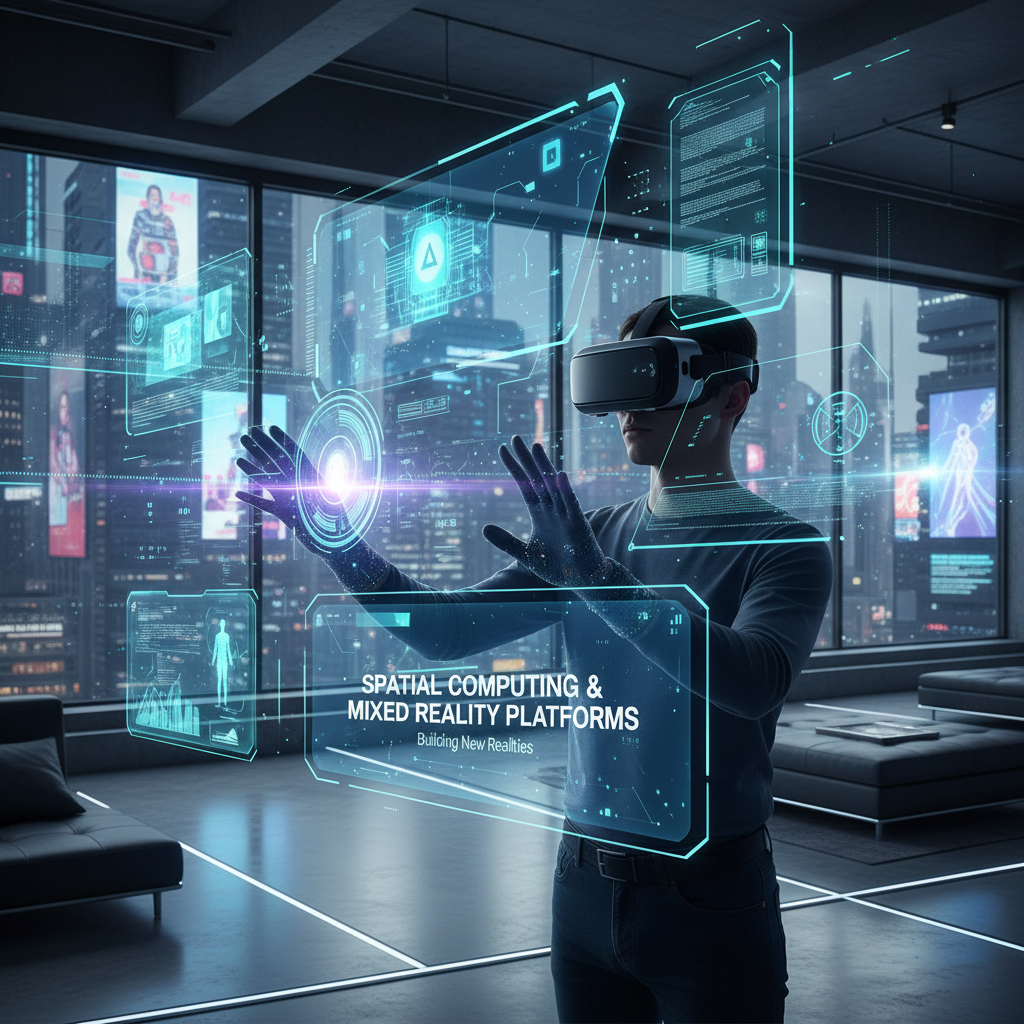
Step into Tomorrow: Spatial Computing & MR
Ever feel like your digital world is constrained by a flat screen? Imagine a world where digital information isn’t just displayed *on* your reality, but seamlessly integrated *into* it. Welcome to the exciting frontier of Spatial Computing and Mixed Reality Platforms!
What Exactly is Spatial Computing?
At its core, spatial computing is about giving computers the ability to understand and interact with the three-dimensional world around us. Instead of just processing data from a mouse and keyboard, a spatial computer uses sensors (like cameras and depth scanners) to map your physical environment. It recognizes objects, surfaces, and even your gestures, allowing digital content to exist and interact meaningfully within that real-world context.
Think of it as the operating system for the real world, enabling applications that know where they are, what’s around them, and how to behave in that space.
The Magic of Mixed Reality (MR) Platforms
Mixed Reality is the dazzling manifestation of spatial computing. It’s not just virtual reality (VR), which immerses you entirely in a digital world, nor is it purely augmented reality (AR), which overlays digital information onto your view of the real world. MR is a sophisticated blend, allowing you to interact with both physical and virtual objects simultaneously.
MR platforms create a spectrum where digital objects can appear solid, persist in space, cast shadows, and even be occluded by real-world objects. This creates an incredibly powerful sense of presence and immersion, making the digital feel truly tangible.
Beyond the Screen: Practical Applications
The implications of spatial computing and MR are vast and transformative, stretching far beyond gaming and entertainment:
Healthcare: Surgeons can practice complex procedures on holographic organs, medical students can explore anatomical models in 3D, and remote assistance can guide frontline workers.
Manufacturing & Design: Engineers can collaborate on 3D prototypes in shared virtual spaces, factory workers can receive real-time holographic instructions overlaid on machinery, and architects can walk through digital blueprints of future buildings.
Education & Training: Learning becomes interactive and engaging. Imagine dissecting a virtual frog in biology class or exploring historical sites as if you were there.
Retail & E-commerce: Customers can virtually try on clothes, place furniture in their living rooms before buying, or explore interactive product displays.
Remote Collaboration: Teams can meet as realistic avatars in a shared virtual space, interacting with 3D models and digital whiteboards as if they were in the same room, regardless of physical location.
The Road Ahead: Opportunities and Challenges
While the potential is immense, spatial computing and MR are still evolving. Challenges include developing more comfortable and affordable hardware, creating intuitive user interfaces, and building a robust ecosystem of compelling content and applications. Data privacy and ethical considerations surrounding persistent digital overlays also require careful attention.
However, with major tech players investing heavily and incredible advancements in sensor technology, AI, and processing power, we are on the cusp of a revolution. These platforms promise to reshape how we work, learn, connect, and experience the world.
Join the Spatial Revolution!
Spatial computing and mixed reality are not just futuristic concepts; they are the next evolutionary step in human-computer interaction. They invite us to step out of the flat screen and into a richer, more interactive, and truly spatial digital future. The possibilities are truly boundless!
What excites you most about this emerging technology? Share your thoughts in the comments below!

Leave a Reply