
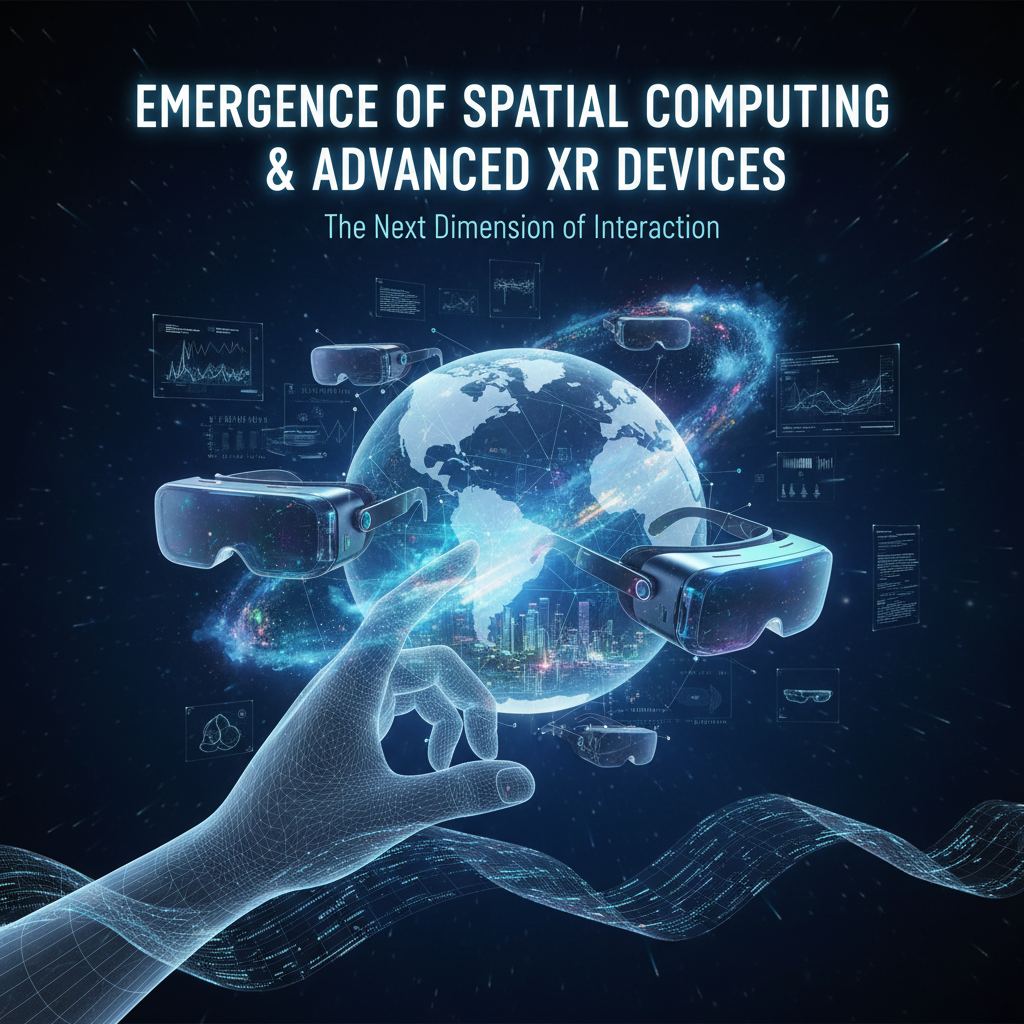
Step into the Future: Spatial Computing & Advanced XR
We’re on the cusp of a profound shift in how we interact with technology and the world around us. Forget flat screens and traditional interfaces; a new era is dawning, driven by Spatial Computing and advanced Extended Reality (XR) devices. This isn’t just about gaming anymore – it’s about blending digital information seamlessly with our physical environment, creating experiences that were once confined to science fiction.
What Exactly is Spatial Computing?
At its core, Spatial Computing is about enabling computers to understand and interact with the real world in three dimensions. Instead of processing data as text or pixels on a screen, spatial computing systems perceive, understand, and augment physical spaces and objects. Think of it as giving technology the ability to “see” and “understand” your living room, office, or an entire factory floor, then place digital content within it in a contextually aware manner.
This goes beyond simple augmented reality overlays. It involves persistent digital twins of environments, shared understanding among multiple users and devices, and intelligent interaction based on physical presence and real-world physics.
The Powerhouse: Advanced XR Devices
The gateway to this spatial revolution lies in advanced XR devices. XR is an umbrella term encompassing Virtual Reality (VR), Augmented Reality (AR), and Mixed Reality (MR). While VR immerses you entirely in a digital world, AR overlays digital content onto your view of the real world, and MR takes it a step further by allowing digital and real objects to interact with each other in real-time.
Modern headsets are no longer clunky prototypes. Devices like Apple Vision Pro, Meta Quest series, and various enterprise-grade AR glasses are becoming more sophisticated, lighter, and more powerful. They feature high-resolution displays, advanced tracking sensors, powerful processors, and improved optics, making the digital blend with reality increasingly convincing and comfortable.
Beyond Gaming: Real-World Applications
While gaming and entertainment have been early adopters, the true potential of Spatial Computing and XR extends far beyond. We’re seeing transformative applications emerge across various sectors:
- Enterprise & Industry: Remote assistance for field technicians, virtual product design and prototyping, employee training, digital twins for factory optimization, and complex data visualization.
- Healthcare: Surgical training, patient rehabilitation, remote consultations, and even therapeutic applications for mental health.
- Education: Immersive virtual field trips, hands-on simulations for complex subjects, and collaborative learning environments.
- Design & Architecture: Visualizing building designs in real-time on-site, collaborative 3D modeling, and client walkthroughs of unbuilt spaces.
- Everyday Life: Enhanced navigation, contextual information overlays while shopping or sightseeing, and new forms of social interaction.
Challenges and the Road Ahead
Despite the incredible progress, the journey is still unfolding. Challenges remain, including the cost of high-end devices, the need for more compelling and intuitive content, battery life, and the social acceptance of wearing headsets in public. Privacy concerns related to constant spatial scanning are also a significant consideration.
However, with ongoing advancements in chip technology, sensor fusion, AI, and connectivity (like 5G/6G), these hurdles are rapidly being addressed. We can anticipate more compact form factors, richer haptic feedback, more natural interfaces (like advanced eye and hand tracking), and a burgeoning ecosystem of developers creating truly indispensable spatial applications.
Embrace the Spatial Future!
The emergence of Spatial Computing and advanced XR devices marks a pivotal moment in technological evolution. We are moving towards a future where our digital lives will seamlessly integrate with our physical world, creating richer, more intuitive, and profoundly immersive experiences. It’s an exciting time to watch, learn, and perhaps even participate in shaping this new frontier. Get ready to step off the screen and into the space!


Leave a Reply