
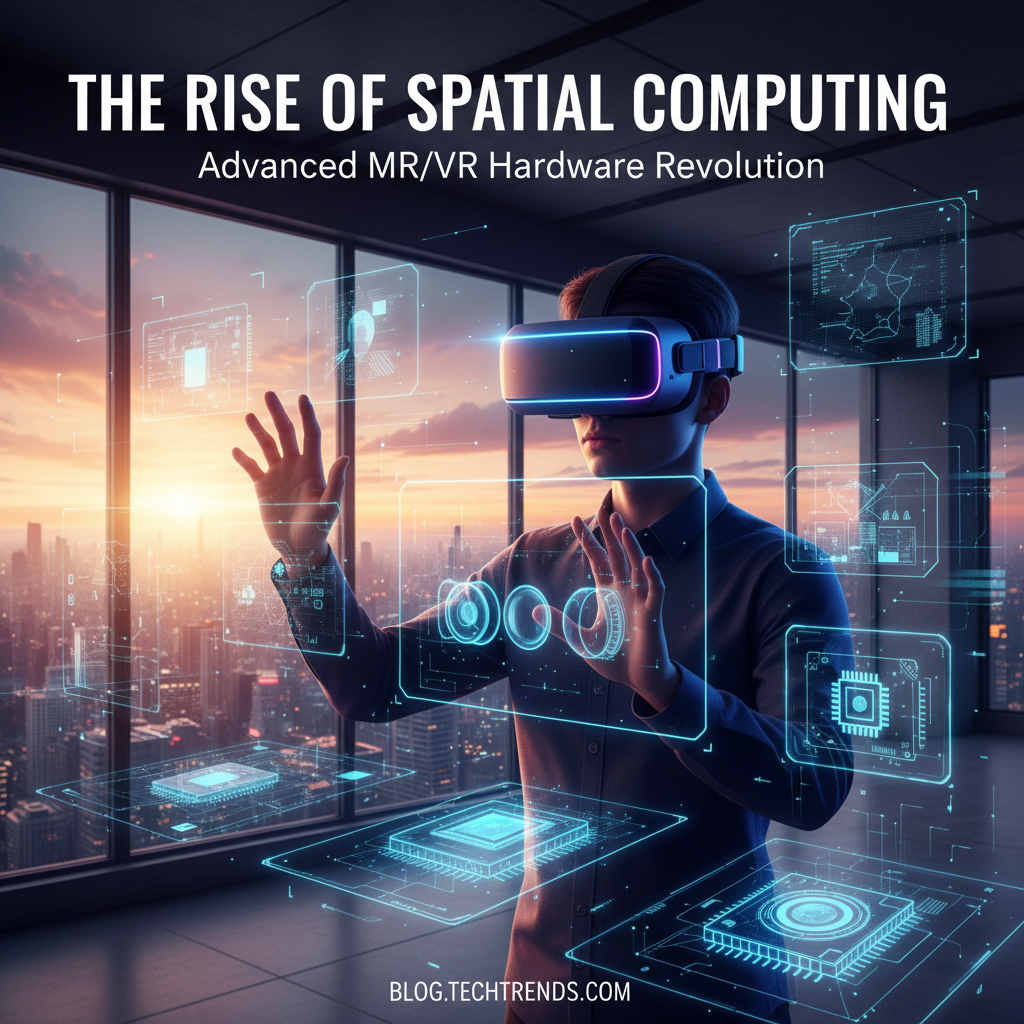
Spatial Computing: A New Reality Unfolds
Get ready to step beyond flat screens and into a world where digital information seamlessly blends with your physical environment. The era of spatial computing, powered by groundbreaking MR/VR hardware, is not just coming – it’s already here, reshaping how we work, play, and interact.
What Exactly is Spatial Computing?
At its core, spatial computing is about giving computers the ability to understand and interact with the three-dimensional world around us. Instead of viewing information on a screen, we’re now able to place, manipulate, and experience digital content directly within our physical space. Think of it as your computer understanding not just what’s on your desk, but your entire room, allowing digital objects to coexist and interact with real ones.
The Hardware Revolution Powering the Shift
This exciting shift wouldn’t be possible without incredible advancements in Mixed Reality (MR) and Virtual Reality (VR) hardware. Gone are the days of bulky, low-resolution headsets. Today’s devices are lighter, more powerful, and offer stunning fidelity.
We’re seeing breakthroughs in high-resolution displays that eliminate the “screen-door effect,” advanced optics that provide wider fields of view, and sophisticated tracking systems that accurately map your movements and environment. Eye-tracking, haptic feedback, and improved processing power within these standalone units mean more immersive, comfortable, and intuitive experiences than ever before. Devices like the Apple Vision Pro, Meta Quest 3, and various enterprise-focused solutions are pushing the boundaries of what’s possible, moving us closer to truly seamless spatial interaction.
Beyond Gaming: A Universe of Applications
While VR’s roots might be in gaming, spatial computing’s potential reaches far, far wider. We’re witnessing transformative applications across numerous sectors:
- Enterprise & Collaboration: Teams can now collaborate on 3D models in a shared virtual space, conduct remote training with lifelike simulations, or visualize complex data in new dimensions.
- Healthcare: Surgeons can practice intricate procedures, medical students can explore the human body in immersive detail, and therapists can use VR for pain management and mental health treatments.
- Design & Engineering: Architects can walk through virtual buildings before they’re constructed, engineers can prototype and test designs in a simulated environment, and artists can sculpt in 3D with unparalleled freedom.
- Education: Learning becomes experiential, allowing students to travel through historical events, explore the solar system, or conduct virtual science experiments from anywhere.
These examples are just the tip of the iceberg. As the technology matures, we can expect even more innovative uses to emerge.
The Road Ahead: Challenges and Opportunities
Of course, spatial computing is still in its early stages. Challenges remain, including reducing hardware costs, improving user comfort for extended periods, standardizing content creation tools, and addressing privacy concerns. However, the rapid pace of innovation suggests that these hurdles will be overcome.
The opportunities, on the other hand, are boundless. Imagine a future where your digital life isn’t confined to a handheld screen but is an integrated part of your physical reality – where information appears contextually, tools are at your fingertips without physical clutter, and communication feels more present and natural.
Join the Journey!
The rise of spatial computing and advanced MR/VR hardware isn’t just a technological fad; it’s a fundamental shift in how humans and computers will interact. It promises to unlock new levels of productivity, creativity, and connection. Are you ready to step into this exciting new reality?
“`

Leave a Reply