
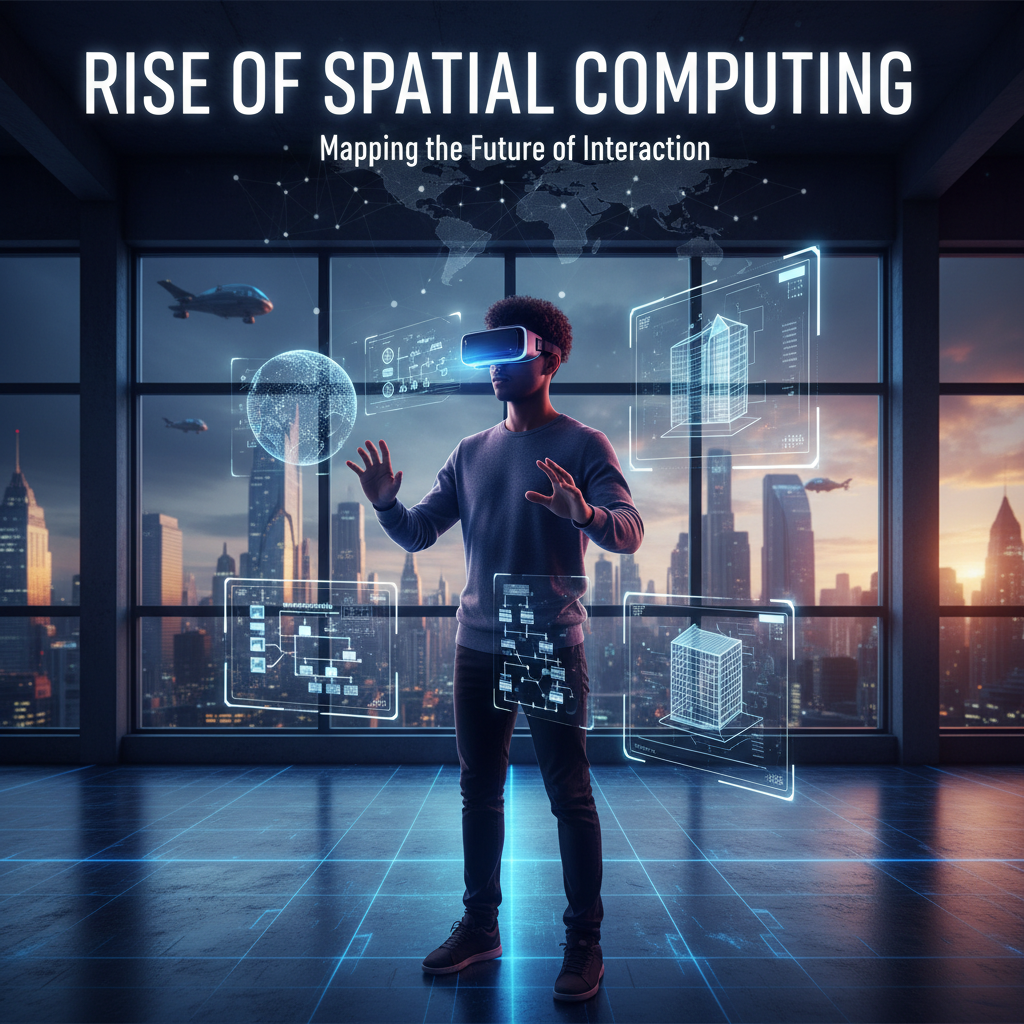
Stepping into Tomorrow: The Rise of Spatial Computing
Imagine a world where your digital life seamlessly blends with your physical surroundings. No more staring at a flat screen, but interacting with information and experiences that exist all around you, integrated into your real environment. This isn’t science fiction anymore; it’s the promise of Spatial Computing, and it’s rapidly emerging as the next major paradigm shift in technology.
What Exactly is Spatial Computing?
At its core, Spatial Computing is about enabling computers to understand and interact with the physical world in three dimensions, much like humans do. It involves mapping real-world environments, tracking objects and users within them, and then overlaying or integrating digital content in a way that feels natural and intuitive. Think beyond Augmented Reality (AR) or Virtual Reality (VR) as isolated experiences; Spatial Computing seeks to create a persistent, interconnected digital layer across our physical world.
The Technologies Fueling This Revolution
The rise of Spatial Computing is not a sudden leap, but rather the convergence of several powerful technologies maturing simultaneously:
- Augmented Reality (AR) & Virtual Reality (VR): These provide the visual and interactive interfaces, from immersive headsets to AR-enabled smartphones, allowing us to see and engage with spatial content.
- Artificial Intelligence (AI): Essential for understanding context, processing natural language, recognizing objects, and making spatial experiences intelligent and responsive.
- Computer Vision & Sensors: Cameras, LiDAR, depth sensors, and other technologies enable devices to accurately map and track environments and user movements.
- 5G Connectivity: Provides the low latency and high bandwidth necessary for real-time processing and streaming of complex spatial data.
- Cloud Computing & Edge Computing: Power the heavy computational demands, with edge computing bringing processing closer to the user for immediate interactions.
Beyond the Screen: Real-World Applications
The potential applications of Spatial Computing are vast and transformative, promising to reshape industries and daily life:
- Healthcare: Surgeons performing complex operations with AR overlays, remote diagnosis, and interactive patient education.
- Manufacturing & Design: Engineers collaborating on 3D models in a shared virtual space, training simulations, and augmented maintenance guides.
- Retail: Virtual try-ons, interactive product displays, and personalized shopping experiences that blend digital information with physical stores.
- Education: Immersive learning environments where students can explore historical sites, dissect virtual anatomy, or conduct science experiments in 3D.
- Entertainment: Next-generation gaming, interactive storytelling, and live events that break the boundaries of traditional screens.
Challenges and the Road Ahead
While the future looks bright, there are significant hurdles to overcome. Privacy concerns, ethical considerations regarding data collection and digital twins, and the need for standardized platforms are critical. User comfort, ergonomics of devices, and accessibility also remain important areas of development. However, as hardware becomes more powerful, algorithms more sophisticated, and user interfaces more intuitive, Spatial Computing is poised to move from niche applications to widespread adoption.
Spatial Computing represents more than just a technological upgrade; it’s a fundamental shift in how we interact with information and the world around us. It promises to dissolve the barriers between the digital and physical, creating richer, more intuitive, and deeply integrated experiences. Get ready to step into a new reality, where the world itself becomes your interface.
“`


Leave a Reply