
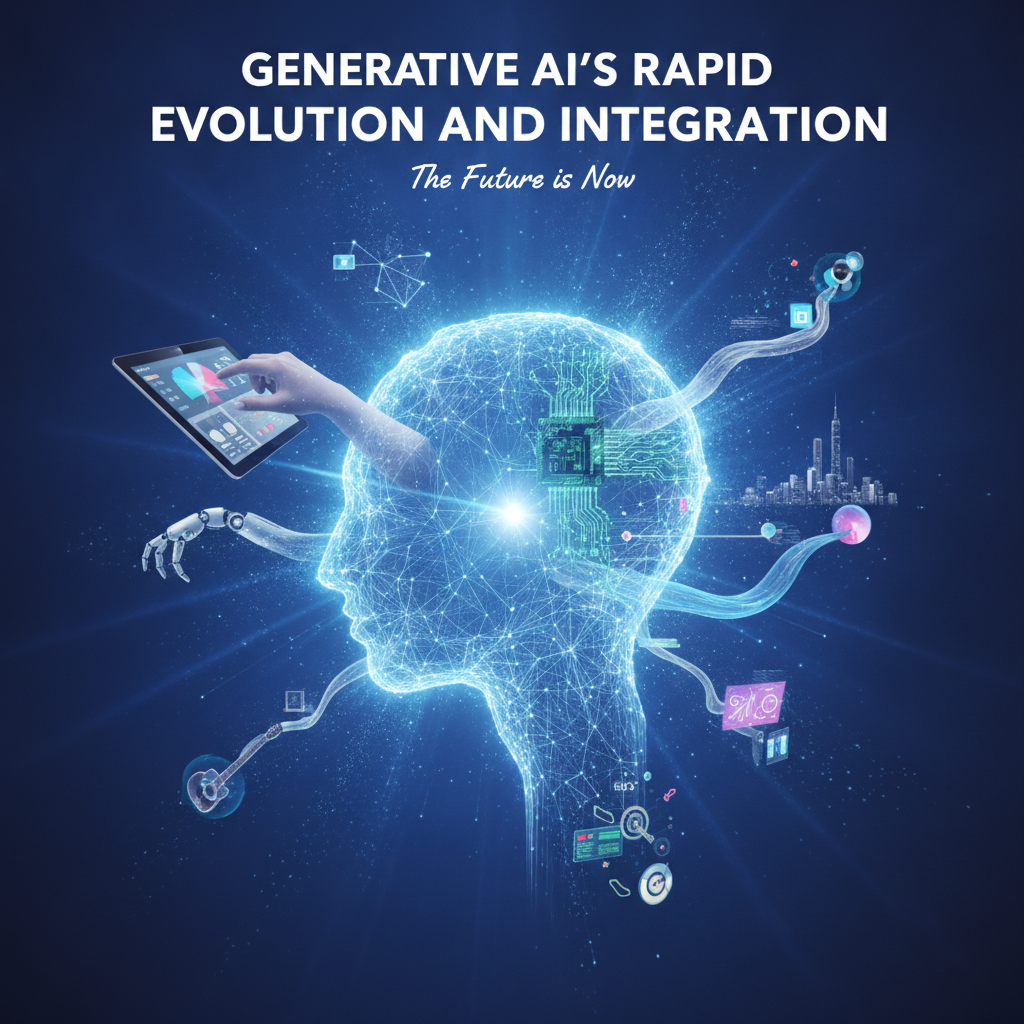
GenAI’s Swift Rise: Transforming Our World
Remember when Generative AI felt like a futuristic concept? Fast forward to today, and it’s not just knocking on our doors; it’s practically moved in! The speed at which Generative AI has evolved and integrated into our daily lives and industries is nothing short of astounding, fundamentally changing how we work, create, and interact with technology.
The AI Tsunami: What’s Driving It?
Just a few years ago, generative models were niche. Now, Large Language Models (LLMs) like those powering sophisticated chatbots and image generators like DALL-E and Midjourney are household names. This rapid evolution isn’t by accident. It’s fueled by monumental leaps in computational power, access to vast, diverse datasets, and groundbreaking algorithmic advancements that have made these sophisticated models more accessible and powerful than ever before.
Crucially, the open-source community and continuous research breakthroughs have democratized access to these powerful tools, accelerating their development and application across various sectors at an unprecedented pace.
From Niche to Ubiquitous: Integration Everywhere
The real story isn’t just the evolution of the technology, but its seamless integration. Generative AI is no longer confined to research labs; it’s a co-pilot in our software, a muse for artists, and a problem-solver for businesses across the globe.
Think about it: content creation (from blog posts and marketing copy to video scripts), software development (code generation, debugging, testing), personalized customer service, drug discovery, architectural design, and even scientific research are all being augmented by generative capabilities. It’s moving us from a world of manual creation to one of intelligent augmentation, where AI acts as an assistant that can draft, ideate, and refine at incredible speed.
Opportunities and the Road Ahead
The potential for efficiency, innovation, and entirely new forms of creativity that Generative AI unlocks is immense. Businesses can automate tedious tasks, creatives can explore new dimensions, and individuals can find powerful tools to enhance their productivity and learning. It’s creating entirely new job roles and industries that we couldn’t have imagined a decade ago, fostering an ecosystem ripe with innovation.
However, this rapid integration also brings important conversations to the forefront. Ethical considerations, responsible deployment, job adaptation, and the need for robust AI governance are critical. The future of Generative AI isn’t just about what it can do, but how we collectively ensure it’s developed and used for good, mitigating risks like misinformation and bias while maximizing its positive impact.
Generative AI’s journey from a fascinating concept to an indispensable tool has been breathtakingly fast. As it continues to evolve and integrate even deeper into our world, staying informed and engaging with its possibilities and challenges will be key. What’s your take on Generative AI’s impact so far?



Leave a Reply