
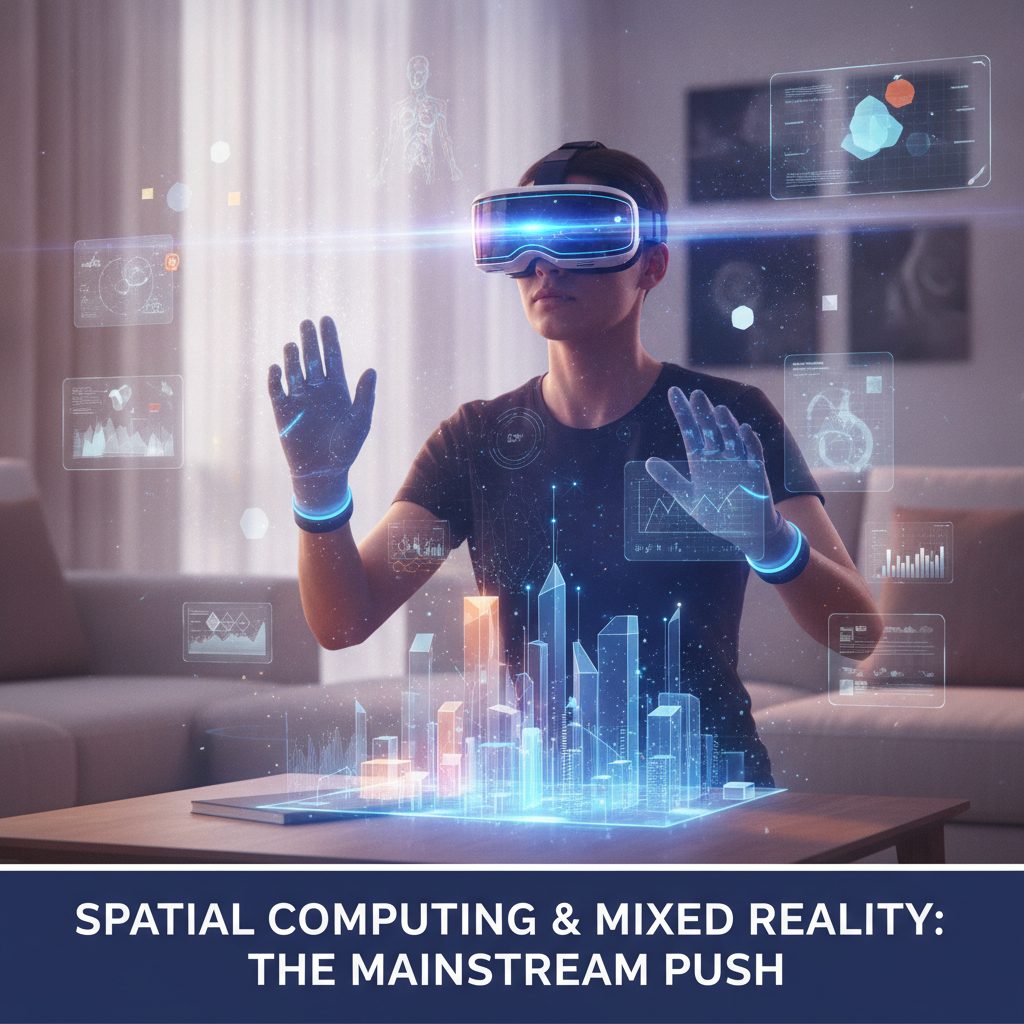
Mixed Reality Goes Mainstream: A Spatial Shift
Remember when smartphones felt like science fiction? Well, get ready for the next wave of technological evolution. Spatial computing and mixed reality (MR) are no longer confined to sci-fi movies or niche tech demos. They’re making a decisive push towards becoming an integral part of our everyday lives, fundamentally changing how we interact with information and the world around us.
What Exactly Are We Talking About?
At its core, spatial computing is about creating interactive experiences that understand and adapt to our physical environment. It’s not just about viewing digital content; it’s about making that content an intelligent, interactive part of our real world. Mixed Reality (MR) is a prime example, blending digital objects seamlessly into our physical space, allowing us to interact with them as if they were truly there.
Think beyond virtual reality (VR), which immerses you entirely in a digital world, or augmented reality (AR), which overlays digital information onto your view of the real world. MR takes it a step further, enabling true interaction between real and virtual elements. It’s about bridging the gap, creating a continuous spectrum of reality.
The Tipping Point: Why The Mainstream Push Now?
Several converging factors are accelerating this mainstream adoption:
- Hardware Evolution: Devices are becoming lighter, more powerful, and less cumbersome. Think compact headsets with impressive displays, improved tracking, and longer battery life.
- Software & AI Advances: Sophisticated spatial mapping, AI-driven object recognition, and intuitive interaction models are making experiences more realistic and user-friendly.
- Developer Ecosystem Growth: Major tech players are investing heavily, fostering robust developer tools and platforms, leading to an explosion of innovative applications.
- Accessibility & Cost: While still premium, costs are beginning to trend downwards, making these technologies more attainable for consumers and businesses alike.
Beyond the Hype: Practical Applications Unleashed
While gaming and entertainment have been early adopters, the real transformative power of spatial computing lies in its practical, everyday applications:
- Enterprise & Industry: From remote assistance for field technicians and collaborative 3D design to employee training and factory floor optimization, MR is boosting productivity and reducing errors.
- Education & Training: Immersive learning experiences can transport students to historical events, dissect virtual anatomy, or practice complex surgical procedures in a risk-free environment.
- Healthcare: Surgeons can visualize patient data in 3D during operations, while therapists can use MR for rehabilitation exercises.
- Everyday Life: Imagine redesigning your living room with virtual furniture before buying, navigating complex environments with contextual digital overlays, or having interactive holographic calls with loved ones.
Navigating the Future: What to Expect Next
The journey to full mainstream adoption still has its hurdles, including continued improvements in comfort, battery life, content availability, and addressing privacy concerns. However, the momentum is undeniable.
We’re moving towards a future where our digital lives will seamlessly integrate with our physical surroundings. Spatial computing and mixed reality aren’t just new devices; they represent a paradigm shift in how we work, learn, play, and connect. Prepare for a world where your digital tools are no longer confined to a screen but are intelligently layered into your reality, ready to assist and enhance your experiences in unprecedented ways.
The mainstream push for spatial computing and mixed reality isn’t just coming; it’s already here, building momentum with every innovation. Get ready to step into a richer, more interactive reality!
Leave a Reply