
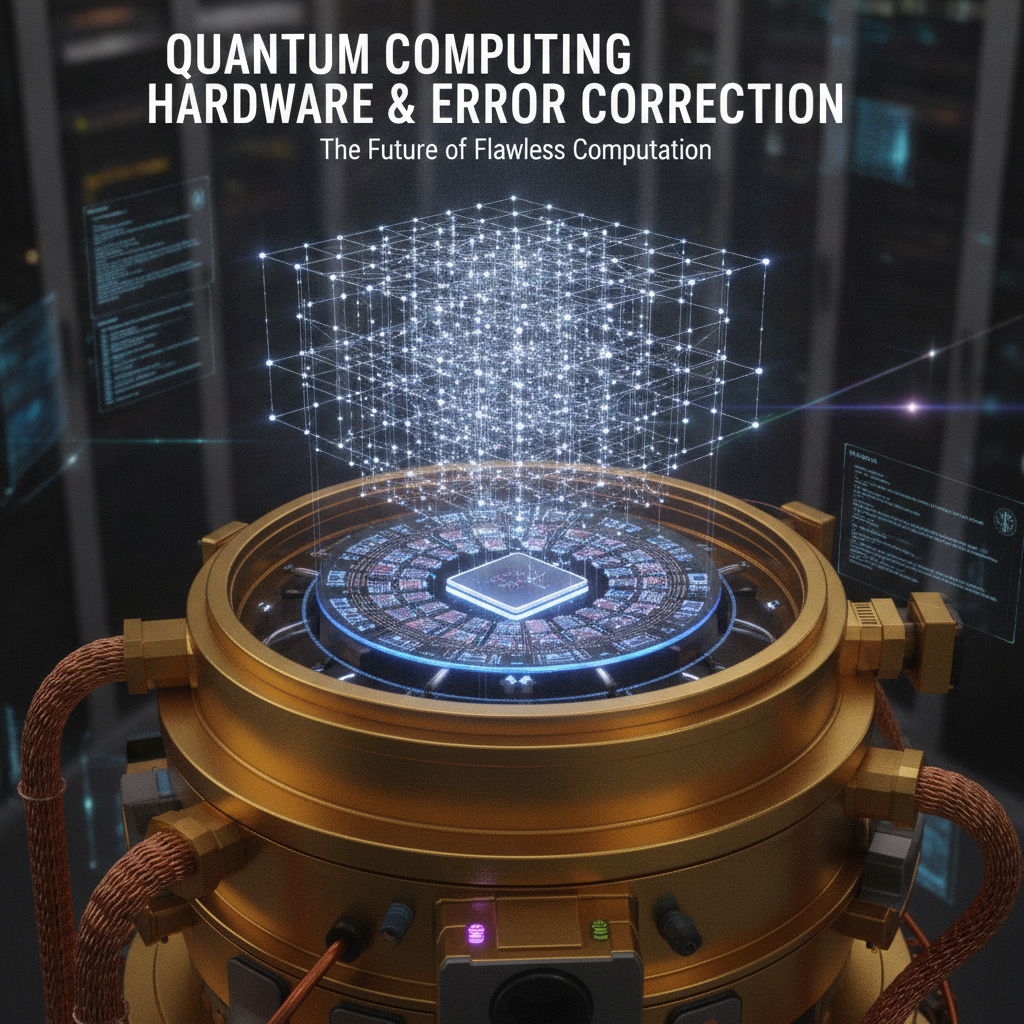
Quantum computing promises to revolutionize fields from medicine to materials science, tackling problems beyond the reach of even the most powerful supercomputers. But bringing these powerful machines to life is an extraordinary engineering challenge. At the heart of it lies the delicate dance between building exquisite quantum hardware and the critical need for quantum error correction.
The Fragile Foundation: Quantum Hardware
Imagine trying to build a computer out of snowflakes. That’s a bit like the challenge of quantum hardware. Quantum computers operate by manipulating “qubits,” which are the quantum equivalent of classical bits. Unlike classical bits that are simply 0 or 1, qubits can exist in superpositions (a combination of both 0 and 1 simultaneously) and be entangled with other qubits, creating a vastly richer computational space.
These qubits can be realized in many physical forms: superconducting circuits cooled to near absolute zero, individual trapped ions held by electromagnetic fields, photons of light, or even tiny defects in diamonds. Regardless of their form, they all share one critical characteristic: extreme fragility. They are incredibly sensitive to their environment, making them prone to errors.
The Quantum Challenge: Errors Everywhere
In the quantum realm, errors aren’t just a nuisance; they’re an inherent part of the system. The very interactions that allow qubits to compute also make them vulnerable. Phenomena like “decoherence” cause qubits to lose their delicate quantum states, effectively scrambling the information they hold. Noise from stray electromagnetic fields, temperature fluctuations, or even interactions with cosmic rays can flip a qubit’s state or corrupt its superposition.
A classical computer bit has robust error correction built in: if a bit flips, you can often just copy it from another identical bit. But quantum mechanics introduces a unique problem: the “no-cloning theorem.” You cannot simply copy an unknown quantum state without disturbing it. This fundamental principle means classical error correction strategies won’t work.
Beyond Classical Fixes: Enter Quantum Error Correction
This is where quantum error correction (QEC) steps in, a brilliant theoretical framework that is now being put to the test in hardware. Instead of directly copying a qubit, QEC encodes one “logical” (error-corrected) qubit into a highly entangled state of many “physical” (noisy) qubits. The information isn’t duplicated; it’s distributed redundantly across the entangled system.
If one of the physical qubits encounters an error, the overall logical qubit’s state can often be inferred and corrected by measuring the correlations (syndrome measurements) between the remaining physical qubits, all without directly measuring and thus destroying the delicate quantum information of the logical qubit itself. It’s an ingenious way to detect and correct errors while preserving the fragile quantum state.
Fault Tolerance: The Path to Scalable Quantum Computing
QEC is a foundational step, but the ultimate goal is “fault-tolerant quantum computing.” This means building a quantum computer that can perform arbitrary computations reliably, even with noisy components and operations. For fault tolerance to work, the physical error rate of individual qubits and operations must be below a certain “threshold.” If the physical errors are too frequent, the act of performing error correction might introduce more errors than it fixes.
Achieving fault tolerance requires not just effective QEC codes but also “fault-tolerant gates” – operations on logical qubits that ensure errors don’t spread uncontrollably. This is a monumental engineering and theoretical task, as current QEC codes often require hundreds, if not thousands, of physical qubits to protect a single logical qubit.
The Road Ahead: Merging Hardware and Theory
Today, researchers are making incredible strides. We are seeing experimental demonstrations of small-scale QEC codes on various hardware platforms. These experiments validate the theory and help us understand the practical challenges of implementing QEC.
The journey to universal fault-tolerant quantum computers is a tight interplay between hardware development and theoretical breakthroughs. Hardware engineers are relentlessly working to improve qubit quality, reduce native error rates, and scale up the number of qubits. Simultaneously, theorists are developing more efficient QEC codes and strategies to reduce the immense overhead required. Every improvement in physical qubit quality brings us closer to crossing that critical fault-tolerance threshold, unlocking the true potential of quantum computing.
Why This Matters
Quantum error correction isn’t just an academic exercise; it’s the bridge that connects today’s noisy, small-scale quantum processors to the powerful, fault-tolerant machines of tomorrow. Without robust QEC and fault tolerance, quantum computers will remain fascinating curiosities. With it, they have the potential to solve some of humanity’s most pressing challenges, from designing new drugs to discovering novel materials, truly changing our world.
“`

Leave a Reply