
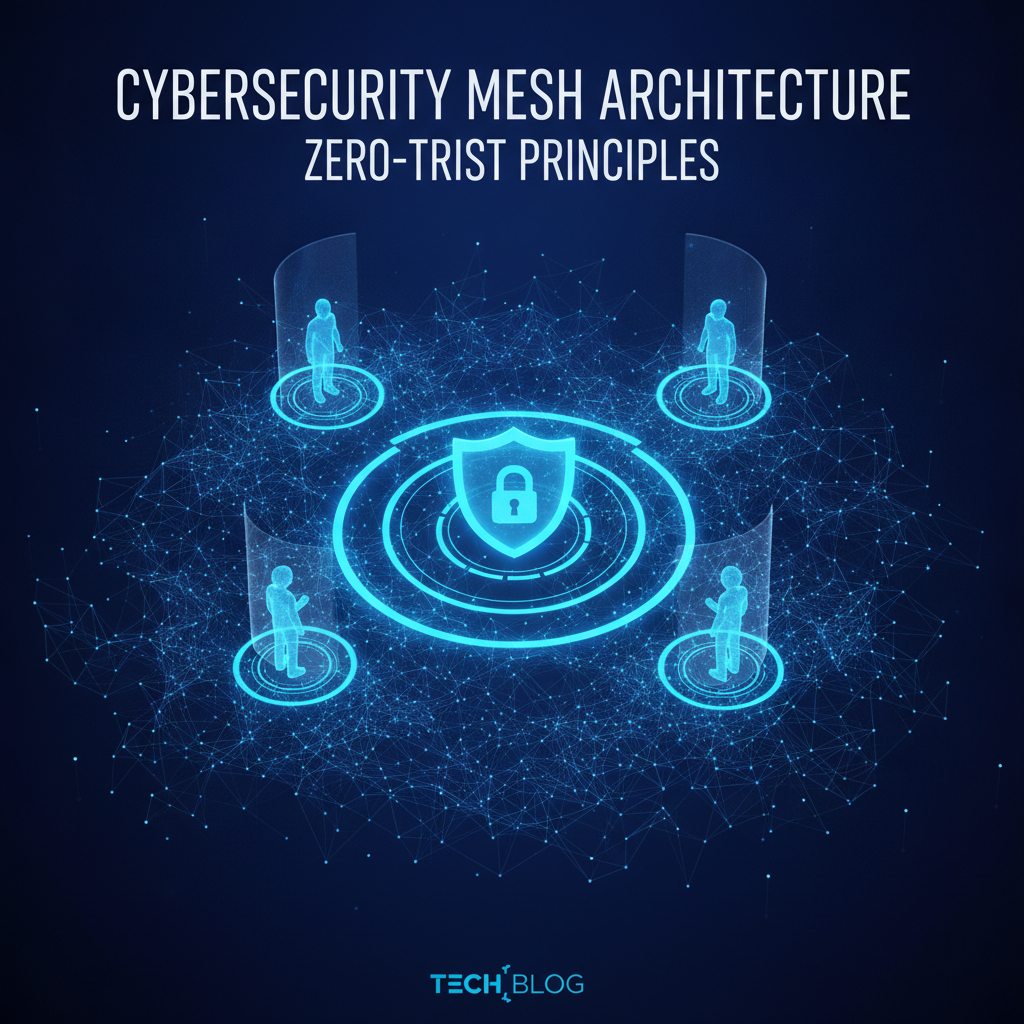
Building Stronger Defenses: Cybersecurity Mesh Architecture & Zero-Trust
In today’s interconnected digital world, the traditional perimeter-based security model is no longer sufficient. With remote work, cloud services, and a proliferation of devices, our digital boundaries are constantly expanding. This complexity calls for a more adaptive and resilient approach to cybersecurity. Enter two game-changing concepts: Cybersecurity Mesh Architecture (CMA) and Zero-Trust Principles.
The Evolving Threat Landscape
Gone are the days when a strong firewall was enough to keep threats out. Attackers are more sophisticated, and vulnerabilities can emerge anywhere within an organization’s sprawling IT ecosystem. Data isn’t just in your data center; it’s across multiple clouds, SaaS applications, and employee devices. This distributed nature demands a security model that’s equally distributed and intelligent.
Unpacking Cybersecurity Mesh Architecture (CMA)
Imagine your security isn’t just one big, monolithic wall, but rather a network of interconnected, cooperative security services spread across your entire digital environment. That’s the essence of Cybersecurity Mesh Architecture. Instead of trying to funnel all traffic through a single choke point, CMA decentralizes security controls.
It’s about having a composable, scalable, and interoperable security fabric where individual security tools (like identity management, data protection, threat intelligence, and access control) work together seamlessly, regardless of where they are deployed. This approach makes security more flexible and responsive to modern business needs.
Embracing Zero-Trust Principles: Never Trust, Always Verify
At its core, Zero-Trust is a security philosophy built on the fundamental principle: “never trust, always verify.” This means no user, device, application, or network segment is inherently trusted, whether it’s inside or outside the traditional network perimeter. Every single access request must be authenticated, authorized, and continuously validated before access is granted.
Key tenets of Zero-Trust include:
- Verify explicitly: Authenticate and authorize every access request based on all available data points, including user identity, location, device health, service requested, and data classification.
- Use least privilege access: Grant users only the minimum access necessary to perform their tasks.
- Assume breach: Design your systems with the assumption that a breach is inevitable or has already occurred, and segment your network accordingly to limit lateral movement of attackers.
The Powerful Synergy: CMA Meets Zero-Trust
While distinct, CMA and Zero-Trust are a match made in cybersecurity heaven. Zero-Trust provides the strategic “why” – the guiding philosophy of distrust and verification. Cybersecurity Mesh Architecture provides the “how” – the architectural framework and distributed capabilities to effectively implement Zero-Trust across a complex, hybrid IT landscape.
CMA enables Zero-Trust by providing:
- Distributed Policy Enforcement: Policies are enforced closer to the assets they protect, rather than at a centralized gateway.
- Centralized Orchestration: Even with distributed enforcement, CMA allows for a unified view and management of security policies.
- Interoperability: It helps different security tools communicate and share context, which is crucial for making informed “trust” decisions in real-time.
- Identity-Centric Security: Identity is at the heart of both, and CMA provides the infrastructure to manage and verify identities across diverse environments.
Benefits for Your Organization
Adopting this combined approach offers significant advantages:
- Enhanced Security Posture: Reduces the attack surface and limits the impact of breaches.
- Improved Agility: Supports rapid deployment of new applications and services securely, without creating new security gaps.
- Better Compliance: Helps meet stringent regulatory requirements by providing granular control and auditability.
- Simplified Management: Despite decentralization, a unified management plane can simplify policy enforcement and monitoring.
- Future-Proofing: Built for the realities of hybrid and multi-cloud environments, adapting to evolving threats.
Getting Started: A Practical Approach
Implementing CMA and Zero-Trust isn’t an overnight project, but a strategic journey. Here are some steps to consider:
- Assess Your Current State: Understand your assets, users, data flows, and existing security tools.
- Prioritize Key Assets: Identify your most critical data and applications to protect first.
- Strengthen Identity and Access Management (IAM): This is the cornerstone of Zero-Trust. Implement MFA everywhere.
- Microsegment Your Network: Isolate critical systems and data to limit lateral movement.
- Adopt a Phased Approach: Start with specific projects or departments, learn, and expand.
- Embrace Automation: Automate security tasks and responses wherever possible to increase efficiency and speed.
The convergence of Cybersecurity Mesh Architecture and Zero-Trust principles represents a paradigm shift in how we approach digital security. By moving away from implicit trust and towards explicit verification across a distributed, intelligent security fabric, organizations can build truly resilient defenses capable of protecting against the threats of today and tomorrow. It’s not just about stopping attacks; it’s about enabling secure innovation and growth in an ever-changing digital landscape.



Leave a Reply