
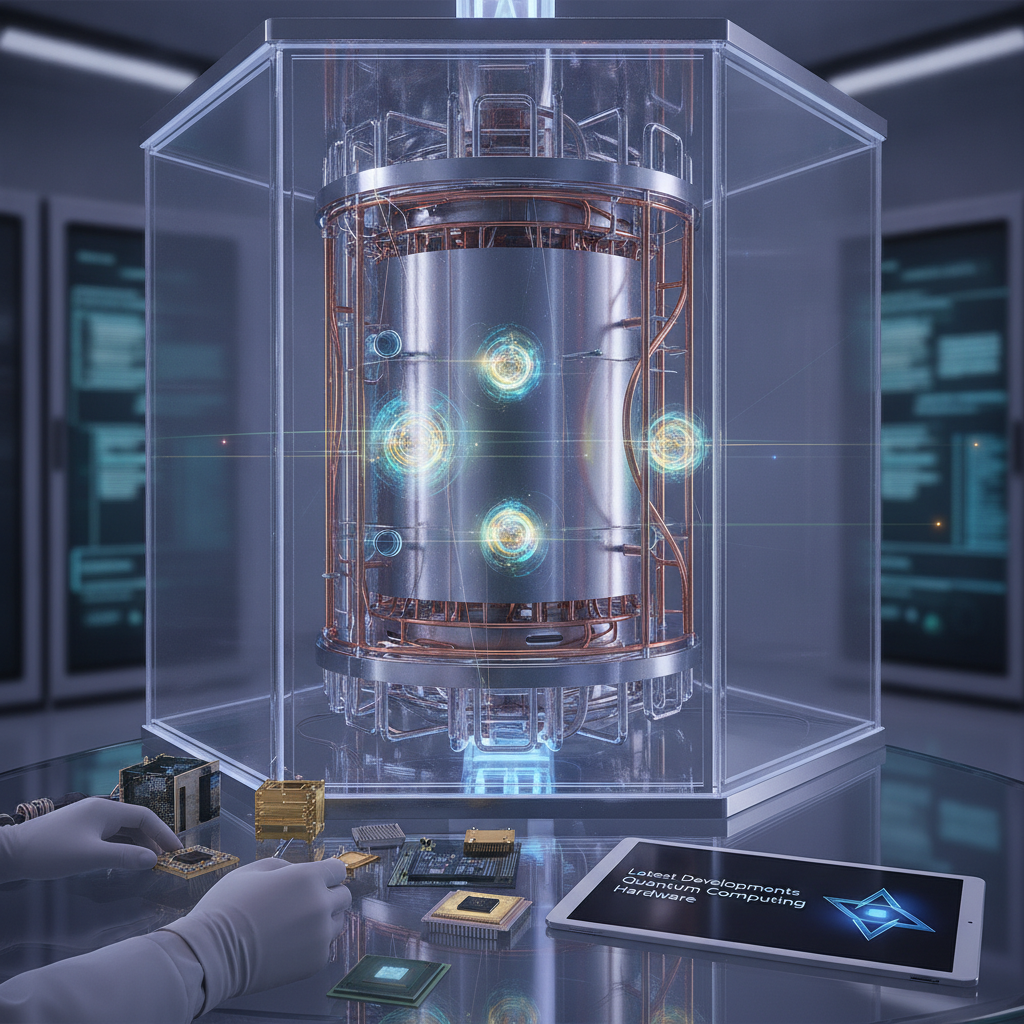
Quantum Hardware: The Next Frontier
The journey into quantum computing is accelerating, and while much attention goes to mind-bending algorithms, the true bedrock of this revolution lies in its hardware. Building stable, scalable, and error-resistant qubits is arguably the most challenging and exciting endeavor in quantum technology today. Let’s take a look at some of the incredible advancements bringing practical quantum machines closer to reality!
Superconducting Qubits: Still Leading the Pack
Superconducting qubits, famously utilized by companies like Google and IBM, continue to push boundaries. We’re seeing systems with qubit counts well over 100, and the focus is increasingly shifting from mere quantity to quality. Researchers are making impressive strides in extending coherence times (how long a qubit can reliably hold quantum information) and reducing error rates. Innovations in qubit design, such as advanced transmon and fluxonium circuits, are central to these improvements, all while operating at the ultra-cold temperatures of dilution refrigerators.
Trapped Ions: Precision and Connectivity
Trapped-ion systems boast some of the highest fidelity operations and excellent qubit-to-qubit connectivity, making them incredibly precise. Recent breakthroughs include the creation of larger, more complex arrays of ions, moving towards architectures that can dynamically shuttle ions between different processing zones – often referred to as “quantum charge-coupled device” (QCCD) architectures. This allows for greater scalability while maintaining their inherent high precision. These systems are demonstrating impressive gate fidelities, positioning them as strong contenders for future fault-tolerant quantum computers.
Semiconductor Qubits: The Silicon Advantage
Leveraging decades of expertise from the classical silicon chip industry, semiconductor (or silicon spin) qubits offer a highly promising path to mass scalability. These qubits, typically based on the spin of an electron within a quantum dot, are showing increasingly high fidelities, sometimes even at temperatures slightly warmer than those required for superconducting qubits. The grand vision is to integrate millions of these tiny quantum dots onto a single chip, mirroring classical processor manufacturing. Recent research has focused on perfecting control and entanglement between these delicate spins.
Emerging Architectures: A Diverse Landscape
Beyond the dominant platforms, a vibrant ecosystem of other quantum hardware approaches is flourishing. Neutral atom arrays, for example, are rapidly advancing, offering a unique blend of high connectivity and scalability by precisely manipulating individual atoms with lasers. Photonic qubits, which use particles of light, are also being explored for their inherent potential in quantum networking and communication, alongside their computational capabilities. Each approach brings distinct advantages and challenges, contributing to a rich tapestry of innovation.
The Road Ahead: Overcoming Quantum Hurdles
Despite these remarkable advancements, significant challenges remain. Scaling up to millions of qubits while maintaining high fidelity is crucial for achieving practical quantum error correction. This demands superior materials, more sophisticated cryogenic control electronics, and ingenious chip designs. The journey is complex and collaborative, but the relentless progress across all these hardware platforms is truly inspiring, driven by brilliant minds worldwide.
It’s an incredibly exciting era to witness the physical foundations of quantum computing take shape. The race to build the ultimate quantum machine is on, and every year brings us closer to a future transformed by this revolutionary technology!
“`


Leave a Reply