
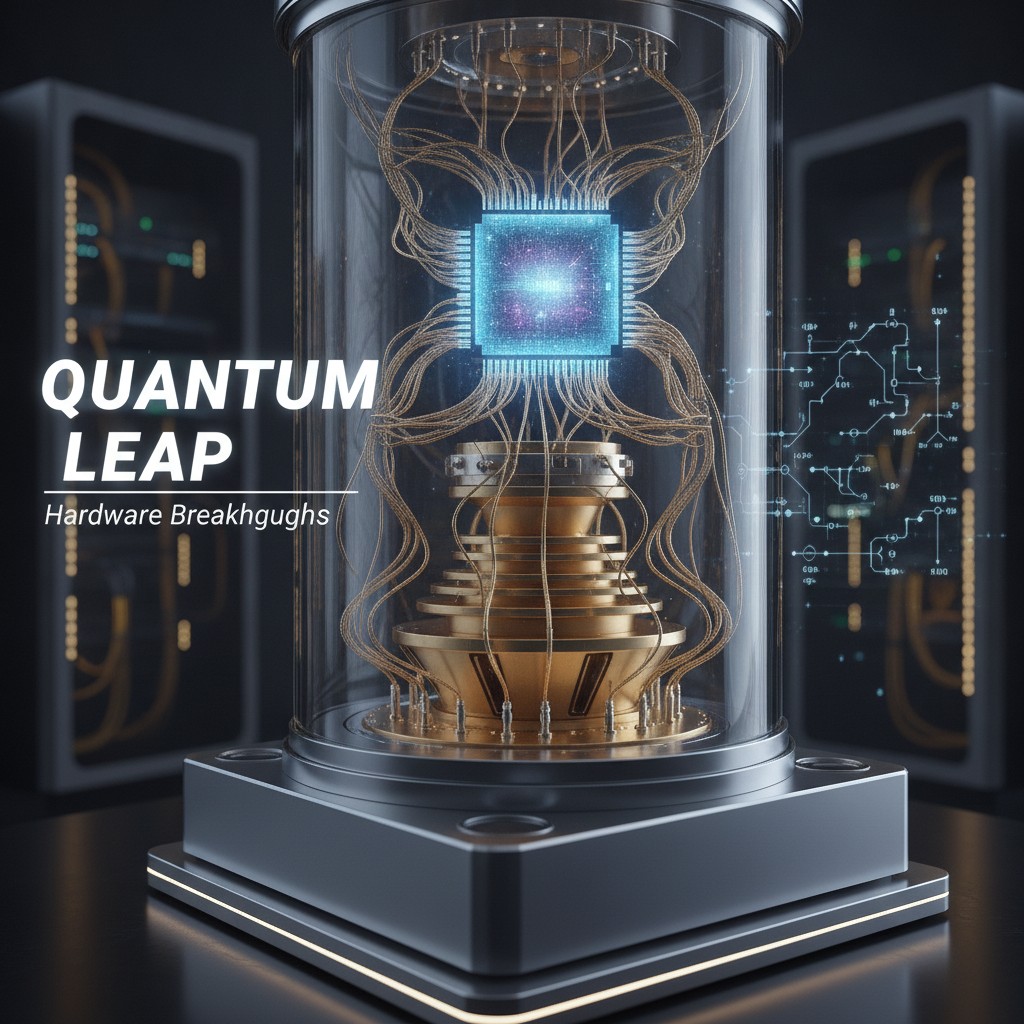
Quantum Leaps: Hardware’s Race to the Future
Welcome back to the blog, quantum enthusiasts! Today, we’re diving into one of the most exciting and rapidly evolving areas in technology: the incredible advancements in quantum computing hardware. While the theoretical side of quantum computing often grabs headlines, it’s the tireless work in laboratories around the world, perfecting the physical qubits, that’s truly bringing this futuristic technology closer to reality.
The Quantum Hardware Revolution
At its core, quantum computing promises to solve problems far beyond the reach of classical computers by leveraging quantum-mechanical phenomena like superposition and entanglement. But to harness these powers, we need stable, controllable, and scalable quantum bits, or “qubits.” The journey to build these qubits has been a marathon, not a sprint, involving intricate engineering, advanced physics, and a dash of innovative genius.
Diverse Paths to Quantum Power
There isn’t just one way to build a quantum computer, and this diversity is a huge strength. Researchers are exploring several promising architectures, each with its unique advantages and challenges:
- Superconducting Qubits: These are currently leading the pack in terms of qubit count and are used by giants like IBM and Google. They operate at extremely low temperatures, just a fraction above absolute zero, making them highly susceptible to environmental noise.
- Trapped Ions: Companies like IonQ are making significant strides with trapped ions. These qubits are individual atoms held in place by electromagnetic fields and manipulated with lasers. They boast long coherence times and high fidelity, but scaling them up efficiently remains a key challenge.
- Silicon Spin Qubits: Offering potential for manufacturability and compatibility with existing semiconductor technology, silicon spin qubits are an exciting dark horse. Intel and others are investing heavily, aiming to leverage the expertise from classical chip manufacturing.
- Topological Qubits: While still largely theoretical or in early experimental stages, topological qubits are sought after for their inherent resistance to noise, making them potentially highly stable for future, fault-tolerant quantum computers.
Recent Milestones: Pushing the Boundaries
The past few years have seen remarkable progress across all these platforms. We’re seeing:
- Increased Qubit Counts: From a handful of qubits, we’re now regularly seeing processors with tens, even hundreds, of operational qubits. While not all are perfectly connected or error-free, this growth is crucial for tackling more complex problems.
- Improved Coherence Times: Qubits are fragile. The longer they maintain their quantum state (coherence), the more complex operations they can perform. Breakthroughs in materials science and isolation techniques are significantly extending these times.
- Enhanced Qubit Fidelity: The accuracy of qubit operations and measurements is vital. Researchers are achieving lower error rates, a critical step toward fault-tolerant quantum computing where errors can be detected and corrected.
- Better Interconnectivity: Connecting qubits efficiently allows for more complex algorithms. New designs are emerging that improve the “all-to-all” connectivity, especially in trapped-ion systems, or local connectivity in superconducting arrays.
Overcoming Quantum Hurdles
Despite these amazing advancements, significant challenges remain. Scaling these systems up while maintaining performance, reducing error rates to practical levels for error correction, and managing the incredibly complex control electronics and cryogenic cooling systems are ongoing battles. The “quantum supremacy” demonstrations were just the beginning; the real race is now towards building truly useful, error-corrected quantum computers.
The Road Ahead for Quantum
These hardware advancements are not just theoretical triumphs; they are paving the way for practical applications in areas like drug discovery, material science, financial modeling, and AI optimization. Every breakthrough brings us closer to a future where quantum computers can solve problems previously thought impossible. It’s a journey filled with incredible engineering, scientific discovery, and profound implications for our world.
The quantum computing landscape is evolving at a breathtaking pace, driven by dedicated researchers and engineers pushing the boundaries of what’s possible. Keep an eye on this space – the next quantum leap might be just around the corner!


Leave a Reply