
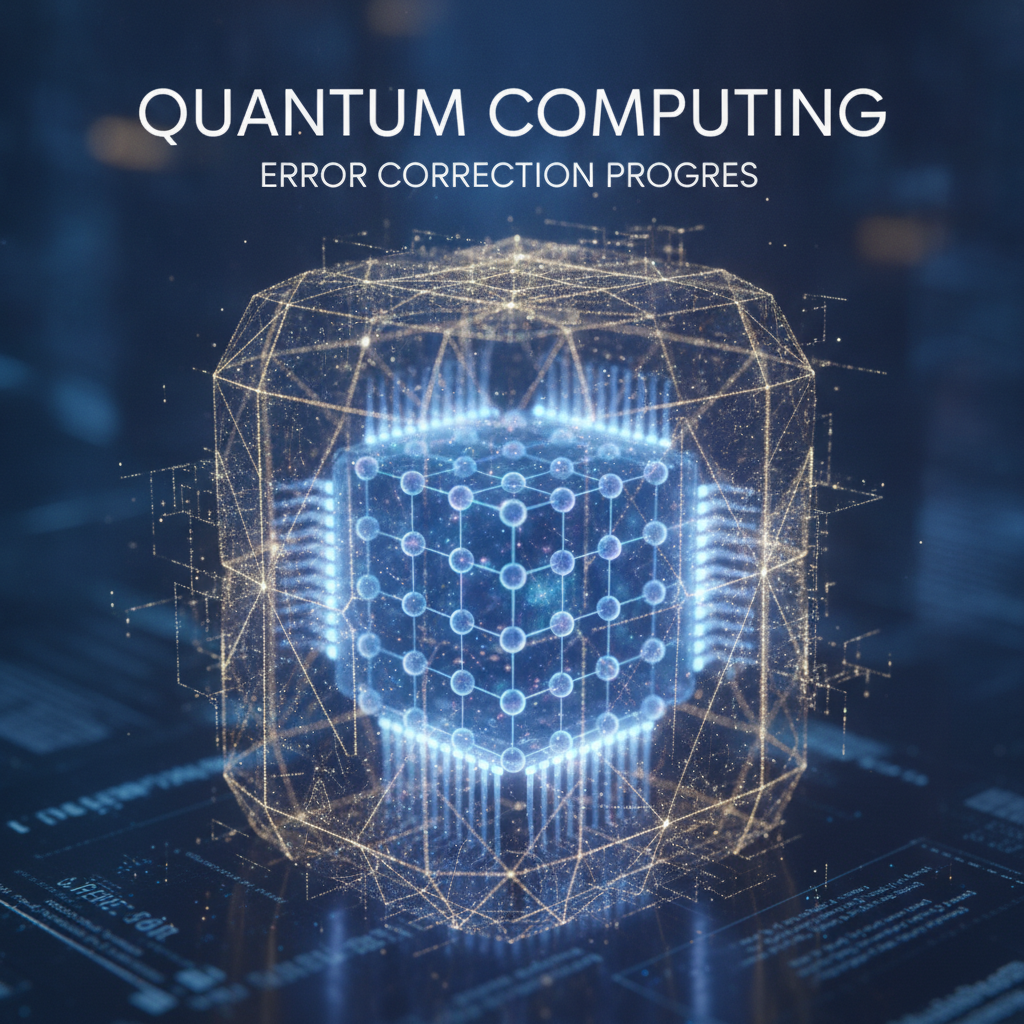
Quantum Error Correction: A Giant Leap Forward
Unlocking the Power of Quantum Computing
Quantum computing holds immense promise, poised to revolutionize fields from medicine to materials science. By harnessing the peculiar laws of quantum mechanics, these machines can tackle problems intractable for even the most powerful supercomputers. However, unlocking this potential isn’t straightforward. At the heart of the challenge lies the incredibly delicate nature of quantum information.
The Fragile World of Qubits
Unlike classical bits, which are simply 0 or 1, quantum bits (qubits) can exist in superpositions of both states simultaneously. They can also be entangled, a phenomenon where their fates are intertwined regardless of distance. This fragility makes them susceptible to environmental noise and interference, causing “errors” that lead to decoherence and loss of quantum information. Without effective error correction, quantum computations quickly become meaningless.
Beyond Classical Redundancy
Classical computers combat errors by simply copying information multiple times. If one copy is corrupted, others can be used. Quantum mechanics, however, forbids perfect copying of an unknown quantum state (the No-Cloning Theorem). This fundamental constraint means quantum error correction (QEC) must employ entirely different strategies. Instead of direct copying, QEC encodes quantum information redundantly across multiple entangled physical qubits to form a more robust “logical qubit.”
Significant Strides Towards Fault Tolerance
The past few years have seen remarkable progress in QEC. Researchers are developing increasingly sophisticated codes, such as surface codes, which are highly fault-tolerant and scalable. Experimental systems are demonstrating longer coherence times and lower error rates for physical qubits. Moreover, we’re seeing impressive achievements in encoding and manipulating logical qubits—the true building blocks of a fault-tolerant quantum computer. Companies and academic institutions are continuously pushing the boundaries, showing the ability to detect and correct specific types of errors in real-time.
For example, recent demonstrations have shown improved performance in creating and sustaining logical qubits, even outperforming their constituent physical qubits in certain metrics. This indicates we’re moving closer to the “break-even” point where error correction actively improves the reliability of quantum information, rather than just adding overhead.
The Path to Practical Quantum Computers
While still in its early stages, the progress in quantum error correction is incredibly encouraging. It’s the critical ingredient that will transform today’s noisy, intermediate-scale quantum (NISQ) devices into powerful, fault-tolerant quantum computers capable of truly revolutionary applications. The journey is complex, requiring advancements in both hardware stability and theoretical error-correction schemes, but each breakthrough brings us closer to a future where quantum computers deliver on their extraordinary promise.
A Brighter Quantum Future
The persistent and innovative work in quantum error correction is not just an academic pursuit; it’s the bedrock upon which the entire quantum computing revolution will be built. As researchers continue to refine techniques and build more robust logical qubits, the vision of powerful, error-free quantum machines draws ever nearer, promising a new era of computational possibilities.

Leave a Reply