
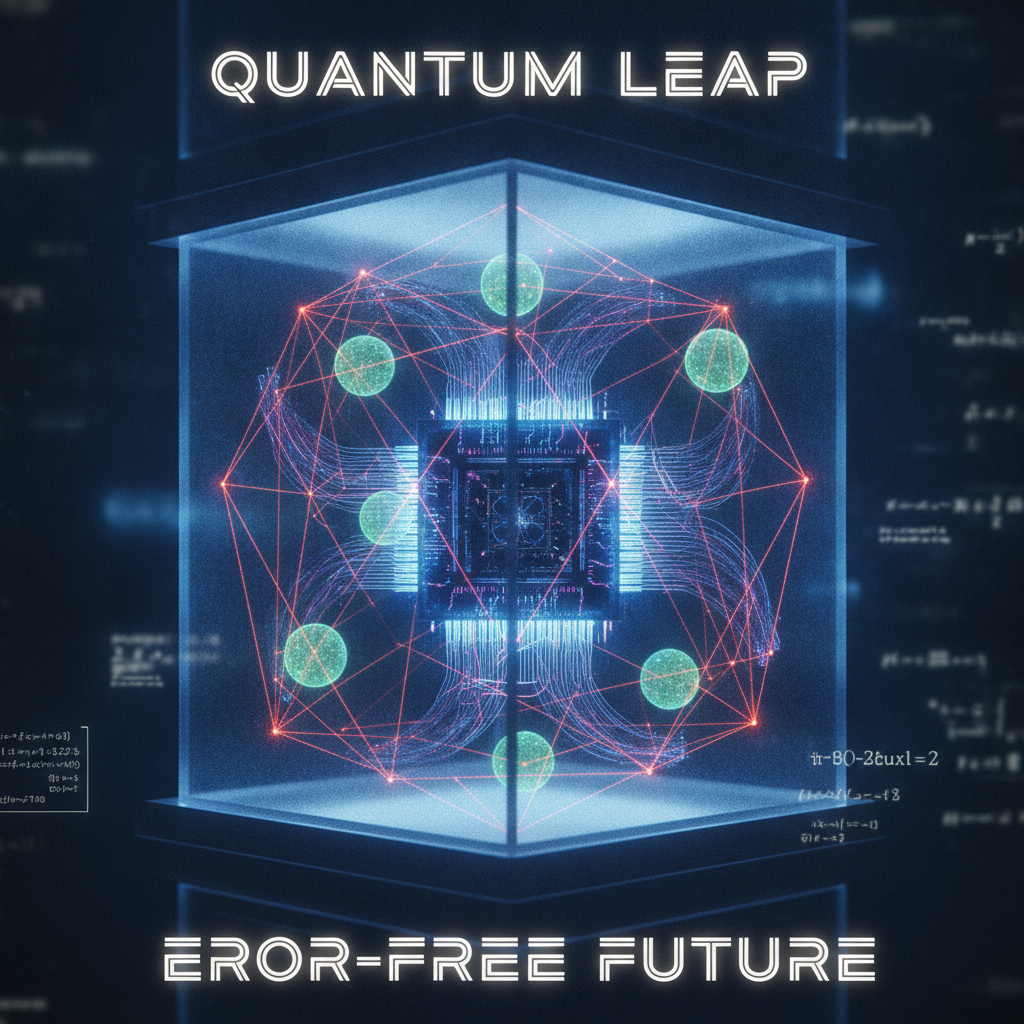
Quantum Leaps: Hardware & Error Correction Progress
Welcome, fellow enthusiasts, to the exciting frontier of quantum computing! It’s a field brimming with potential, promising to revolutionize everything from medicine and materials science to artificial intelligence. But realizing this potential isn’t a walk in the park. Two critical pillars are rapidly evolving to make it a reality: advancements in quantum hardware and sophisticated error correction techniques. Let’s dive in!
Building Better Qubits: The Hardware Revolution
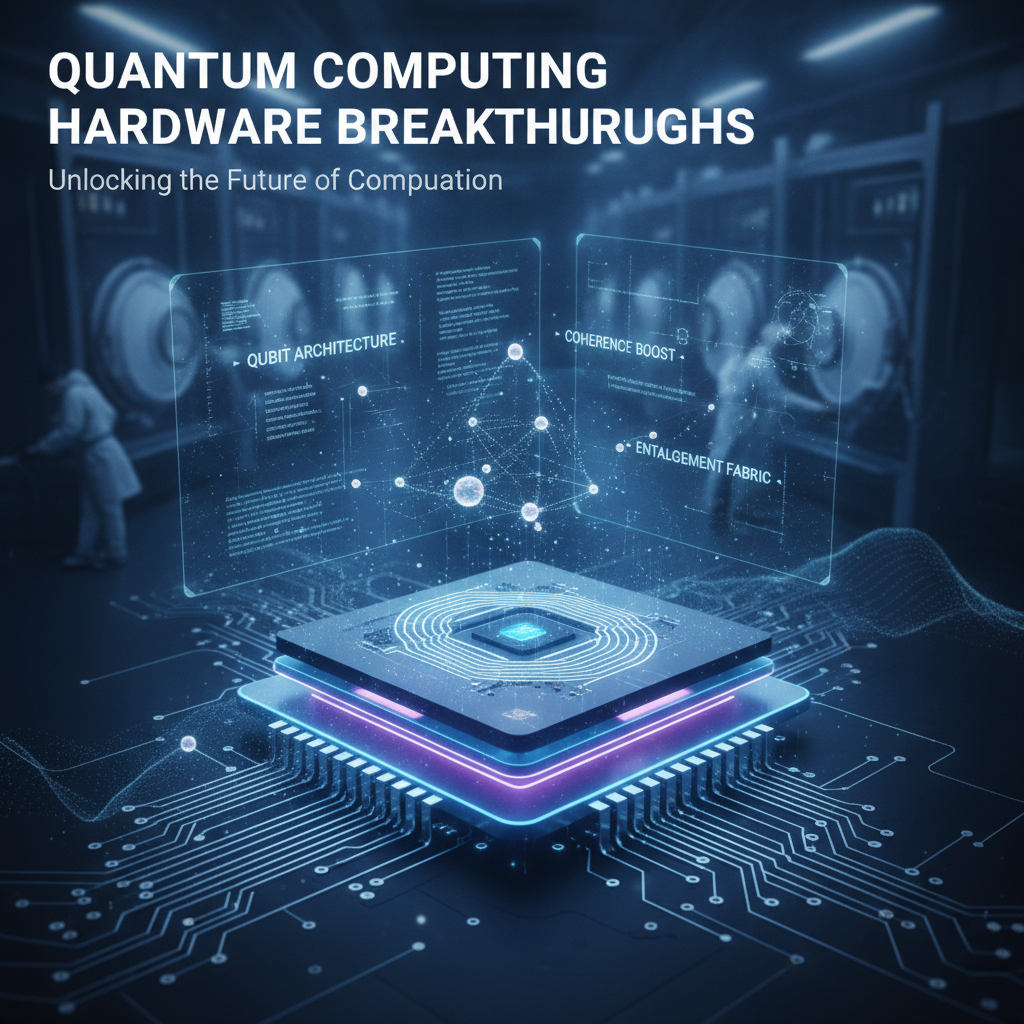
At the heart of any quantum computer are qubits – the quantum equivalent of classical bits. Unlike bits that can only be 0 or 1, qubits can exist in superposition (both 0 and 1 simultaneously) and be entangled, opening up immense computational power. Recent years have seen incredible progress in developing and scaling various qubit technologies:
Superconducting Qubits: Favored by giants like IBM and Google, these operate at ultra-low temperatures, demonstrating impressive connectivity and control. We’re seeing more qubits on a single chip and improved coherence times.
Trapped Ions: Known for their exceptionally high fidelity and long coherence times, trapped ions are a leading contender. Companies like IonQ are making strides in building modular systems with many individually addressable qubits.
Photonic Qubits: Utilizing photons as qubits offers speed and compatibility with existing fiber optics. While challenging to scale, breakthroughs in integrated photonics are bringing these closer to practical applications.
Silicon Qubits: Leveraging existing semiconductor manufacturing processes, silicon-based qubits (like spin qubits in quantum dots) show promise for scalability and long coherence at slightly higher temperatures.
The race is on to create more stable, coherent, and interconnected qubits – the fundamental building blocks for powerful quantum processors.
The Quantum Achilles’ Heel: Why Errors are a Big Deal
Quantum systems are incredibly delicate. Qubits are highly susceptible to “noise” from their environment, leading to a phenomenon called decoherence. This causes them to lose their quantum properties and revert to classical states, introducing errors into computations. Unlike classical computers where you can simply copy a bit to check for errors, the “no-cloning theorem” prevents direct copying of an unknown quantum state. This makes traditional error correction impossible and necessitates a fundamentally different approach.
Quantum Error Correction (QEC): The Path to Fault Tolerance
This is where Quantum Error Correction (QEC) steps in, acting as the guardian of quantum information. Instead of directly copying qubits, QEC encodes a single “logical” qubit across multiple “physical” qubits. By cleverly distributing information and exploiting entanglement, errors on individual physical qubits can be detected and corrected without disturbing the precious quantum state of the logical qubit.
Think of it like having a secret message written in a code. Even if a few letters get smudged, because of the code’s redundancy, you can still figure out the original message. QEC aims to do this for quantum information, allowing complex quantum algorithms to run reliably over extended periods.
Recent Breakthroughs Paving the Way
The field of QEC is seeing rapid experimental validation. Researchers are moving beyond theoretical proposals to demonstrating QEC in actual hardware:
Encoding and Protecting Logical Qubits: Experiments have successfully encoded a logical qubit using a small number of physical qubits (e.g., 7 or 13 physical qubits for one logical qubit) and shown that this logical qubit is indeed more robust to noise than its individual physical constituents.
Error Detection and Correction Cycles: Teams are demonstrating the ability to detect and correct errors in real-time, completing repeated error correction cycles – a crucial step towards sustained fault-tolerant operation.
Improved Code Architectures: Advances in theoretical QEC codes, like surface codes and topological codes, are being actively implemented and tested, pushing the boundaries of what’s experimentally feasible.
These milestones are critical, moving us closer to fault-tolerant quantum computing, where errors can be continuously mitigated, ensuring the integrity of computations.
The Road Ahead: Towards a Fault-Tolerant Future
While we’re still in the “Noisy Intermediate-Scale Quantum” (NISQ) era, where devices are prone to errors and limited in qubit count, the advancements in both hardware and QEC are incredibly promising. The journey to a truly fault-tolerant quantum computer – one capable of solving problems far beyond classical reach – will require thousands, if not millions, of physical qubits to create a handful of highly reliable logical qubits.
The ongoing interplay between improving qubit quality and developing more efficient error correction schemes is what will ultimately unlock the full power of quantum computing. It’s a complex, challenging, but exhilarating race towards a future we can only begin to imagine.
Wrapping Up
From superconducting circuits to trapped ions, and from the delicate dance of qubits to the intricate codes that protect them, the progress in quantum hardware and error correction is nothing short of revolutionary. These two areas are not just advancing in parallel; they are deeply intertwined, each pushing the other forward. Keep an eye on this space – the future of computing is being written right before our eyes!

Leave a Reply