
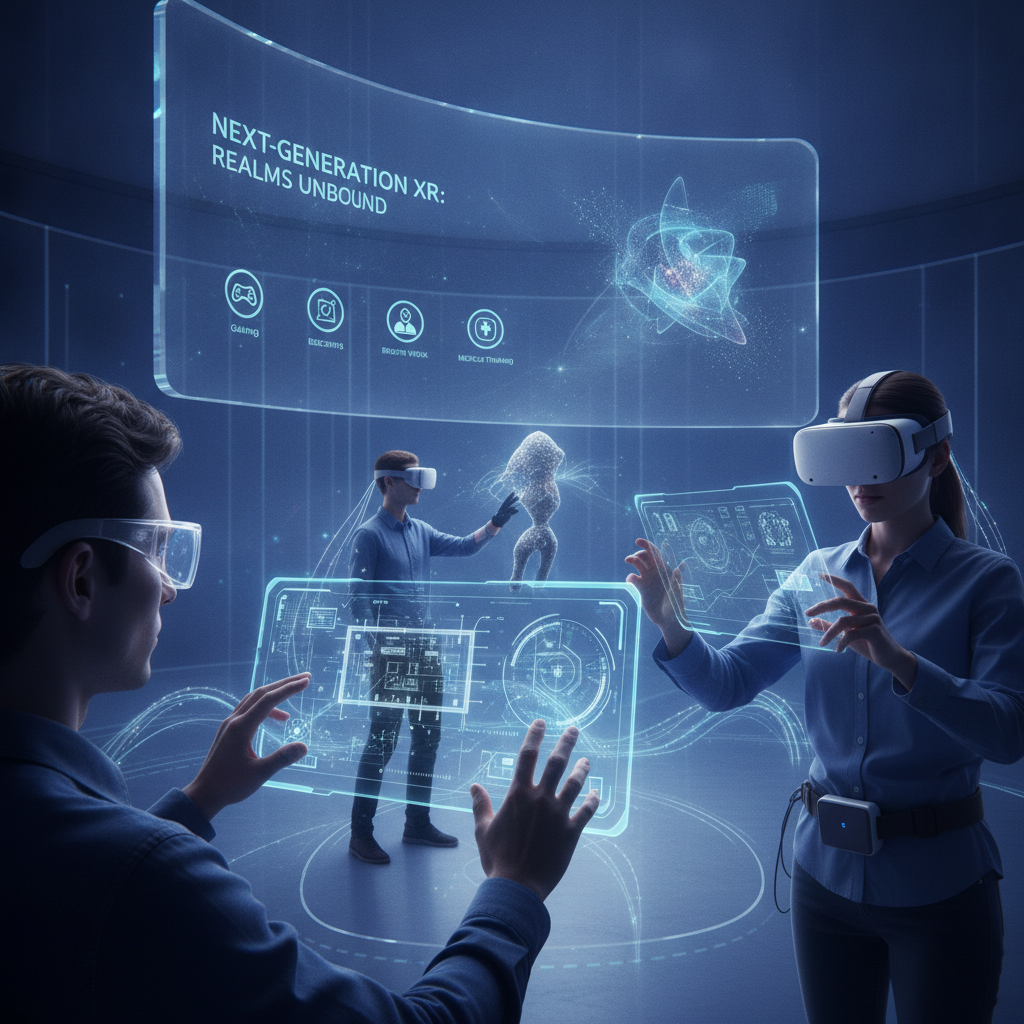
Stepping into Tomorrow: The Future of XR
Get ready to dive into a world where the lines between digital and physical blur! Extended Reality (XR) – an umbrella term encompassing Virtual Reality (VR), Augmented Reality (AR), and Mixed Reality (MR) – is no longer just a sci-fi dream. We’re on the cusp of a revolutionary leap, with next-generation devices and platforms set to redefine how we work, learn, play, and connect.
Hardware Horizons: Lighter, Sharper, Smarter
The latest advancements in XR hardware are truly mind-boggling. Imagine headsets that are sleek, lightweight, and as comfortable as your favorite pair of glasses, yet pack incredibly powerful processing capabilities. We’re seeing resolutions so high that individual pixels are virtually invisible, paired with wider fields of view that make experiences truly immersive.
Beyond visual fidelity, haptic feedback is becoming incredibly sophisticated, allowing us to “feel” digital objects with unprecedented realism. Eye-tracking and hand-tracking are evolving rapidly, making interactions more intuitive and natural, eliminating the need for bulky controllers in many scenarios. Plus, with integrated AI, these devices are learning and adapting to our unique environments and behaviors.
Platform Power: Intelligent and Interconnected Worlds
It’s not just about the gadgets; the platforms powering XR are undergoing a massive transformation too. Next-gen XR platforms are focusing on spatial computing – understanding and mapping our physical world in real-time, allowing digital content to seamlessly interact with it. Think persistent digital objects that stay in place even when you leave and come back!
Interoperability is key. We’re moving towards a future where your digital identity and assets can traverse different XR experiences and devices. Cloud-based rendering will offload heavy processing, enabling more complex and collaborative virtual environments. Developer ecosystems are flourishing, providing powerful tools for creators to build incredibly rich and engaging content, from hyper-realistic simulations to fantastical new worlds.
Transforming Industries: Beyond Gaming
While gaming and entertainment remain popular drivers, the impact of next-gen XR stretches far wider. In healthcare, surgeons are training with unparalleled realism, and patients are receiving innovative therapies. Education is becoming interactive and engaging, with virtual field trips and hands-on learning no longer limited by physical space.
For businesses, XR is revolutionizing remote collaboration, product design, and employee training. Architects can walk through virtual buildings, engineers can test prototypes digitally, and teams can meet in shared virtual spaces that feel incredibly natural, no matter their geographical location. Social interaction itself is poised for a major upgrade, offering new ways to connect with friends and family across distances.
The Road Ahead: Exciting Challenges and Opportunities
Of course, this journey isn’t without its challenges. Widespread adoption will depend on affordability, battery life improvements, and robust content libraries. Privacy and ethical considerations around data collection in these deeply immersive environments are also paramount and being actively addressed by developers and policymakers.
Despite these hurdles, the trajectory of Next-Generation Extended Reality is undeniably thrilling. We’re moving beyond simple entertainment to a future where XR devices and platforms become integral tools, enhancing our perception of reality and unlocking unprecedented levels of human connection and innovation.
So, buckle up! The future of XR isn’t just coming; it’s already beginning to unfold, promising a more immersive, interactive, and intelligent world right at our fingertips.
“`



Leave a Reply