
Quantum Leaps: Hardware & Algorithms Surging Ahead
Quantum computing, once a realm of theoretical physics, is rapidly transitioning into a tangible technological frontier. The past few years have witnessed breathtaking advancements not just in the foundational hardware that makes these computations possible, but also in the sophisticated algorithms designed to harness their unique power. This exciting synergy is propelling us towards a future where previously intractable problems might find elegant quantum solutions.
The Evolving Quantum Processor Landscape
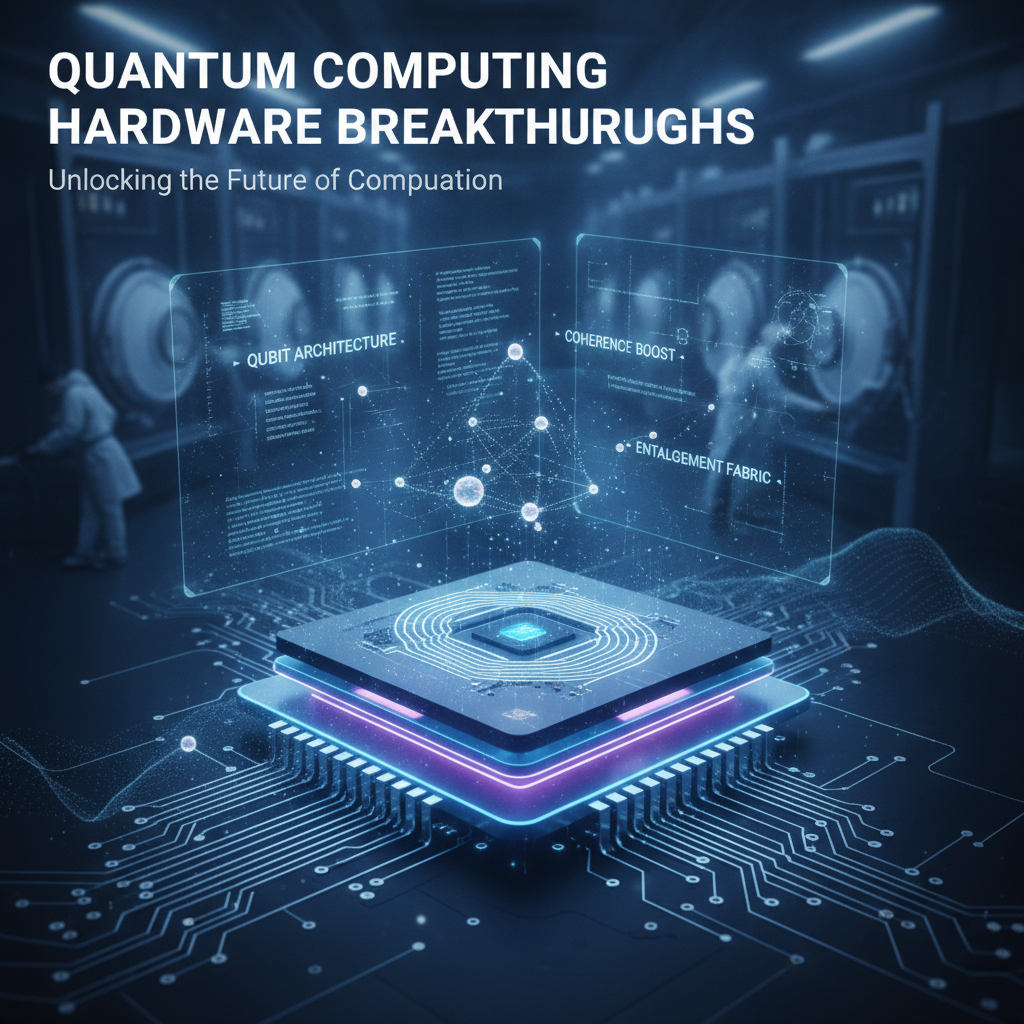
The quest for stable, controllable, and scalable qubits—the fundamental building blocks of quantum computers—is relentless. Superconducting qubits, pioneered by companies like IBM and Google, continue to push boundaries in qubit count, with devices now featuring hundreds of qubits. Trapped-ion systems, championed by IonQ, offer high fidelity and connectivity, consistently demonstrating impressive performance. Emerging contenders like neutral atoms and photonic systems are also showing immense promise, each bringing unique strengths to the table, from long coherence times to inherent error robustness.
While the sheer number of qubits is a compelling metric, equally critical are improvements in qubit coherence times (how long a qubit maintains its quantum state) and gate fidelities (the accuracy of operations). Significant engineering feats are being achieved to minimize environmental noise and optimize control mechanisms, steadily chipping away at the high error rates that currently limit the utility of today’s Noisy Intermediate-Scale Quantum (NISQ) devices. The path to fault-tolerant quantum computing, though long, is becoming clearer with these continuous hardware refinements.
Unlocking Potential: New Quantum Algorithms
Parallel to hardware evolution, the development of quantum algorithms is flourishing. For the current NISQ era, variational quantum algorithms like the Variational Quantum Eigensolver (VQE) for chemistry simulations and the Quantum Approximate Optimization Algorithm (QAOA) for combinatorial optimization problems are at the forefront. These hybrid algorithms leverage classical computers to optimize parameters for quantum circuits, making them suitable for present-day hardware constraints and showing early promise in specific domains.
Beyond NISQ, researchers are refining and discovering new algorithms that promise exponential speedups for a range of complex problems. Shor’s algorithm for factoring large numbers, and Grover’s algorithm for searching unsorted databases, remain benchmarks for the potential of future fault-tolerant machines. The implications span diverse fields: accelerating drug discovery and materials science through precise molecular simulations, optimizing financial models, and revolutionizing artificial intelligence with quantum machine learning techniques.
Hardware-Software Synergy and Future Outlook
The relationship between quantum hardware and algorithms is deeply symbiotic. Advances in qubit stability and error rates directly enable the execution of more complex and deeper quantum circuits, unlocking the potential for more sophisticated algorithms. Conversely, the demand for solving grand challenges with new algorithms drives the innovation and investment in advanced quantum hardware. This continuous feedback loop is vital for sustained progress.
While the journey is fraught with significant engineering and scientific challenges—from scalable error correction to robust cryogenic systems and integrated software stacks—the pace of innovation is undeniably accelerating. Research institutions, startups, and tech giants are all pouring resources into this field, fostering a vibrant ecosystem of collaboration and competition.
The advancements in quantum computing hardware and algorithms are not just incremental steps; they represent a fundamental shift in our computational capabilities. We are on the cusp of an era where quantum computers could solve problems currently beyond the reach of even the most powerful supercomputers. While the “quantum revolution” may still be a few years away from widespread impact, the foundational work happening today is laying the groundwork for a truly transformative future.
“`

Leave a Reply