
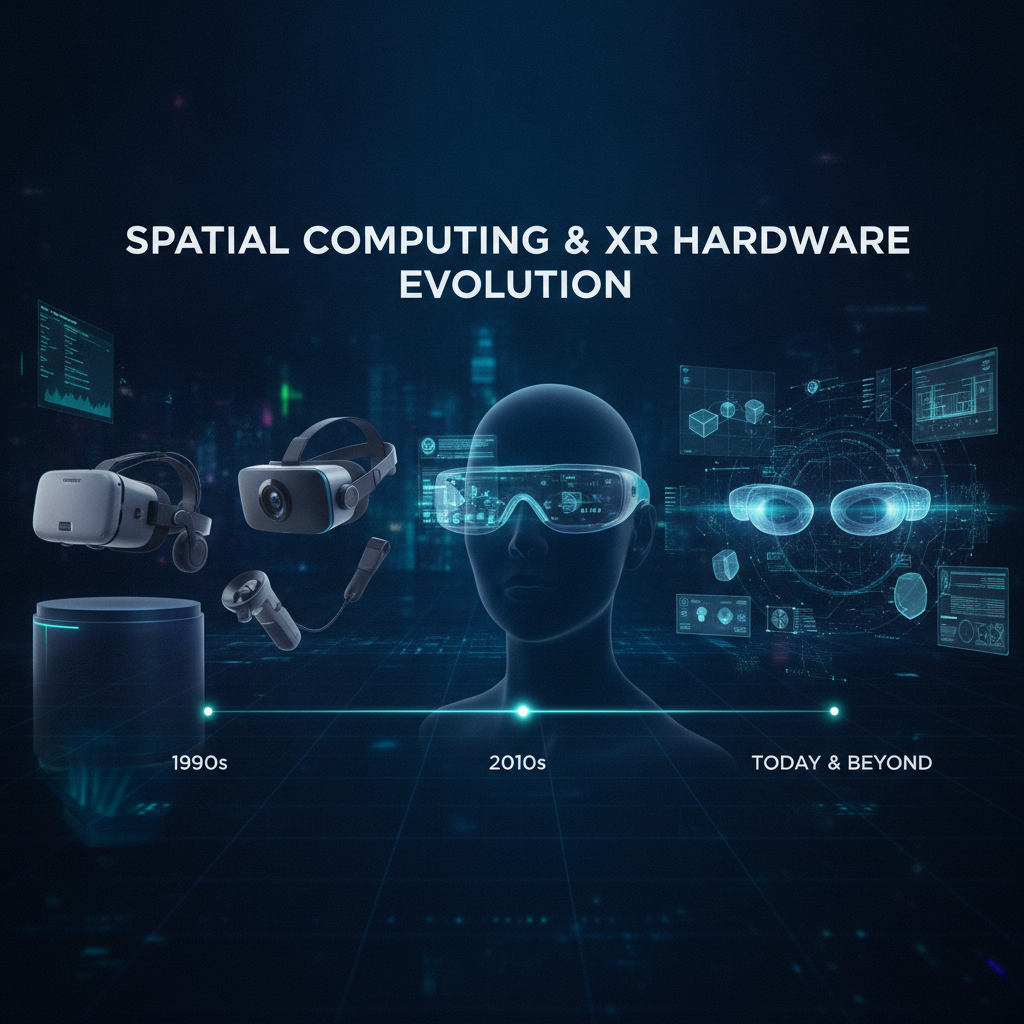
Spatial Computing & XR: Hardware’s Leap Forward
Welcome to the exciting world where digital and physical realities seamlessly merge! Spatial Computing, powered by incredible advancements in Extended Reality (XR) hardware, is transforming how we interact with technology and the world around us. Let’s take a journey through the evolution of the devices making this magic happen.
What is Spatial Computing?
At its core, Spatial Computing allows computers to understand and interact with the real-world environment, placing digital content directly into our physical space. It’s not just about wearing a headset; it’s about computing that respects and integrates with our physical surroundings. XR hardware – encompassing Virtual Reality (VR), Augmented Reality (AR), and Mixed Reality (MR) – is the window and interface to this new paradigm.
The Early Days: A Vision in Progress
Remember the early days of VR? Bulky headsets, pixelated screens, and a cord tethering you to a powerful PC. While groundbreaking for their time, devices like early Oculus Rift or HTC Vive were proof-of-concept more than mass-market products. They showed us the potential but highlighted major hurdles: comfort, resolution, field of view, and the sheer processing power required.
AR, too, started with relatively primitive overlays, often via smartphone cameras or experimental glasses that struggled with form factor and visual fidelity. The dream was clear, but the hardware wasn’t quite ready for prime time.
Hardware’s Renaissance: The Modern Era
Fast forward to today, and the landscape is dramatically different. We’re witnessing a “hardware renaissance” driven by relentless innovation. Key advancements include:
- Miniaturization & Ergonomics: Headsets are becoming lighter, more balanced, and increasingly comfortable for extended use.
- High-Resolution Displays: From LCD to OLED and now micro-OLED, resolutions have skyrocketed, drastically reducing the “screen door effect” and delivering stunning visual clarity.
- Powerful Processors: Dedicated XR chipsets (like Qualcomm Snapdragon XR2 Gen 2 or Apple’s M-series) provide standalone devices with desktop-class processing power, enabling complex applications without external computers.
- Advanced Sensors & Tracking: Inside-out tracking eliminates the need for external base stations. Passthrough cameras enable high-fidelity mixed reality, letting you see your real world with digital overlays. Eye-tracking and hand-tracking offer intuitive, natural interaction methods.
Key Drivers of XR Evolution
Displays: Windows to New Worlds
The display is paramount in XR. We’ve seen a rapid evolution from low-resolution LCD panels to vibrant OLED screens, and now to groundbreaking micro-OLED technology found in devices like the Apple Vision Pro. These advancements bring higher pixel density, better contrast, and wider color gamuts, making digital content feel more real and immersive. Combined with wider fields of view and higher refresh rates, the visual experience is continuously improving.
Processing Power: Untethered Performance
The shift to standalone XR devices has been transformative, largely thanks to powerful, efficient mobile processors. These chips are specifically designed for the demanding requirements of XR, handling high-resolution rendering, complex sensor data processing, and AI-driven features simultaneously. This has freed users from cables and external computers, making XR more accessible and versatile.
Interaction & Immersion: Beyond Controllers
While traditional controllers still have their place, the trend is towards more natural interaction. Hand-tracking allows you to use your own hands to manipulate virtual objects, while eye-tracking can be used for precise input or even foveated rendering (optimizing resolution where you’re looking). These technologies make the experience feel more intuitive and less like interacting with a computer, blurring the lines between user and interface.
The Road Ahead: What’s Next?
The journey is far from over. We can expect future XR hardware to become even lighter, perhaps resembling regular eyeglasses. Battery technology will improve, extending usage times. Haptic feedback will become more sophisticated, adding another layer of immersion. AI will play an increasing role in understanding context and personalizing experiences. As costs come down and capabilities expand, Spatial Computing and XR hardware are poised for widespread adoption across consumer, enterprise, and industrial sectors.
Conclusion: The Future is Spatial
From rudimentary prototypes to the sophisticated, high-fidelity devices of today, the evolution of XR hardware has been nothing short of spectacular. This continuous innovation is the bedrock upon which Spatial Computing is built, promising a future where our digital and physical lives are not just connected, but intrinsically intertwined. Get ready, because the spatial future is here, and it’s only just beginning!


Leave a Reply