
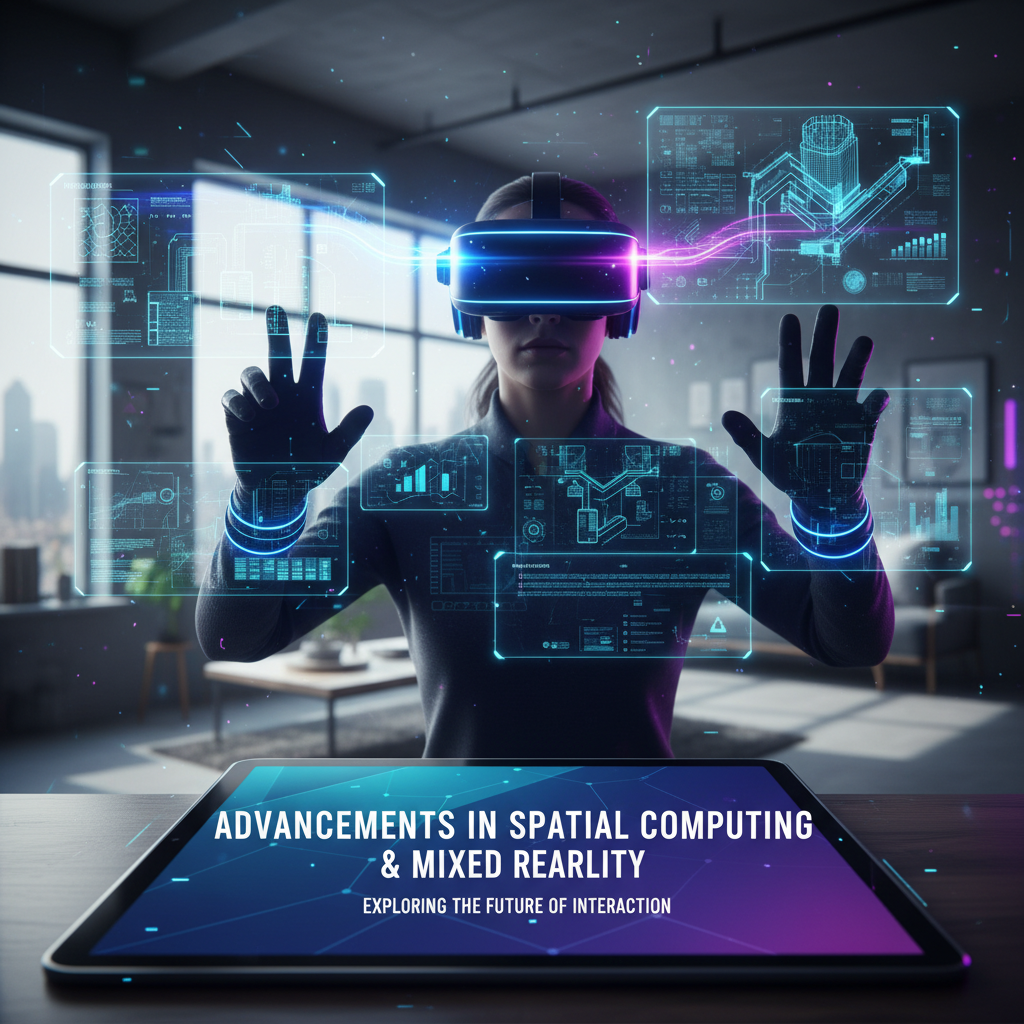
Step Into the Future: Spatial Computing & Mixed Reality
The lines between our physical and digital worlds are blurring at an incredible pace, thanks to groundbreaking advancements in spatial computing and mixed reality (MR). No longer confined to science fiction, these technologies are rapidly redefining how we interact with information, each other, and our environments. Get ready to explore a future where digital content seamlessly integrates with your reality!
What is Spatial Computing Anyway?
Before we dive into the cool stuff, let’s clarify. Spatial computing is essentially the ability for computers to understand and interact with the physical world in a three-dimensional way. It’s the technology that allows devices to perceive space, objects, and people, enabling digital content to exist and interact meaningfully within our physical surroundings. Mixed reality, a key interface for experiencing this, blends virtual objects with the real world in real-time, allowing you to “see” and interact with digital elements as if they were physically present.
Recent Leaps in Technology
The past few years have seen exponential growth across several fronts. We’re witnessing a rapid evolution that’s making MR more accessible and powerful than ever:
- Hardware Evolution: Lighter, more comfortable headsets with wider fields of view and higher resolution displays are hitting the market. Advanced sensors for environmental understanding and precise hand tracking are becoming standard, moving beyond bulky prototypes to more consumer-ready devices.
- Software Innovation: Powerful development kits (SDKs) and platforms are empowering creators to build richer, more interactive MR experiences. Artificial Intelligence (AI) and Machine Learning (ML) are playing a crucial role in improving object recognition, spatial mapping, and user interaction, making digital elements more responsive and “aware” of their surroundings.
- Connectivity: The rise of 5G and advancements in cloud computing are enabling complex MR experiences to be rendered remotely and streamed to devices. This reduces reliance on on-board processing power, opening doors for massive, shared virtual spaces and more sophisticated applications.
Transforming Industries & Daily Life
The impact of spatial computing and MR extends far beyond entertainment. These technologies are poised to revolutionize numerous sectors:
- Enterprise & Education: Imagine remote collaboration where colleagues can interact with 3D models as if they’re in the same room, regardless of their physical location. Or immersive training simulations for surgeons, engineers, and first responders, offering hands-on experience in a safe, controlled environment.
- Design & Manufacturing: Architects can walk through their building designs before they’re built, making real-time adjustments. Manufacturers can overlay digital instructions onto real machinery for assembly, maintenance, or quality control, boosting efficiency and reducing errors.
- Entertainment & Social: Picture attending a concert with friends, each from their own home, yet all sharing a virtual space that blends seamlessly with your living room. Or playing interactive games that use your entire house as the playground, blending digital elements with your physical environment.
The Road Ahead: Challenges & Promise
While the future of spatial computing and mixed reality is undoubtedly bright, there are still hurdles to overcome. Reducing hardware costs, increasing battery life, and fostering a robust ecosystem of compelling content are ongoing challenges. However, the trajectory is clear. As these technologies mature, they promise to unlock unprecedented levels of creativity, collaboration, and immersion, fundamentally changing our relationship with technology and the world around us.
Conclusion: Your Reality, Enhanced
Spatial computing and mixed reality aren’t just incremental upgrades; they represent a paradigm shift. They invite us to step beyond flat screens and into an interactive, digital-physical continuum where information is no longer confined to a display but becomes an integrated part of our environment. The future is spatial, and it’s arriving faster than you think. Are you ready to explore the possibilities and enhance your reality?
“`

Leave a Reply