
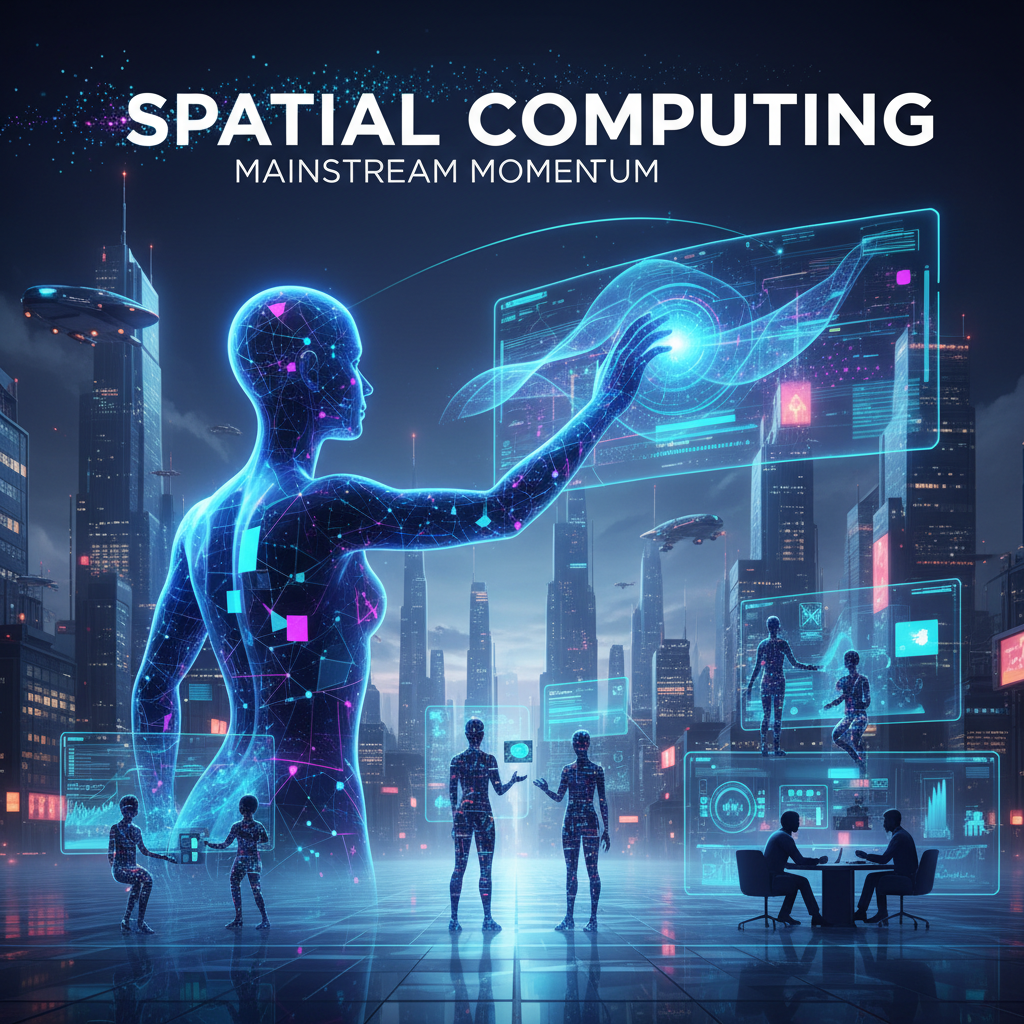
Stepping Into Tomorrow: Why Spatial Computing’s Mainstream Moment Is Now
Remember a time when our digital lives were confined to flat screens? While smartphones and laptops still dominate, a groundbreaking shift is underway, inviting us to step into our digital world rather rather than just looking at it. Spatial computing, once a futuristic concept, is rapidly gaining mainstream momentum, promising to redefine how we interact with information, work, and even entertain ourselves.
What Exactly Is Spatial Computing?
At its core, spatial computing is about blending digital content with our physical environment in a way that feels natural and intuitive. Think beyond virtual reality (VR) or augmented reality (AR) as separate entities; spatial computing encompasses both, creating experiences where digital objects coexist with and react to the real world around us. It’s about interacting with data, apps, and people in a three-dimensional space, using gestures, gaze, and voice, rather than just clicks and taps.
The Tipping Point: Drivers of Mainstream Adoption
So, why now? Several key factors are converging to push spatial computing from niche technology to mainstream contender:
- Hardware Evolution: Devices like Apple’s Vision Pro, Meta Quest headsets, and Magic Leap are becoming more powerful, comfortable, and accessible, offering unprecedented fidelity and processing power.
- Robust Ecosystems: Developers are building increasingly sophisticated applications and platforms, creating compelling use cases across various sectors.
- Enterprise Recognition: Businesses are realizing the immense potential for training, design, remote collaboration, and operational efficiency, driving significant investment and adoption.
- Consumer Curiosity: The novelty factor combined with genuine utility is piquing consumer interest, moving beyond early adopters.
Beyond Gaming: Real-World Applications Flourish
While gaming and entertainment have always been early frontiers for immersive tech, spatial computing’s real mainstream impact is being felt across diverse industries:
- Healthcare: Surgeons use AR overlays for precision, medical students practice complex procedures in VR, and patients receive therapy in immersive environments.
- Manufacturing & Design: Engineers prototype designs in 3D, collaborate on virtual models from across the globe, and workers receive step-by-step assembly instructions overlaid onto real machinery.
- Education: Students embark on virtual field trips to ancient Rome or explore the human body in exquisite detail, making learning more engaging and effective.
- Retail: Customers virtually try on clothes or place furniture in their homes before buying, enhancing the online shopping experience.
- Work & Collaboration: Imagine attending meetings where colleagues appear as realistic avatars around a shared virtual whiteboard, regardless of their physical location.
What This Means for You: A Glimpse into the Future
As spatial computing continues its trajectory, its influence on our daily lives will become increasingly pervasive. We’re moving towards a future where our digital tools are no longer confined to screens but are interwoven with our physical reality, creating more intuitive, efficient, and engaging experiences. This isn’t just about entertainment; it’s about fundamentally changing how we learn, work, communicate, and interact with the world around us. It’s an exciting, transformative journey, and we’re just at the beginning.
The mainstream momentum of spatial computing is undeniable, signaling a new era of human-computer interaction. It’s a field brimming with innovation and potential. What are your thoughts on this exciting shift? How do you envision spatial computing impacting your world? Share your insights in the comments below!
“`


Leave a Reply