Unlocking Creativity: The Power of Multimodal Generative AI
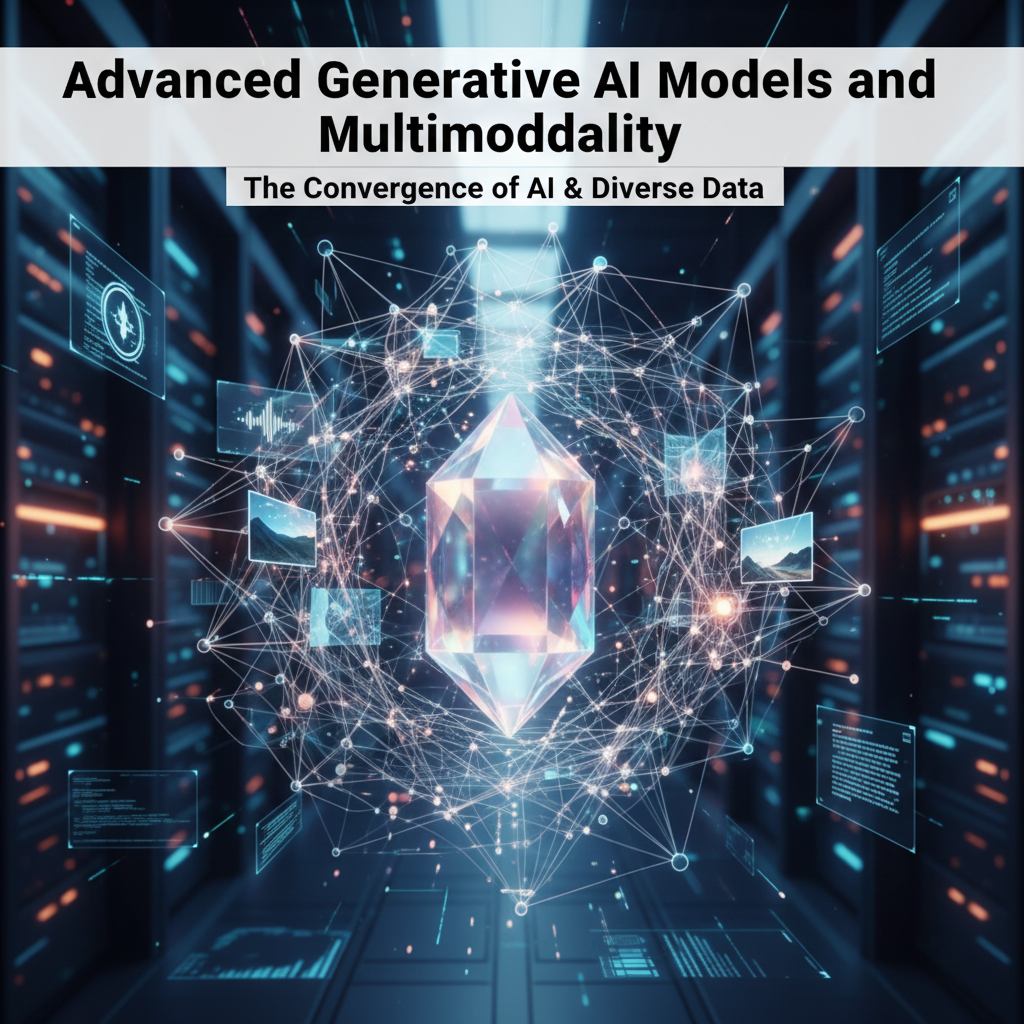
Welcome to the forefront of artificial intelligence! If you’ve been following the rapid advancements in AI, you’ve undoubtedly heard about generative models like ChatGPT or Midjourney. But what’s next? The answer lies in combining these incredible capabilities with something even more profound: multimodality. Let’s dive into how Advanced Generative AI Models are embracing and excelling with multimodality, pushing the boundaries of what machines can create and understand.
What is Multimodality in AI?
At its core, multimodality in AI refers to the ability of a system to process, understand, and generate information across multiple types of data, or “modalities.” Think of how humans interact with the world: we see, hear, speak, and touch. Each of these is a different modality. Historically, AI models excelled at one specific task within a single modality – a text model for language, an image model for vision. Multimodal AI breaks down these silos, allowing models to learn from and integrate information from various sources simultaneously.
For generative AI, this means moving beyond just text-to-text or image-to-image. It’s about models that can take a text prompt and generate a high-quality image (like DALL-E or Stable Diffusion), or even generate video, 3D models, or music from a simple description.
The Synergy of Different Data Types
The real magic happens when different modalities are brought together. Imagine a model that understands not just the words in a description but also the visual nuances, the spatial relationships, or even the emotional tone conveyed. This cross-modal understanding leads to richer, more coherent, and more contextually aware outputs.
- Text + Image: Generate artwork from poetic descriptions.
- Text + Audio: Create custom sound effects or music scores based on a screenplay.
- Image + Text: Caption complex scenes accurately or answer questions about an image’s content.
- Video + Text + Audio: Summarize an entire movie, including dialogue, visuals, and background music.
This synergy allows for a more holistic interpretation of user intent and a more sophisticated generation of content that resonates deeply across different sensory experiences.
Powering Multimodal Capabilities: Key Technologies
Several technological breakthroughs are enabling this leap forward:
Large Language Models (LLMs): Models like GPT-4, though primarily text-based, are often the “brain” orchestrating multimodal tasks. They provide the deep semantic understanding needed to interpret complex prompts and guide the generation process across other modalities.
Diffusion Models: These have revolutionized image and video generation, capable of creating incredibly realistic and diverse content by iteratively refining noisy data. They are increasingly being adapted for 3D and other modalities.
Transformer Architectures: The underlying architecture for many of these models, transformers excel at understanding long-range dependencies and relationships within and across different data types, making them ideal for multimodal integration.
Cross-Attention Mechanisms: A crucial component allowing models to “pay attention” to relevant parts of one modality (e.g., words in a prompt) when processing another (e.g., pixels in an image).
Applications and Impact on Industries
The implications of advanced multimodal generative AI are vast and transformative:
- Creative Industries: Revolutionizing graphic design, film production, music composition, and game development by enabling rapid prototyping and ideation.
- Education: Creating interactive learning materials, generating visual explanations for complex topics, or even personalized virtual tutors.
- Accessibility: Enhancing experiences for individuals with disabilities through advanced image descriptions, video summarization, or text-to-sign language generation.
- Marketing & Advertising: Producing highly targeted and personalized content across various media formats with unprecedented efficiency.
- Scientific Research: Accelerating discovery by generating hypotheses, visualizing complex data, or even designing new molecules.
From generating a compelling marketing campaign complete with visuals and audio, to designing an entirely new architectural concept from a simple sketch and text description, the possibilities are genuinely boundless.
The Road Ahead: Challenges and Opportunities
While the advancements are breathtaking, the journey is still unfolding. Challenges include the massive computational resources required to train and run these models, the need for even larger and more diverse multimodal datasets, and critical ethical considerations around bias, intellectual property, and responsible use.
However, the opportunities for innovation, creative expression, and solving complex real-world problems are immense. As these models become more sophisticated and accessible, they promise to unlock unprecedented levels of creativity and understanding, fundamentally changing how we interact with technology and the world around us.
Advanced Generative AI Models are not just getting better; they are becoming more holistic. By embracing multimodality, AI is moving closer to mimicking human intelligence in its ability to perceive and create across diverse sensory inputs. We’re truly entering an exciting new era where imagination is the only limit to what AI can help us achieve.
What multimodal AI application excites you the most? Share your thoughts in the comments below!
“`

Leave a Reply