
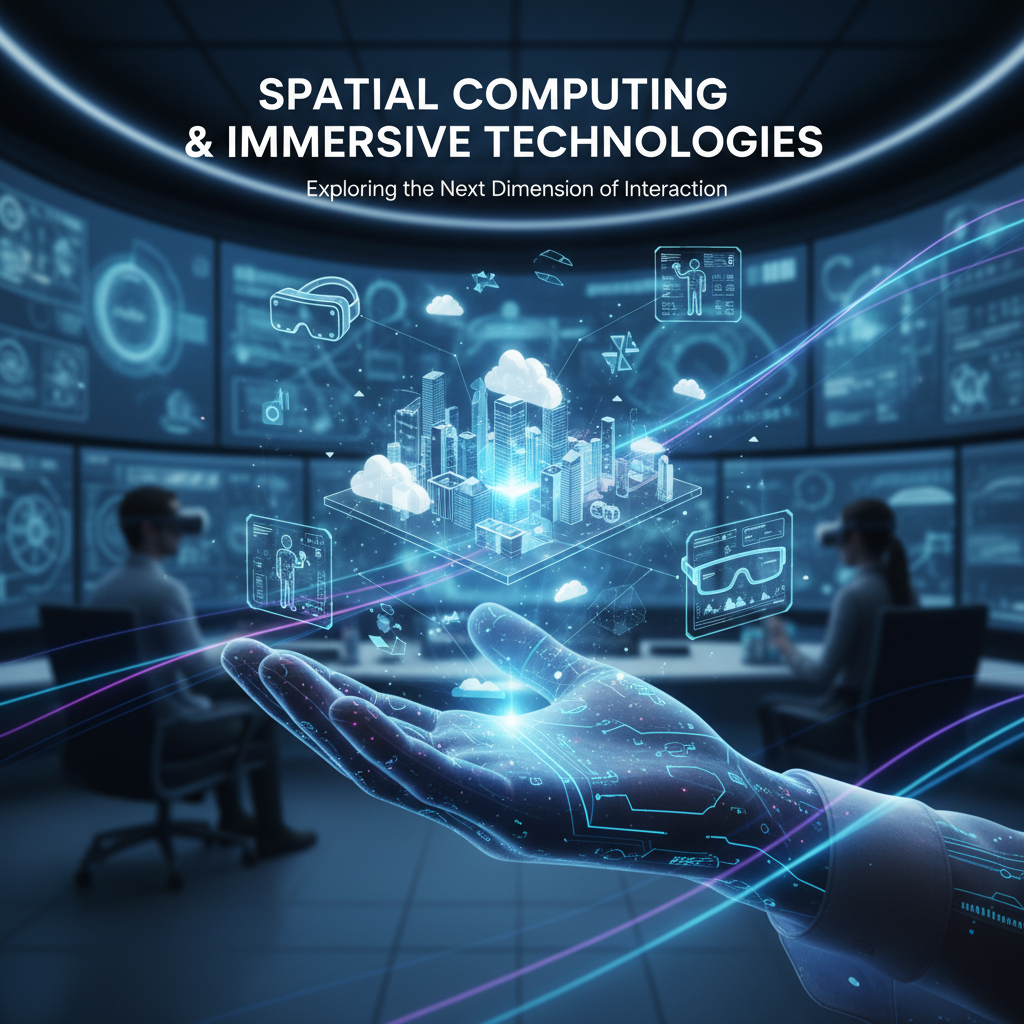
Step Into Tomorrow: Spatial Computing Unveiled!
Ever feel like your digital world is constrained by a flat screen? Get ready to break free! We’re on the cusp of a revolutionary shift, moving beyond clicks and swipes into an era where our digital interactions blend seamlessly with our physical surroundings. Welcome to the captivating world of Spatial Computing and Immersive Technologies!
What Exactly is Spatial Computing?
At its core, Spatial Computing is the concept of a computer understanding and interacting with the real world – its objects, spaces, and even people – in three dimensions. Instead of just displaying information on a screen, it allows digital content to exist and behave within our physical environment. Imagine digital objects that “know” where your coffee table is, or virtual collaborators sitting across from you in your living room. It’s about making computing intuitive, contextual, and truly integrated with how we experience the world.
The Technologies Behind the Magic
This exciting field is powered by a suite of cutting-edge immersive technologies. You’ve likely heard of:
- Virtual Reality (VR): Fully immerses you in a digital world, often experienced through headsets like Meta Quest or PlayStation VR, transporting you to new places or fantastical realms.
- Augmented Reality (AR): Overlays digital information onto your real-world view, enhancing what you see. Think of smartphone filters, Pokémon GO, or professional tools like Microsoft HoloLens that project holograms into your workspace.
- Mixed Reality (MR): Takes AR a step further, allowing digital objects not only to appear in your real world but also to interact with it, understanding depth, occlusion, and even physics.
These technologies, combined with advancements in sensors, AI, and haptic feedback, are creating experiences that blur the lines between what’s real and what’s digital in truly profound ways.
Beyond Entertainment: Real-World Applications
While immersive technologies are famous for gaming and entertainment, their impact stretches far wider, promising to transform nearly every industry:
- Healthcare: Surgeons can practice complex procedures, medical students can explore the human body in 3D, and patients can receive therapy in calming virtual environments.
- Education & Training: Students can take virtual field trips to ancient Rome or outer space, while employees can undergo realistic simulations for dangerous jobs without any risk.
- Manufacturing & Design: Engineers can collaborate on 3D models of products in shared virtual spaces, making changes in real-time before a single physical prototype is built.
- Retail & E-commerce: Imagine trying on clothes virtually or placing furniture in your living room before you buy it, all through your smartphone or smart glasses.
From enhancing productivity and efficiency to fostering entirely new forms of creativity and connection, the possibilities are virtually limitless.
Embracing the Spatial Future
Spatial Computing and Immersive Technologies aren’t just futuristic concepts; they are rapidly becoming a tangible part of our present. As devices become more powerful, accessible, and less obtrusive, our daily lives will increasingly be touched by these innovations. We’re moving towards a world where our digital tools are no longer confined to screens but are interwoven with the fabric of our physical existence.
So, are you ready to step into tomorrow? Keep an eye on this space – the future is not just coming; it’s inviting you to walk right in!
“`



Leave a Reply