
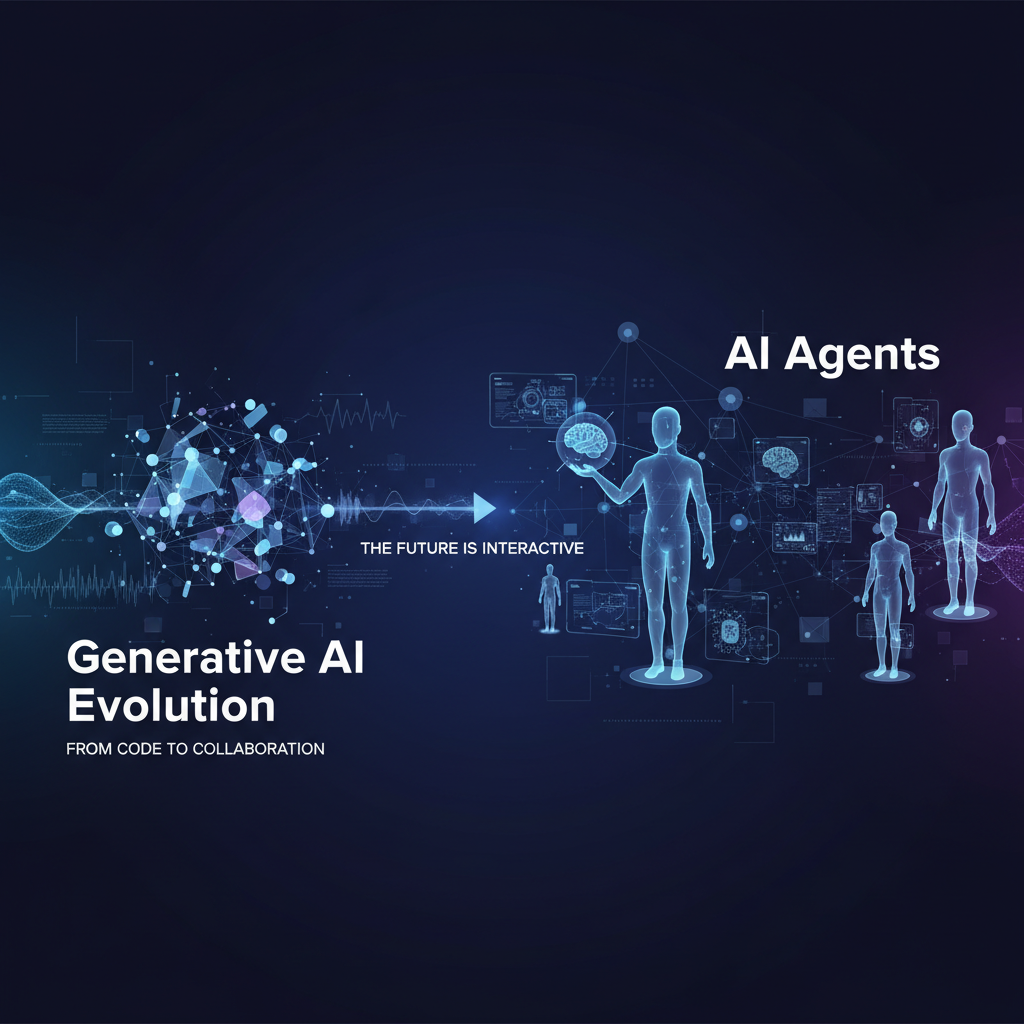
From Generative AI to Autonomous Agents
Remember when Generative AI burst onto the scene, dazzling us with its ability to create stunning images, write compelling text, and even generate code? It felt like science fiction becoming reality, and frankly, it still does! But what if I told you that was just the beginning? We’re now witnessing the next exciting leap: the evolution of Generative AI into sophisticated AI Agents.
Generative AI: A Retrospective on Rapid Progress
The past few years have been nothing short of revolutionary for Generative AI. From Large Language Models (LLMs) like ChatGPT churning out human-like prose, to text-to-image models creating breathtaking art from simple prompts, the creative capabilities have been astounding. We’ve seen it assist programmers, inspire artists, and even help scientists accelerate discovery. It’s transformed how we interact with technology, making creation more accessible and efficient than ever before.
The core strength of Generative AI lies in its ability to understand patterns in vast datasets and then generate novel outputs that fit those patterns. It’s brilliant at responding to specific prompts and fulfilling defined tasks. But it generally waits for *us* to give it the next instruction.
Enter the Era of AI Agents: Beyond Simple Generation
So, what exactly is an AI Agent, and how does it differ from the Generative AI we’ve grown to love? Think of an AI Agent as a Generative AI model with an added layer of autonomy, planning, and tool-use capabilities. Instead of simply generating a response to a single prompt, an AI Agent can:
- Understand Complex Goals: It can take a high-level objective and break it down into smaller, manageable sub-tasks.
- Plan and Execute: It develops a strategy to achieve its goal and takes sequential actions.
- Use Tools: It can interact with external systems, databases, web browsers, or APIs to gather information or perform actions.
- Learn and Adapt: It can observe the outcomes of its actions and adjust its future plans.
- Maintain State and Memory: It remembers past interactions and decisions to inform future ones.
Imagine telling an AI Agent, “Plan and book a weekend trip to a beach destination, considering my budget and preference for quiet places.” Instead of just suggesting destinations, it would research flights and hotels, check reviews, compare prices, and even initiate bookings, all while keeping your constraints in mind. It’s a proactive problem-solver, not just a reactive generator.
How AI Agents Work Their Magic
At the heart of an AI Agent often lies a powerful LLM, which acts as its “brain” for reasoning and decision-making. However, this brain is augmented with several crucial components:
- Planning Module: Breaks down complex tasks into smaller, executable steps.
- Memory: Stores past experiences, observations, and relevant information for long-term consistency.
- Tool Use Module: Allows the agent to access and leverage external tools (e.g., search engines, calendars, APIs).
- Reflection/Self-Correction: Enables the agent to evaluate its own actions and learn from mistakes, iteratively improving its performance.
This multi-faceted approach allows AI Agents to tackle problems requiring multiple steps, dynamic decision-making, and interaction with the real world (or digital world, at least!).
The Future is Autonomous: Impact and Implications
The rise of AI Agents promises to usher in a new era of automation and intelligent assistance across countless domains:
- Personal Productivity: Imagine an agent managing your schedule, email, research, and even drafting presentations.
- Software Development: Agents could write, test, debug, and even deploy code with minimal human oversight.
- Customer Service: Highly personalized and proactive support that anticipates needs and resolves issues autonomously.
- Scientific Research: Agents designing experiments, analyzing data, and synthesizing findings.
Of course, with great power comes great responsibility. The development and deployment of AI Agents will require careful consideration of ethics, safety, control, and transparency. Ensuring these agents align with human values and operate reliably will be paramount.
Embracing the Next Frontier
From simple text generation to autonomous, goal-driven agents, the evolution of Generative AI is a testament to humanity’s relentless pursuit of innovation. We’re moving from a world where AI creates to one where AI actively contributes and collaborates. The journey of AI agents is just beginning, and it promises to be one of the most transformative technological shifts of our time. Get ready; the future is going to be incredibly intelligent!
“`



Leave a Reply