
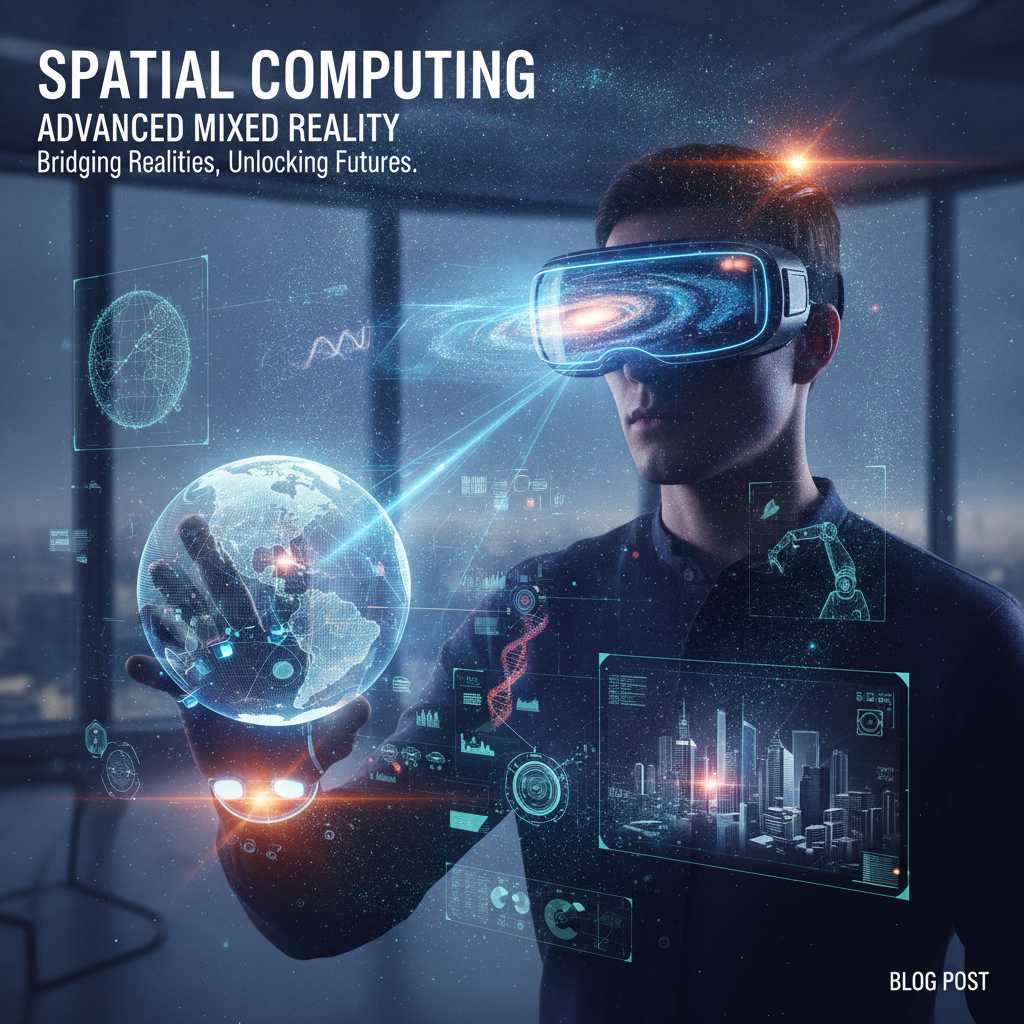
Spatial Computing: Unlocking a New Reality
For decades, our interaction with computers has largely been confined to 2D screens – be it a desktop, laptop, or smartphone. We’ve tapped, swiped, and clicked our way through digital information, always observing it from a distance. But what if the digital world wasn’t just *on* a screen, but *in* our world? Welcome to the exciting frontier of Spatial Computing and Advanced Mixed Reality.
What Exactly is Spatial Computing?
At its heart, Spatial Computing is about enabling computers to understand and interact with the physical world around us, not just pixels. Imagine a computer that knows the layout of your room, the objects within it, and your position relative to them. It’s about moving beyond flat interfaces and into a three-dimensional, contextual understanding of space.
This involves a complex interplay of sensors, artificial intelligence, and sophisticated software that can map environments, track movement, and allow digital content to be seamlessly integrated into the real world. The computer becomes aware of its surroundings, allowing for a much more intuitive and natural way to interact with information and digital objects.
Beyond AR and VR: The Mixed Reality Edge
While often grouped with Augmented Reality (AR) and Virtual Reality (VR), Advanced Mixed Reality (MR) is where Spatial Computing truly shines. VR immerses you completely in a digital world, blocking out the physical. AR overlays digital information onto your real-world view, like Pokémon GO.
Mixed Reality takes this a significant step further. It allows for digital objects to not only appear in your physical space but also to interact with it and with each other. Think of a virtual blueprint laid out on your physical conference table, which you can walk around, manipulate, and even ‘see’ behind real-world objects. These digital elements become persistent and contextually aware, blurring the lines between what’s real and what’s virtual in a highly compelling way.
Why This Matters: Real-World Applications
The potential applications of Spatial Computing and Advanced Mixed Reality are vast and transformative, promising to revolutionize industries and everyday life:
Work & Collaboration: Imagine remote teams collaborating on a 3D product design, with virtual models appearing right in their respective physical workspaces. Designers can ‘hold’ and manipulate prototypes before a single physical component is built.
Healthcare: Surgeons could overlay patient CT scans directly onto the body during operations, or medical students could practice complex procedures on highly realistic virtual organs in a physical operating room.
Education & Training: Learning becomes deeply immersive. Students could explore a human heart floating in their classroom, or engineers could receive interactive, holographic instructions for machinery repair.
Retail & Design: Visualize furniture in your living room before buying, or architects can walk through a building design before construction even begins.
Entertainment: Gaming and storytelling will become incredibly personal and interactive, breaking free from the confines of a screen and playing out in your actual environment.
The Road Ahead: Challenges and Opportunities
While the vision is captivating, bringing Spatial Computing to widespread adoption presents challenges. These include developing more comfortable and powerful hardware (lighter headsets, longer battery life), refining tracking and rendering accuracy, ensuring user privacy in spatially aware environments, and establishing universal standards for content creation.
However, the opportunities far outweigh the hurdles. As technology advances, we’re moving towards a future where computing is less about static screens and more about dynamic, interactive experiences woven into the fabric of our physical world. It promises to unlock new levels of creativity, efficiency, and human-computer interaction.
Embrace the Spatial Future!
Spatial Computing and Advanced Mixed Reality aren’t just buzzwords; they represent a fundamental shift in how we will interact with digital information and each other. It’s about empowering us to create, learn, and connect in ways previously confined to science fiction. Keep an eye on this space – the future is unfolding, and it’s happening all around us!
Leave a Reply